Azerbaijan faces backlash in Turkey after representative stayed for Netanyahu’s UN speech
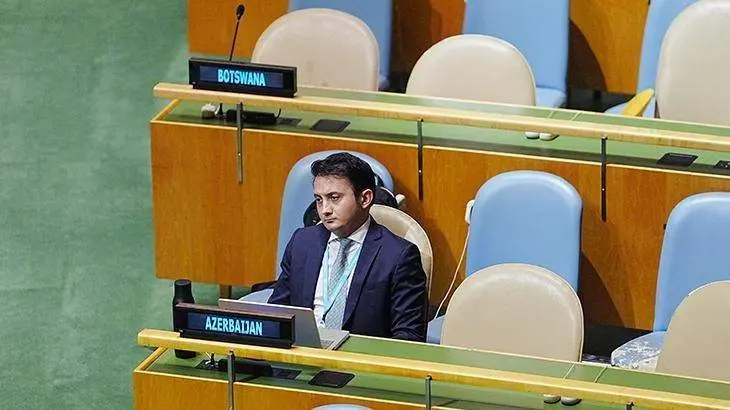
Azerbaijani representative remained in the General Assembly hall during Israeli Prime Minister Benjamin Netanyahu’s speech at the United Nations, while dozens of delegations, including Türkiye’s, walked out. The move triggered a wave of criticism of Baku in Türkiye — ranging from accusations of insufficient solidarity with Ankara to outright accusations of “betrayal”. Azerbaijan, meanwhile, says “unfounded and biased claims” are being circulated against relations between the two countries.
On 22 September, Turkish President Recep Tayyip Erdoğan devoted his address to the UN General Assembly to the war in Gaza and the Palestinian issue.
“Gaza has become the most inhumane and shameful concentration camp of our time,” he said. According to Erdoğan, the world was facing “a genocidal mindset that is never satisfied with killing”.
“No one with humanity, compassion and a conscience in their heart can turn a blind eye” to what was happening, the Turkish president said. He called on countries that had not yet recognised Palestine to do so and said Türkiye would continue to speak for a “free and sovereign State of Palestine”.
On the same day, French President Emmanuel Macron spoke of the “industrialisation of war crimes, violations of international law and the destruction of civilian infrastructure” and of the violation of Palestinians’ “most basic rights”.
“Are we supposed to stand by and watch this spectacle that makes us all feel ashamed? Never,” Macron said.
At the same time, France reaffirmed its commitment to Israel’s security and to a two-state solution to the conflict.
On 24 September, Netanyahu took the podium at the General Assembly. As the Israeli prime minister began his speech, dozens of delegations walked out of the hall.
Turkey’s state-run Anadolu Agency estimated that around 70 delegations either left the chamber or left their seats empty. They included Türkiye, Palestine, Tunisia, Syria, Algeria, Yemen, Egypt, Iraq, Saudi Arabia, Jordan, Iran, Qatar, Lebanon, Malaysia, Indonesia and Kuwait.
The Israeli side put the figure at 77 countries, although this included states whose representatives were not present at the session.
Netanyahu responded to the walkout from the podium: “If there are any other moral cowards in the audience who haven’t walked out, please do so now.”
He referred to Hamas as the “butchers of October 7”, accused the group of using Palestinian civilians as human shields and said: “Israel did not commit genocide. Israel prevented genocide.”
Speaking about Israel’s opponents, Netanyahu called on countries to “join us in standing up to the barbarians who threaten our common civilisation”. He spoke of “fanatical jihadists” who, he said, threatened other countries’ waterways, energy supplies and economic lifelines.
Netanyahu also directly attacked Türkiye. He called Erdoğan a “tyrant”, accused Ankara of hosting Hamas leaders and described Türkiye as a “super-spreader of antisemitic lies”.
The Israeli prime minister also accused Erdoğan of killing Kurdish civilians, persecuting journalists and opposition figures, denying the Armenian genocide and said: “He illegally occupies Northern Cyprus.”
“He says he will be the ruler of Jerusalem. No, sir. You will not. This is our country, our city, our eternal capital,” Netanyahu said.
After most national delegations had left, representatives of the United States, Germany, France, China, the United Arab Emirates, Bahrain, Colombia, Greece, Ukraine, Belarus and other countries remained in the chamber. In Central Asia, Kyrgyzstan and Uzbekistan joined the walkout, while the Kazakh delegation remained. The Azerbaijani representative also stayed until the end of the Israeli prime minister’s speech, while the Turkish delegation left.
It was this episode that subsequently triggered a sharp reaction in Türkiye. Although Azerbaijan was far from the only country whose representative remained in the chamber, Turkish media and commentators focused particular attention on Baku because of the special nature of relations between the two countries and expectations of political solidarity associated in Ankara with the formula “one nation, two states”.
The Haberler news website ran the headline: “The country that caused great disappointment at the UN! Listened to Netanyahu until the end.” Sözcü wrote: “Delegations left one after another: Azerbaijan’s representative listened to Netanyahu.”
Sözcü also noted that representatives of the United Arab Emirates, Colombia, Morocco, Bahrain and Greece remained in the chamber.
Turkish commentator Ali Kuzencik reacted angrily: “Has the spirit of traitor Ali Haydar Karayev returned to Baku, brother?”
Kuzencik also linked the incident to the “one nation, two states” formula:
“If we say ‘one nation, two states’, then we must stand shoulder to shoulder not only in good times, but also in difficult times.”
“This action is completely incompatible with brotherhood,” he wrote.
He then directed his criticism specifically at Baku, arguing that when Netanyahu “attacked Türkiye from the UN podium and called Erdoğan a ‘tyrant’”, Azerbaijan should have “always stood alongside Türkiye, like Pakistan”.
Haber Vitrini used an even harsher headline: “Shame on you… Azerbaijan’s representative remained in the hall while Netanyahu was speaking.”
The publication claimed that the Azerbaijani representative had remained in the chamber “on orders received”.
Other reports went further, explicitly describing the incident as “betrayal”.
There was, however, an opposing view in Türkiye as well.
Professor Aygun Attar urged people not to turn a single diplomatic episode into a campaign against Azerbaijan. She said the presence of one diplomat in the hall did not prove that Baku supported Netanyahu or Israel’s policy in Gaza.
She stressed that Azerbaijan was an “independent and sovereign state” with its own diplomatic and strategic interests.
Azerbaijan’s Media and Broadcasting Council said that “unfounded and biased claims” aimed at undermining relations between the two countries were being circulated in Turkish media and on social networks. Baku described such a campaign as unacceptable and said it could have a negative impact on mutual trust.
Azerbaijan has not officially explained why its representative did not join the walkout.