Over 30 Journalists Imprisoned in Azerbaijan: Call in Berlin for Europe Not to Remain Silent
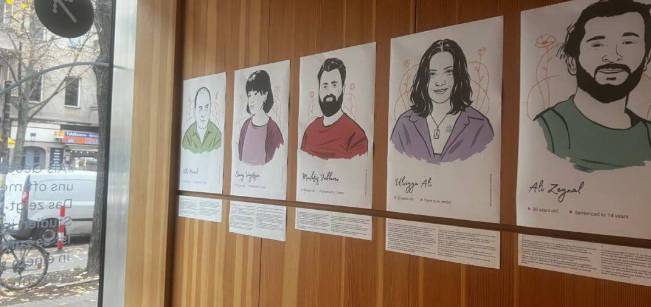
An exhibition dedicated to journalists imprisoned in Azerbaijan has opened in Berlin. Visitors were presented with portraits of the detainees, the stories behind their arrests, and the charges brought against them; they were also invited to write letters in support of the prisoners. The event took place on November 10 at the Publix innovation and media center as part of "Berlin Freedom Week."
The exhibition was organized by the exiled Azerbaijani outlet *Mikroskop Media* and "Exile Team," an informal initiative that supports journalists forced to flee their home country. The display highlights the cases of more than 30 media workers arrested in connection with *Meydan TV*, *Toplum TV*, *Abzas Media*, and other outlets.
"The goal of the event was to draw the attention of the European public to the plight of journalists imprisoned in Azerbaijan and to demonstrate solidarity with them," said investigative journalist Fatima Karimova, co-founder of *Mikroskop Media*, as quoted by *Kavkazsky Uzel* (Caucasian Knot).
According to Karimova, the exhibits provided details on the journalists' professional work, the circumstances of their arrests, and the charges filed against them. During the exhibition, visitors had the opportunity to write postcards and letters to the prisoners. The organizers plan to deliver copies of these messages to the detainees via their relatives and lawyers, while keeping the originals safe until the journalists are released.
"In this way, we want to provide the journalists with moral support and let them know that they have not been forgotten while in custody," Karimova noted.
She pointed out that the European public is not always aware of the full scale of the persecution faced by journalists in Azerbaijan. "People find it hard to imagine how it is possible for 7–10 employees from a single media outlet to end up in prison all at once," the journalist told *Kavkazsky Uzel* (Caucasian Knot).
Kerimova also believes that European politicians do not pay enough attention to human rights violations in Azerbaijan—a situation she attributes to political and economic interests.
"Some people are simply unaware of the arrests of journalists due to a lack of information. Events like our exhibition and campaign provide an opportunity for them to learn about what is happening. It is crucial to keep talking about the situation of journalists in Azerbaijan, to share their stories, inform the public, and draw the attention of the European media," she emphasized.
Among those who visited the exhibition were foreign journalists, members of the public, and politicians—including Frank Schwabe, a member of the Bundestag from the Social Democratic Party of Germany. He leads the group of Socialists, Democrats, and Greens in the Parliamentary Assembly of the Council of Europe.
In an interview with *Meydan TV*, Schwabe stated that economic ties with Baku should not prevent European politicians from publicly criticizing the human rights situation in the country.
"There is no reason to remain silent," the MP asserted.
According to him, the human rights situation in Azerbaijan has deteriorated over the last decade, and the number of political prisoners continues to rise. Schwabe urged the international community to push for their release, including by raising the issue during bilateral negotiations.
He also pointed to Azerbaijan’s obligations to the Council of Europe and the necessity of implementing rulings from the European Court of Human Rights.
"We aren't asking for anything extraordinary. We simply want these rulings to be implemented," Schwabe told *Meydan TV*. In the 2026 Reporters Without Borders press freedom index, Azerbaijan ranks 171st out of 180 countries, placing it behind Belarus and a number of African nations.
As of October 5, 2026, there were 322 political prisoners in Azerbaijan, including 31 journalists and bloggers. These figures appear in an updated list compiled by Leyla Yunus, director of the Institute for Peace and Democracy, and Elshan Hasanov, head of the Center for Monitoring Political Prisoners. The authors based their work on the criteria for defining political prisoners as established in Resolution 1900 of the Parliamentary Assembly of the Council of Europe. The Azerbaijani authorities deny the existence of political prisoners in the country, asserting instead that the criminal cases are linked to specific offenses.