"I didn't give them a single name": Georgian journalist reports pressure while in custody
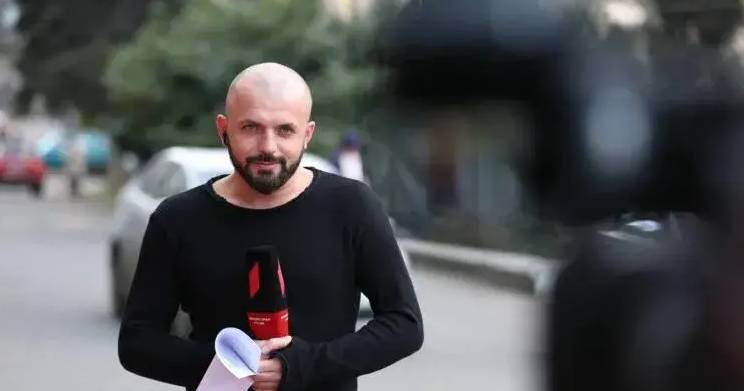
Nodar Chachua, a former journalist for the Georgian Public Broadcaster who was arrested on drug-related charges, has alleged that he is being pressured by officers from the Central Criminal Police. According to him, law enforcement officials are attempting to coerce him into providing testimony against other individuals. A letter written by the journalist from detention was published by the television channel TV Pirveli.
In the letter, Chachua also asserts that his wife is being held in custody despite a lack of sufficient evidence linking her to any crime.
"For over a month, the Central Criminal Police have been holding my wife as a hostage. My family has been subjected to unprecedented pressure for exactly 42 days. They are keeping my wife in captivity, even though there is no evidence against her. The primary reason for her 42-day detention is to exert pressure on me," the former journalist wrote.
Chachua states that police officers have been demanding that he provide the names of individuals whom the investigation suspects may be connected to the case. He explains that while he is friends with some of these people, he has only crossed paths with others occasionally, and has no contact whatsoever with the rest.
The journalist also recounted that, at the time of his arrest, law enforcement officers threatened him and used physical force. He claims this took place at his home, even before the search began.
"Intimidation, threats, and physical abuse continued for nearly two hours during my arrest—right inside my home, before the search had even started. Two high-ranking officers from the department were involved. I do not know their names or surnames, but I would be able to identify both of them if necessary," Chachua writes. He believes that the demand to name specific individuals and confess to a crime may have less to do with an actual investigation and more to do with the personal interests of high-ranking officials within the agency—officials who, according to the journalist, are seeking to bolster their own professional standing. Chachua asserts that he refused to provide the testimony they demanded.
"However, this scenario failed. They did not get a single name out of me," the letter states.
The former journalist also reported attempts to extract a confession from his wife, Lalo. He says that security officials want her to confirm that she was aware of the five grams of a prohibited substance discovered during a search of their home. Chachua claims that law enforcement is using this to "justify" her detention.
"But they won't succeed here either: in the 21st century, it is impossible to 'justify' taking hostages," he wrote.
Nodar Chachua was arrested on October 6 on charges of acquiring, possessing, and distributing a particularly large quantity of narcotics. He faces up to 20 years in prison or a life sentence. His wife, who also previously worked as a journalist, is charged with the acquisition and possession of narcotics.
These proceedings are taking place against the backdrop of a rapidly deteriorating situation regarding media freedom in Georgia. In the 2026 rankings by Reporters Without Borders (RSF), the country fell to 135th place out of 180—a drop of 21 positions in a single year. The organization attributes this decline to increased state control over the media, restrictive legislation, attacks on journalists, and pressure exerted on independent newsrooms.
Further data on the scale of the problem is provided by the Center for Media and Information Studies (CMIS) in Georgia. According to his estimates, 229 incidents involving violations of media freedom were recorded in the country between September 2025 and August 2026. These incidents affected 174 journalists and 117 media organizations. The recorded cases include 102 instances of verbal attacks or attempts to discredit journalists, 81 incidents involving legal or judicial harassment, 33 cases of unlawful interference with the work of media professionals, and 21 violations of labor rights.
In June 2025, the European Parliament adopted a specific resolution on media freedom in Georgia. Members of the European Parliament (MEPs) condemned the intimidation of and attacks on members of the press, and demanded that the authorities ensure the safety of staff at independent media outlets, allowing them to carry out their work without hindrance.
On October 8, 2026, the European Parliament once again criticized the Georgian authorities. In the adopted resolution, the MEPs pointed to a deterioration in the state of human rights, media freedom, and the rule of law, and called for the release of political prisoners. The document was supported by 445 MEPs, with 37 voting against it and 97 abstaining.