Pashinyan opts for climate summit in Turkey over CSTO meeting where Armenia was stripped of its voting rights
Armenia once again failed to participate in a meeting of the Collective Security Council of the Collective Security Treaty Organization (CSTO), held on November 11 in Moscow. Instead of meeting with the leaders of the organization’s member states, Prime Minister Nikol Pashinyan traveled to Turkey to attend a summit of leaders at the 31st UN Climate Change Conference (COP31).
The meeting, chaired by Russian President Vladimir Putin, was attended by the leaders of Belarus, Kazakhstan, Kyrgyzstan, Russia, and Tajikistan. Armenia was the only member state not represented at the gathering.
Pashinyan arrived in Antalya on November 11. The day before, he had been in France, where he participated in the Paris Peace Forum and met with President Emmanuel Macron. In Turkey, the Armenian Prime Minister is scheduled to take part in summit events and hold bilateral meetings with his foreign counterparts.
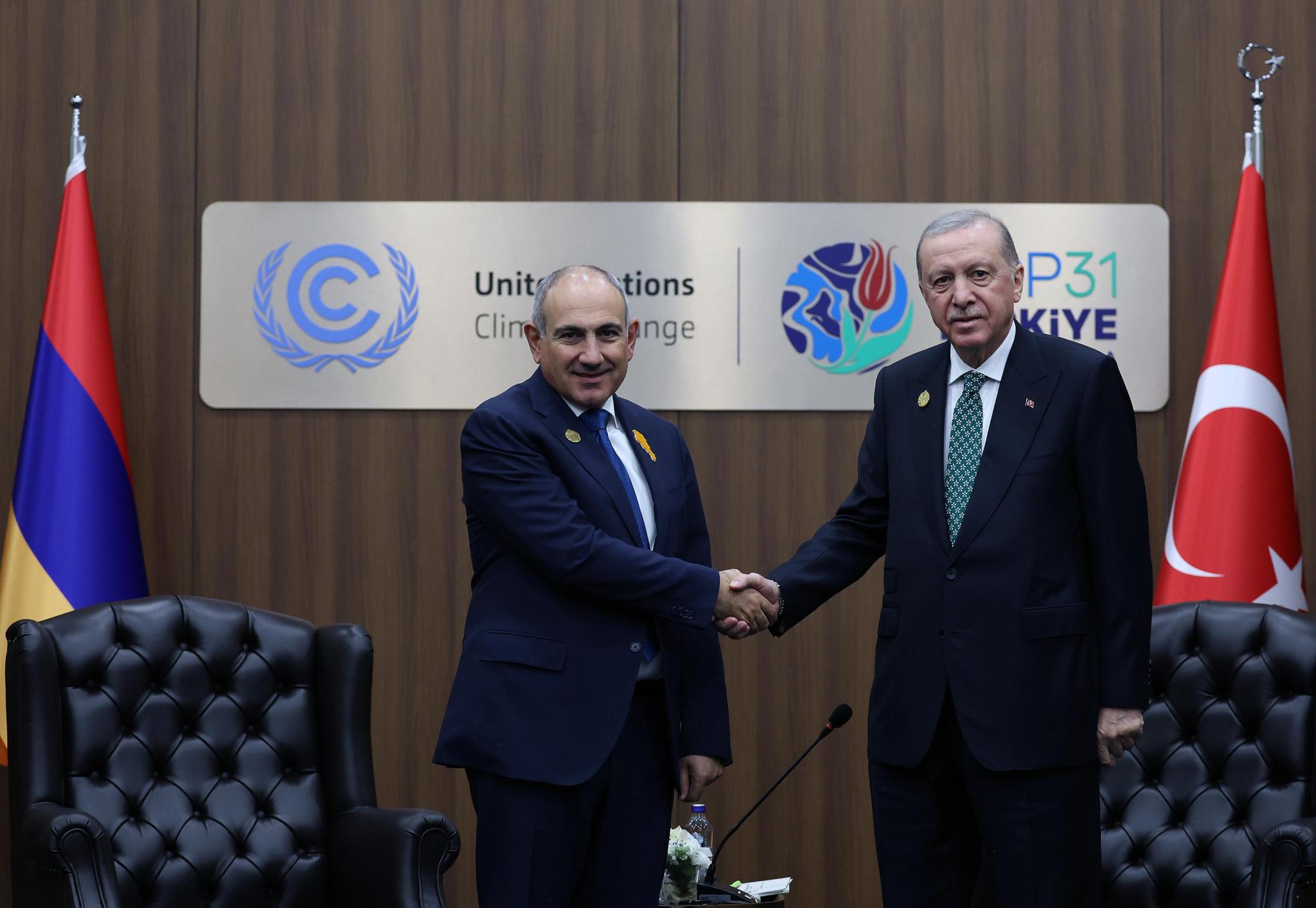
On the sidelines of the COP31 summit, Pashinyan met with Turkish President Recep Tayyip Erdoğan. According to the Armenian Prime Minister’s office, the two sides discussed the normalization of bilateral relations and emphasized the need to advance this process toward its logical conclusion. They also addressed the development of trade and economic ties, the establishment of peace between Armenia and Azerbaijan, and the unblocking of transport links—including the implementation of the TRIPP project. Pashinyan congratulated Erdoğan on the organization of the summit and expressed his condolences regarding the loss of life in an explosion at a metallurgical plant in İzmir. Against the backdrop of Armenia’s latest absence from Collective Security Treaty Organization (CSTO) events, Russian presidential press secretary Dmitry Peskov stated that the organization would respond to Yerevan’s refusal to participate in its activities.
"We do not know what Pashinyan is expecting, but it is clear that Armenia is not participating in the work of the CSTO. Consequently, the CSTO will respond to this," the Kremlin representative said on November 11.
He also noted that measures stipulated by the organization’s charter could be invoked upon the decision of the member states.
One of the issues addressed at the meeting in Moscow concerned the restriction of Armenia’s rights within the CSTO due to outstanding membership dues. A day earlier, Russian Foreign Minister Sergey Lavrov stated that the member states had no intention of expelling the republic, but would propose suspending its voting rights and its ability to nominate candidates for quota-based positions.
"There is no room for ambiguity here. Since 2024—for more than two years now—Yerevan has failed to pay its membership dues. As a result, the question has been raised regarding the application of Article 25 of the CSTO Charter to the Republic of Armenia," Lavrov declared on November 10.
Following the meeting on November 11, the CSTO member states decided to strip Armenia of its voting rights, as well as its ability to appoint representatives to key positions within the organization. Peskov announced this decision following the meeting of the leaders.
While Armenia remains a formal member of the CSTO, its participation in the organization’s activities is effectively frozen. In February 2024, Pashinyan announced the suspension of the republic’s participation, arguing that the organization had failed to fulfill its obligations toward Yerevan. In particular, the Armenian authorities pointed to the lack of an appropriate response from the CSTO to events along the Armenian-Azerbaijani border in 2021–2022.
On November 5, 2026, Pashinyan stated that Armenia’s interest in the CSTO had been exhausted and that the republic was no longer interested in the organization.