The Republican Party of Armenia has proposed that the opposition unite and renounce cooperation with the government
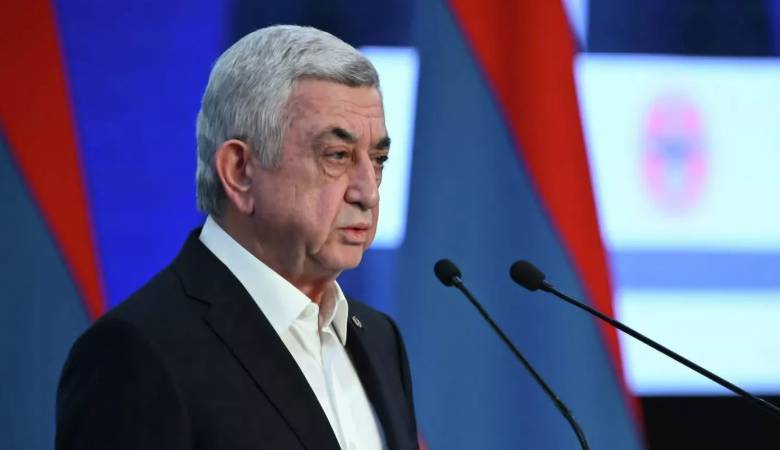
In Yerevan, the Republican Party of Armenia proposed signing a memorandum of unity among opposition forces and renunciation of cooperation with the current government. This statement was made by its chairman, former President Serzh Sargsyan, at the party congress.
He also presented the party's campaign slogan: "Go, so that they go."
Sargsyan announced that the party had decided not to participate in the upcoming parliamentary elections, despite, as he believes, the possibility of overcoming the threshold.
"I know that with proper work we would have overcome the 4% threshold required for the party, but the prospect of winning a few mandates is not interesting to us—we need to achieve a change of power," Sargsyan said, sharing his plans.
He stated that the refusal to participate is dictated by a desire not to increase disunity within the opposition. However, party supporters will participate in the vote and will support only opposition forces.
Sargsyan emphasized that the party intends to remain an active participant in the political struggle. He also pointed to the threat within the opposition from people "who are dividing its ranks by joining the government."
In this regard, the party proposed that those declaring their refusal to cooperate with the ruling Civil Contract party formalize their position in writing. This would involve the signing of a memorandum by candidates at the top of their electoral lists.
"And the top three candidates on the election list of all opposition forces should sign a memorandum, making a moral commitment not to leave the opposition," Sargsyan urged.
Furthermore, he announced the preparation of a program to strengthen the state, which the party is ready to propose to other opposition forces. He also called for joint awareness-raising and protest actions during the European Political Community summit, which will be held on May 4-5. According to Sargsyan, the participants of the event should present "the real situation with democracy in Armenia."
Parliamentary elections in the country are scheduled for June 7. The ruling Civil Contract party, led by Prime Minister Nikol Pashinyan, the Armenia bloc of second President Robert Kocharyan, the Strong Armenia with Samvel Karapetyan bloc, and a number of other political forces and initiatives have previously announced their intention to participate.
In March, Pashinyan sharply criticized opposition presidential candidates Robert Kocharyan, Samvel Karapetyan, and Gagik Tsarukyan. He accused them of seeking to revise the peace agreement with Azerbaijan and, as he put it, "open the door to war."
Samvel Karapetyan is currently under house arrest. On March 13, the Anti-Corruption Court of Armenia extended this pretrial detention for one month. The defense assessed this ruling as an attempt at political interference aimed at limiting Karapetyan's ability to participate in the election campaign as the leader of the Strong Armenia party.
Samvel Karapetyan was arrested on June 18 of last year, and his pretrial detention was subsequently extended several times. On December 30, the court granted the defense's motion, replacing his pretrial detention with house arrest and bail. Karapetyan is accused of publicly calling for the seizure of power and the overthrow of the constitutional order. On October 13, the Russian Investigative Committee announced that the charges had been supplemented by paragraphs 2 and 3 of Part 3 of Article 296 of the Criminal Code ("money laundering on an especially large scale using official or official powers or the influence derived from them"). Karapetyan pleads not guilty.
In February of this year, the Strong Armenia party nominated businessman Samvel Karapetyan as a candidate for prime minister. The country's authorities declared his participation in the elections inadmissible, as he holds Russian and Cypriot citizenship.
Nikol Pashinyan took over Armenia following the "Velvet Revolution," sparked by his successor Serzh Sargsyan's attempt to remain in power after two presidential terms as prime minister, initiating a reduction in the president's powers in favor of the head of government.