Save Saakashvili: Ukraine and the Chechen diaspora in Europe stood up for the former Georgian leader
On January 4, rallies were held in Georgia and other countries around the world in support of former Georgian President Mikheil Saakashvili. The protesters demanded that the Georgian authorities allow the prisoner Saakashvili to continue treatment in a foreign clinic. He is now in the Vivamedi clinic in Tbilisi due to complications after a long hunger strike.
According to the Mtavari Arkhi television company, pickets and rallies under the slogan SaveMisha were held at the Consulates General and Embassies of Georgia in New York, Washington, London, Berlin, Munich, and Frankfurt. Vienna, Brussels, Strasbourg, Prague, Stockholm, Bern, Sofia, Barcelona, Athens, Tel Aviv, Kyiv, Chisinau.
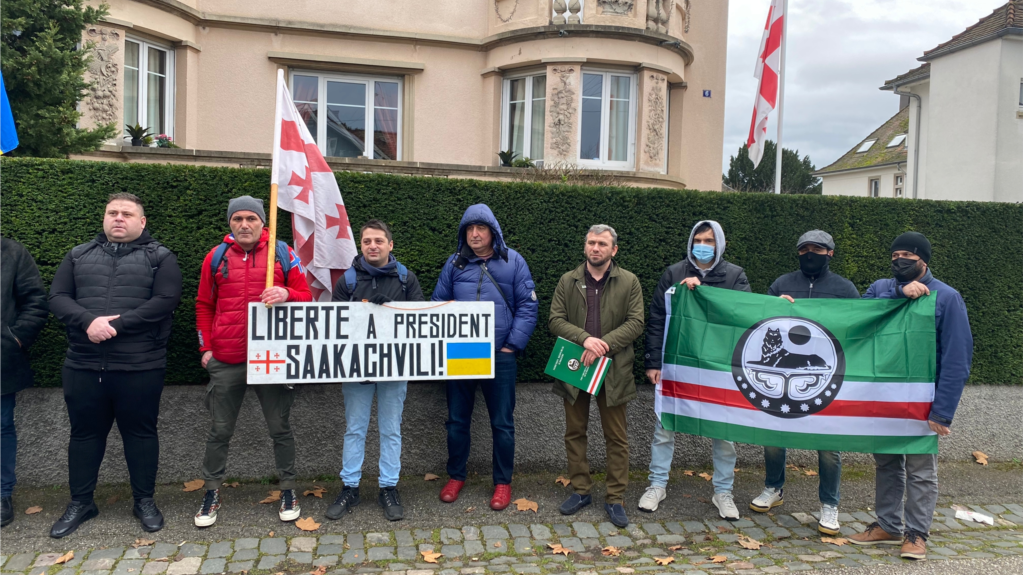
The actions of the Georgian diaspora in Europe were supported by supporters of the unrecognized Chechen Republic of Ichkeria. Thus, the honorary consul of Ichkeria in France, Chechen public figure Shamil Albakov went to a picket in Strasbourg.
Activists of the Chechen diaspora in Vienna and Bern also spoke out in support of Saakashvili and against violations in the prison system.
The Ukrainian authorities also spoke out in defense of Saakashvili. On January 1, Vladimir Zelensky, during a joint press conference with the head of Austria, Alexander Van der Bellen, said that the authorities in Tbilisi were slowly killing Saakashvili.
“I am not discussing the question of why the former president of Georgia was arrested, what the consequences of this are for the politics and democracy of Georgia. This is their internal question. I'm talking about the arrest of Ukrainian citizen Mikheil Saakashvili, who is publicly tortured every day. And I think their goal is to kill him,” said the Ukrainian leader.
On January 2, the Ministry of Foreign Affairs of Ukraine published a special statement in which it expressed a strong protest in connection with the inhumane treatment of Ukrainian citizen Mikheil Saakashvili.
“In the worst traditions of the NKVD of the USSR, the Georgian authorities are using psychological and physical violence against Mikheil Saakashvili, denying him urgently needed medical care, deliberately creating an immediate threat to his life. The gross violation of human rights in relation to a citizen of Ukraine runs counter to Tbilisi’s declared policy of obtaining EU membership and indicates the collapse of democracy in Georgia,” the Foreign Ministry said in a statement.
Official Kyiv called on the Georgian authorities to “immediately stop mocking Mikheil Saakashvili” and hand him over to Ukraine. The Foreign Ministry also appealed to foreign governments and international organizations to publicly speak out in defense of “a Ukrainian citizen, the former president of Georgia, whose life was under threat due to political repression by the Georgian authorities.”
On February 2, 19 non-governmental organizations of Georgia appealed to the Tbilisi City Court with a request to expedite a decision on the claim of Saakashvili’s lawyers to defer the execution of his sentence or release him, taking into account his serious health condition. On February 4, human rights activists from Freedom House called on the Georgian authorities to provide the ex-president with full medical care.
However, the Georgian authorities did not relent. On February 6, the Tbilisi City Court rejected the request to defer the execution of the sentence or release Saakashvili. The trial took place from December 1, 2022 in the absence of the defendant, who only occasionally joined court hearings via video link from the clinic.
The ex-president of Georgia is serving a 6-year sentence for abuse of official powers and organizing the beating of deputy Valery Gelashvili in 2005. The verdict was passed in absentia. Three more criminal cases against Saakashvili are pending in court - about embezzlement of public funds, illegal crossing of the Georgian border and the dispersal of the rally on November 7, 2007. Saakashvili was detained on October 1, 2021, immediately went on a hunger strike demanding his release, and kept it for 50 days.