"The stakes are off": Zelenskyy's visit to Yerevan provokes a sharp reaction from Moscow
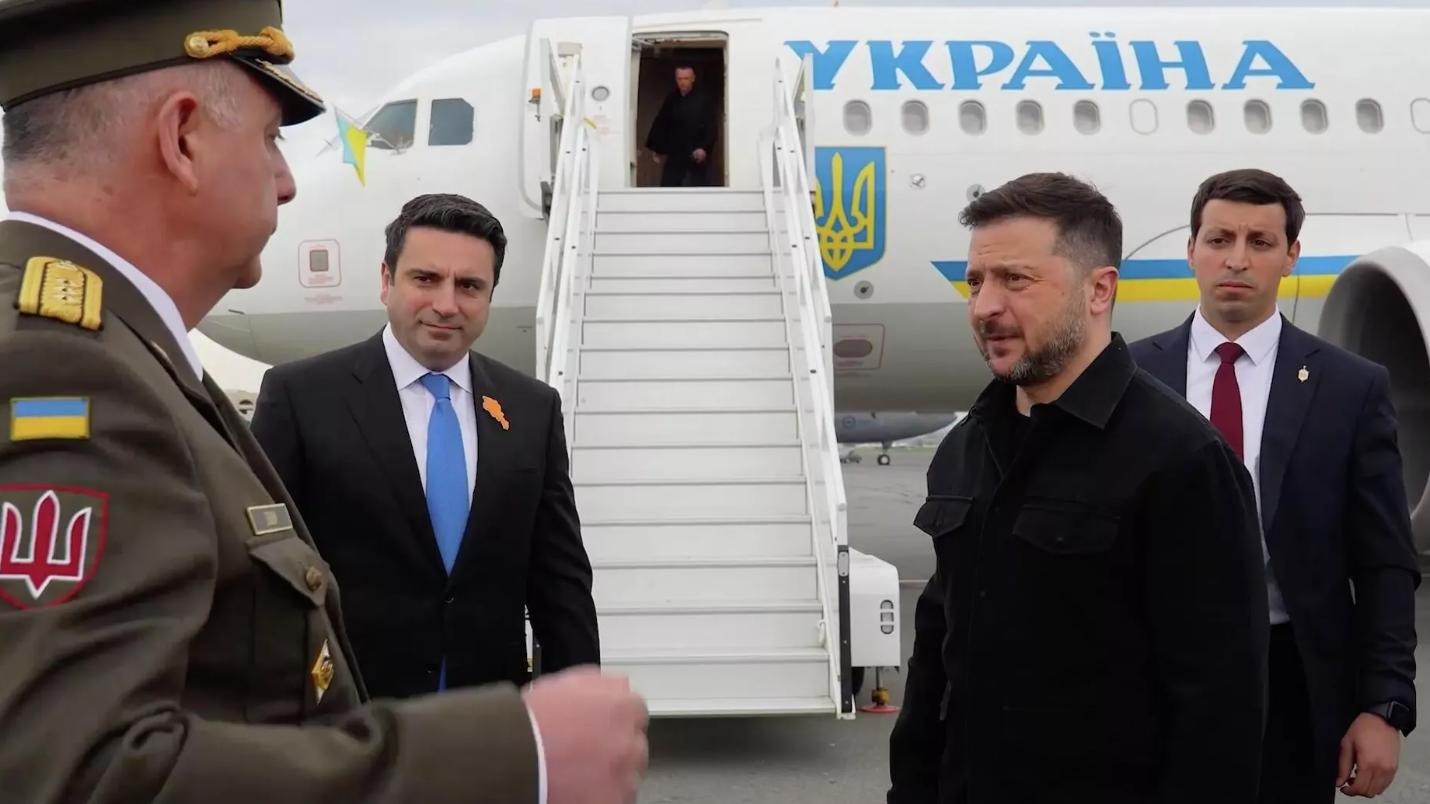
Ukrainian President Volodymyr Zelenskyy arrived in Armenia on a working visit to participate in the European Political Community (EPC) summit. He was met at Yerevan's Zvartnots International Airport by Speaker of the Armenian Parliament Alen Simonyan. This is Zelenskyy's first visit to Armenia.
The EPC summit will begin in Yerevan on Monday, May 4. A separate session on Ukraine will be held during the event, with the participation of the head of state, according to the Elysée Palace.
The summit is expected to discuss the military conflicts in Ukraine and Iran, the creation of global transport corridors, and the development of the South Caucasus. Representatives from approximately 50 countries will participate in the events.
On April 30, Armenian Prime Minister Nikol Pashinyan announced during a briefing that Zelenskyy was expected among other guests at the EPC summit.
"I am expecting all members of the European Political Community, yes, including the President of Ukraine," Pashinyan said. The Kremlin newspaper Moskovsky Komsomolets reacted critically to this.
"The Prime Minister cannot help but understand (and he does understand) that, in today's reality, welcoming Zelenskyy in Yerevan would mean putting an end to relations with Moscow. But this doesn't seem to bother him. The stakes are high: Pashinyan believes that only the West can help him retain power in the upcoming parliamentary elections on June 7. And to gain the West's support, he must play by its rules and side with history. That means, in the conflict between Russia and Ukraine, siding with Ukraine. Which is precisely what he is doing. Zelenskyy's visit to Yerevan is likely part of a 'package deal' between Pashinyan and his European partners. In return, they promise to stage a pompous show in Yerevan, clearly of a pre-election nature. In addition to the European Political Community summit," Komsomolets journalist Marina Perevozkina wrote.
Commenting on Zelenskyy's visit to Yerevan, political scientist Sergei Markedonov suggested that it is "an important (and dangerous) symbol of a new version of Armenian diversification."
"Today, the Armenian government has different priorities. And although EU membership is not a prospect for Yerevan (unlike Tbilisi, Armenia is not even a candidate for EU membership), the republic's authorities are trying to get closer to Brussels, leaving aside even the obvious economic benefits of the Eurasian Economic Union and cooperation with Russia. In this context, Zelenskyy in Yerevan is an important (and dangerous) symbol of a new version of Armenian diversification. He sets the contours of Armenia's future if the Civil Contract is electorally successful. It could turn out, as in the song popular in the late 1980s, 'You left your native shore, but never reached the other.'" In fact, Ukraine never became a European shore between 2013 and 2026; Brussels values it as a Euro-frontier. But this country, unlike Armenia, is at least geographically located in Europe. However, in its struggle with Russia, it is also seeking to expand into those non-Western countries and regions that are of particular interest to Moscow. The Middle East, the South Caucasus…,” writes Markedonov.
Furthermore, the Armenian newspaper Hraparak reported that Russia is developing new sanctions against Armenia in response to Yerevan's "anti-Russian actions." These actions include Ukrainian President Volodymyr Zelenskyy's visit to the summit in Yerevan.