Fine for Muslim Prayer, Hijab Attack and Metro Harassment: A New Wave of Xenophobia Raises Concerns in Russian Cities
Over the past several weeks, a series of high-profile incidents across Russia has reignited debate over xenophobia, religious intolerance and the authorities’ response to alleged hate-motivated incidents.
Although the circumstances differed, the cases shared a common feature: those targeted by administrative action or public hostility were Muslims, including members of Russia’s ethnic minorities and people from Central Asian countries.
Among the incidents that attracted widespread attention were a court fine imposed on a native of Russia’s Chechen Republic for performing Islamic prayer in public, an alleged assault on a woman wearing a hijab in Surgut, and two separate confrontations on the Moscow Metro involving reported ethnic insults and demands that passengers “go back to where they came from.”
Taken individually, each episode could have remained an isolated local incident. Collectively, however, they have renewed questions over whether Russian authorities respond consistently to offences allegedly motivated by ethnic or religious hatred.
Fine for Public Prayer
One of the most widely discussed cases involved a native of Russia’s Chechen Republic who was fined by a Moscow court after performing Islamic prayer near a traffic police facility.
The incident first came to public attention in early July through the Telegram channel Ethnocrime, which reported that the events had occurred on May 27 outside a Moscow traffic police registration and inspection office. According to the channel, the driver of a Kia Rio stopped his vehicle by the roadside, laid out a prayer mat and began performing salah, the obligatory Muslim prayer. Police officers and passing motorists reportedly noticed the scene.
The independent Telegram outlet Ostorozhno Novosti later identified the man as Ahmad, a taxi driver. According to the publication, one of the mandatory daily prayer times occurred during his work shift. Unable to find a nearby mosque or designated prayer facility, he chose to pray by the roadside before resuming work.
The outlet reported that Ahmad was detained approximately two weeks later and taken to the prosecutor’s office. During questioning, he reportedly said he had merely been fulfilling a religious obligation and asked officials to issue only a warning.
The case was nevertheless referred to court, which found him guilty of violating regulations governing public assemblies and imposed a fine of 5,000 roubles.
The ruling prompted extensive discussion on social media and within Muslim communities. Critics questioned why an individual act of worship had been treated as a public event, arguing that there was no indication the prayer constituted an organised demonstration or political activity.
As of publication, no public statements had been issued by the authorities in Chechnya, the regional human rights commissioner or the man’s relatives.
The case was not unprecedented. Last summer, a court in Samara fined the head of a local Muslim organisation following a collective prayer held in the courtyard of a residential building. Organisers likewise maintained that the gathering had been solely a religious observance.
Alleged Attack on Woman Wearing Hijab
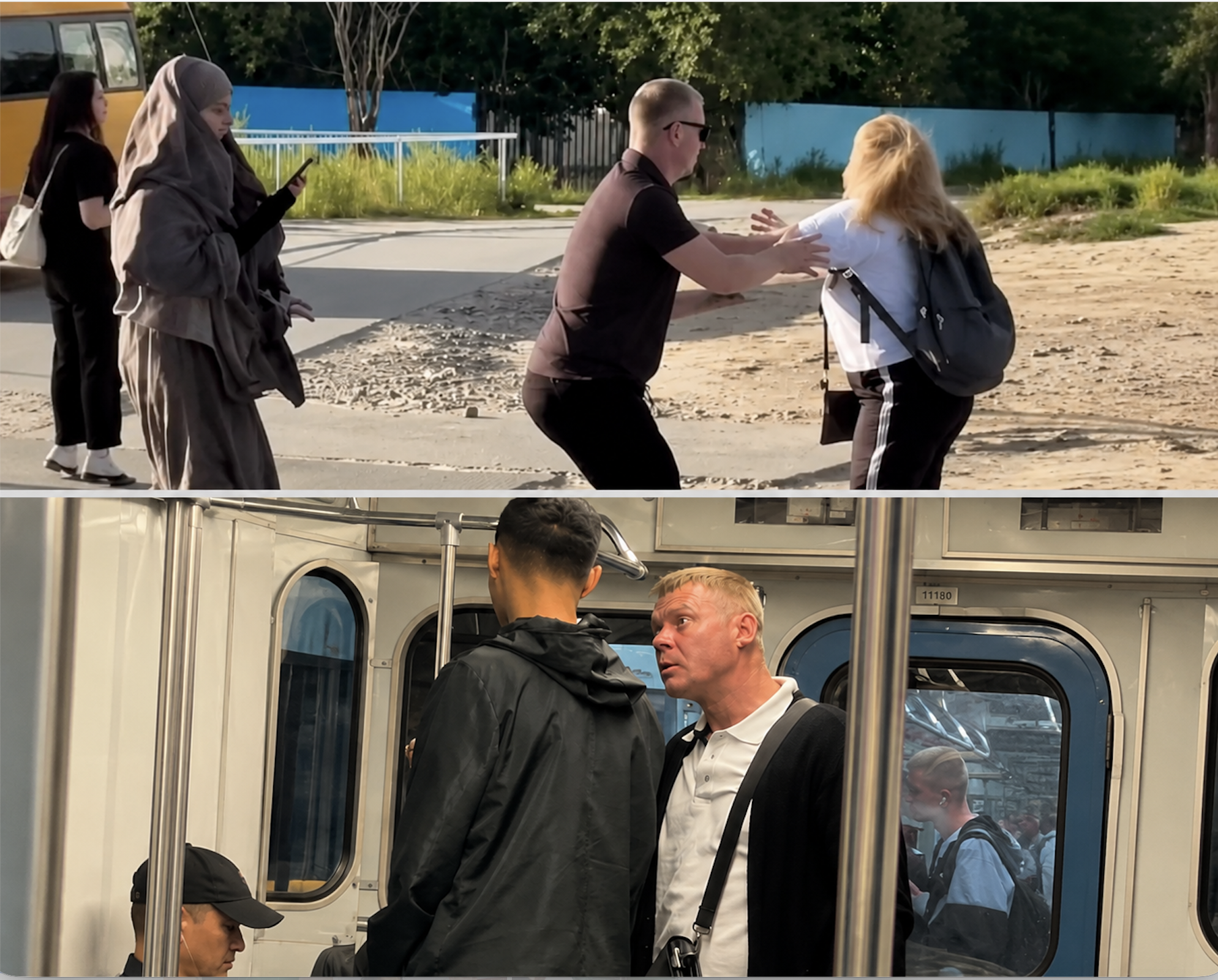
In the Siberian city of Surgut, a local resident allegedly attacked a young Muslim woman wearing a hijab while she was walking with her young child.
Videos circulating online and witness accounts indicate that the attacker first insulted the woman and her religion, then allegedly attempted to remove her headscarf, struck her and continued filming the confrontation on a mobile phone.
According to those accounts, bystanders intervened, came to the woman’s assistance and threatened to call police, after which the alleged attacker left the scene.
Representatives of Muslim organisations and residents of several predominantly Muslim regions called for an impartial investigation.
According to the regional branch of Russia’s Interior Ministry, investigative procedures were launched following the complaint. As of publication, however, authorities had not announced whether criminal or administrative charges had been filed.
Ethnic Abuse on the Moscow Metro
In June, video footage from the Moscow Metro circulated widely online, showing a passenger verbally abusing another man with ethnic slurs while allegedly attempting to force him from his seat.
The footage prompted social media users to call for the individual responsible to be identified and prosecuted.
Days later, another video from the capital’s underground railway appeared online. It appeared to show a group of teenagers verbally abusing a young Chechen woman wearing a hijab and telling her to “go back home.”
The woman did not respond to the provocation, but the verbal abuse reportedly continued in front of other passengers.
Like the Surgut incident, the videos reignited debate over the effectiveness and impartiality of the state’s response to manifestations of ethnic and religious intolerance.
A Broader Pattern?
Observers note that the incidents also share another characteristic: information about them emerged primarily through independent media outlets and social media rather than official government statements or state-controlled media.
At the same time, incidents involving migrants or people from the North Caucasus accused of crimes often receive swift attention from law enforcement agencies and extensive coverage in state media.
Critics argue that this perceived contrast contributes to growing social tensions among Russia’s ethnic minority communities.
A number of commentators have accused authorities of selective law enforcement and double standards, saying the discussion reflects increasing sensitivity surrounding equality before the law, particularly in the North Caucasus.
Why the “Russian Community” Movement Is Being Discussed
Against this backdrop, increasing attention has focused on the activities of the nationalist organisation known as Russkaya Obshchina (“Russian Community”).
The group regularly publishes videos showing its activists conducting what it describes as raids targeting migrants, confronting people from the North Caucasus and using rhetoric that critics describe as overtly nationalist.
Some media outlets have reported what they describe as a pattern in which Investigative Committee Chairman Alexander Bastrykin responds quickly to publications by the organisation.
No direct evidence has been publicly presented demonstrating that Bastrykin or the Investigative Committee formally sponsors or supports the group. Nevertheless, critics argue that perceptions of selective law enforcement have fuelled speculation about possible backing from some officials.
Russian authorities have not publicly acknowledged any institutional relationship with the organisation.