37 Participants in Protests Against School Hijab Restrictions Arrested in Baku
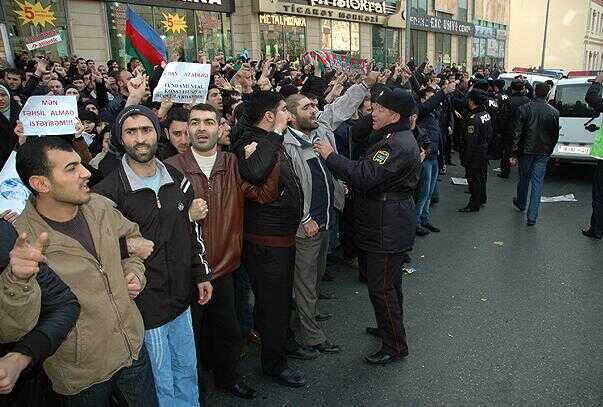
Amidst protests against restrictions on the hijab in schools, demonstrations took place outside educational institutions in Baku and other parts of Azerbaijan.
On October 9, students from Baku School No. 69 in the Balakhani settlement refused to attend classes in solidarity with female classmates wearing hijabs. Footage posted on social media shows students gathering in front of the building with a banner reading "The hijab is not an obstacle to education." Reports of similar actions also emerged from other regions of the country.
On October 12, similar protests occurred at other schools in Baku. Specifically, students from School No. 322 gathered at the building's entrance, demanding that girls wearing hijabs be allowed to attend class. Protests were also recorded in the village of Mollaoba (Masally District), at School No. 9 (Jalilabad District), and in the settlement of Hokmali near Baku. In some instances, students boycotted classes; in others, they gathered outside school buildings and held lessons outdoors. Parents also threatened not to send their children to school if female students wearing hijabs continued to be barred from attending classes.
Against this backdrop, the Ministry of Internal Affairs of Azerbaijan announced on October 12 the arrest of 37 people in connection with conflicts surrounding the new school uniform requirements. According to the ministry, those detained clashed with school staff, damaged state property, and attempted to disrupt traffic and the operations of educational institutions.
Investigative bodies within the Ministry of Internal Affairs have initiated a criminal case regarding these events under Article 233 of the Criminal Code of Azerbaijan, which covers the organization of, or active participation in, actions that violate public order. The authorities did not disclose details of the investigation or specify the charges brought against each of the 37 detainees, nor did they state exactly where the incidents took place.
New requirements for school uniforms were introduced in September. While the document does not explicitly ban the hijab, wording regarding clothing that does not align with the principles of secular education has allowed some schools to bar female students wearing headscarves from attending classes.
The restrictions have also affected teachers. According to Abzas Media, some female teachers in Baku’s Bayil district were ordered to either remove their hijabs or stop coming to work, effective October 9.
Imprisoned journalist Polad Aslanov also spoke out against the new restrictions. He began a hunger strike on October 8, citing violations of the rights of female students and teachers who are prohibited from wearing Muslim headscarves. His wife, Gulmira Aslanova, published his statement.
Protests against the new rules also took place outside Azerbaijan. On October 3, demonstrators gathered outside the Azerbaijani consulate in Istanbul to demand a review of the restrictions.
A number of Azerbaijani media outlets—including those aligned with the government—have linked the protests to attempts by external forces, primarily those linked to Iran, to incite religious conflict and promote the idea of establishing Sharia law in Azerbaijan.
On October 11, the National NGO Forum of Azerbaijan issued a statement accusing Iran and other foreign nations of launching information attacks against the Azerbaijani state's secular model. The document’s authors claim that this material aims to "promote the establishment of a state system based on Sharia principles" in the country and to incite societal conflict. That same day, Rashad Majid, Chairman of the Press Council of Azerbaijan, stated that the widespread debate over school uniform regulations raised suspicions, describing the situation as a threat to secular education posed by external forces.
"If you advocate for the hijab in secondary schools and oppose standardized school uniforms, you are effectively opposing the existence of a secular Azerbaijani state," he concluded.
Opponents of the restrictions, however, argue that the new uniform requirements effectively deprive female students who wear the hijab of their right to education and force female teachers to choose between their religious beliefs and their jobs.
In their view, the principle of secular education should not serve as grounds for restricting freedom of religion, and the state is obligated to guarantee all children equal access to education, regardless of their religious beliefs.