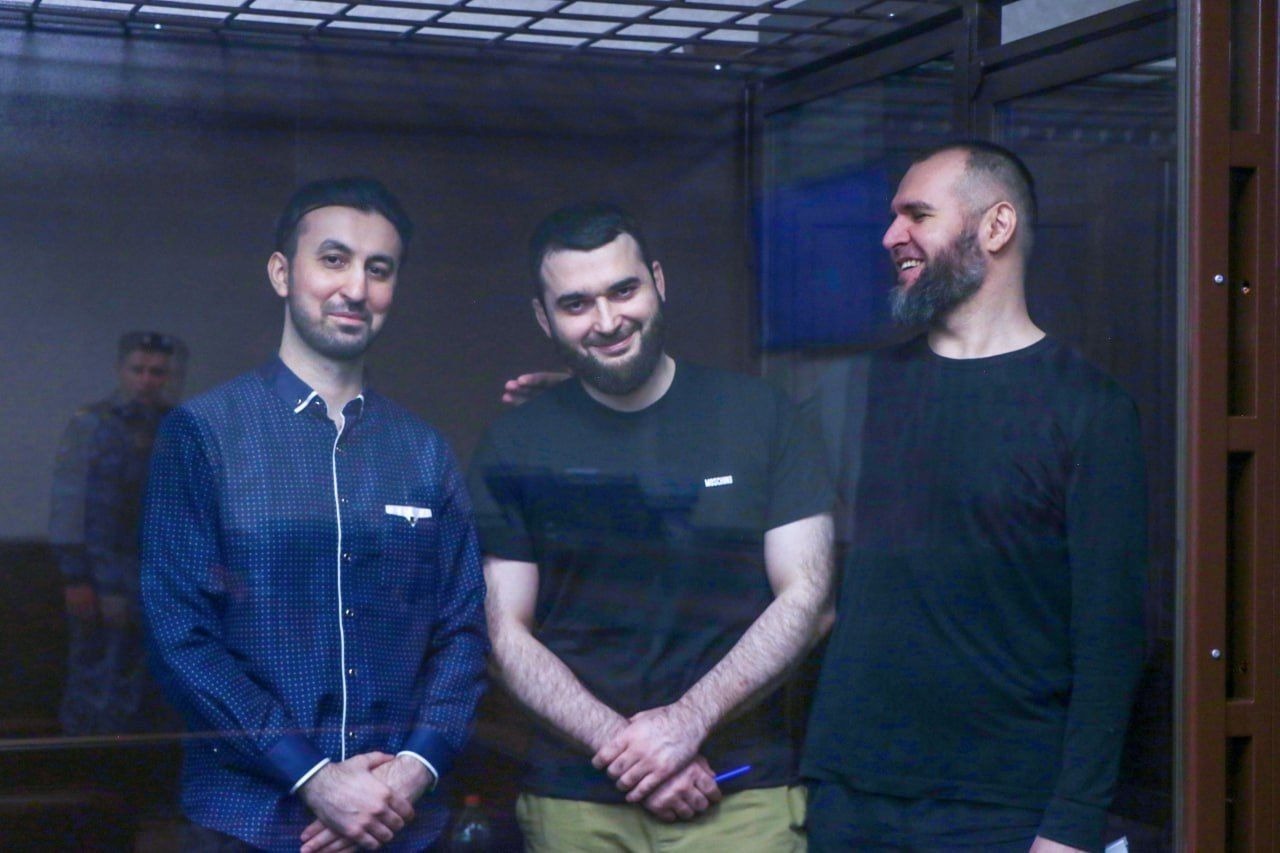
Abdulmumin Gadzhiev called the criminal case against him a blatant lawlessness and falsification

In the Southern District Military Court in Rostov today, the verdict was to be announced on the editor of the Dagestan publication Chernovik, Abdulmumin Gadzhiev, and two other defendants in the case, Kemal Tambiev and Abubakar Rizvanov. They are accused of financing terrorism. Earlier, the prosecutor asked the defendants for 19 years in prison. The verdict will be announced on September 12.

“Our trial has become a household name and is perceived in society as an example of blatant lawlessness and falsification of a criminal case. This case was a fake from start to finish,” Gadzhiev, referred to by the Human Rights Center “Memorial,” said in his last word.

According to Gadzhiev, 40 volumes of waste paper in the form of a “criminal case” are not consistent logically and are full of contradictions and errors. “We will give full publicity to the work of the investigation and conduct our own investigation into the investigation conducted by investigator Nadir Televov. Whatever sentence the Rostov military court pronounces, we will not leave a single person in doubt about our innocence,” the journalist said.
In his opinion, the criminal case against him and other citizens is the “philosophy” of the country’s entire law enforcement system, which was perfectly described by Leo Tolstoy in the novel “Sunday” and which has not changed at all in 150 years.

During the proceedings, three linguistic examinations were made. None of them found anything illegal in the journalist's articles. The examinations did not find calls for extremism or terrorism, but did reveal propaganda of education, development and interest in modern technologies.

Последние новости
Pashinyan spoke in Armenian at the SCO summit; the Kremlin
Politics
Pashinyan spoke in Armenian at the SCO summit; the Kremlin "did not understand" why
6 September 2026

Armenian Prime Minister Nikol Pashinyan delivered a speech in Armenian at the expanded summit of the Shanghai Cooperation Organization (SCO) in Bishkek. The Kremlin described this as a "signal" regarding Armenia's sovereignty but admitted it "did not understand" why the statement could not have been made in Russian.

In Dagestan, the body of a drowned youth was found at a depth of 60 meters
Society
In Dagestan, the body of a drowned youth was found at a depth of 60 meters
6 September 2026

On September 6, rescuers discovered the body of a 20-year-old man who drowned on August 25 near the village of Shamilkala on the Irganay Reservoir in Dagestan. It is reported to be at a depth of approximately 60 meters. The body has not yet been recovered, as rescuers are awaiting additional equipment.

Rostov Region hit by drone attack: two high-rise buildings damaged, child injured
Politics
Rostov Region hit by drone attack: two high-rise buildings damaged, child injured
6 September 2026

On the night of September 6, Rostov Region, along with other Russian regions, was again attacked by Ukrainian drones. Specifically, a massive airstrike was reported on Rostov-on-Don. According to the Telegram channel Astra, drones circled over the city for over four hours, and gunfire and the sound of a helicopter were heard. Bataysk was also hit. The Telegram monitoring channels Supernova+ and Exilenova+ published photos and videos from eyewitnesses.

Expert Explains Why Moscow and Yerevan Take Incompatible Positions on a Referendum on Armenia’s EU Membership
Politics
Expert Explains Why Moscow and Yerevan Take Incompatible Positions on a Referendum on Armenia’s EU Membership
5 September 2026

The meeting between Vladimir Putin and Nikol Pashinyan in Bishkek, as expected, failed to resolve the central contradiction in relations between Moscow and Yerevan: whether Armenia is prepared to make a final choice between Eurasian and European integration. According to Sergey Markedonov, a leading researcher at MGIMO’s Institute for International Studies, Moscow and Yerevan hold fundamentally different positions on whether Armenia should hold a referendum that could determine the country’s future foreign policy course.