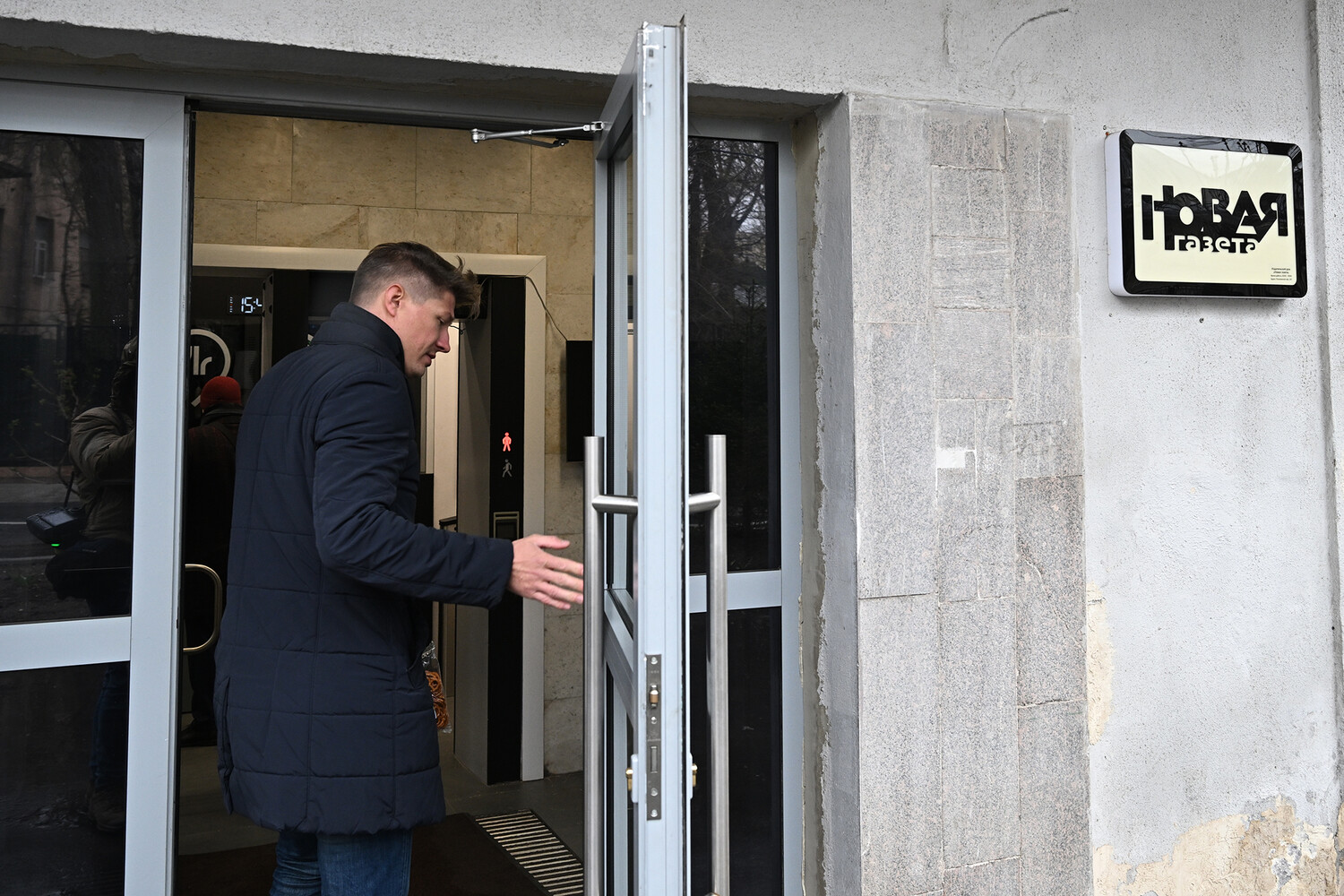
The Novaya Gazeta editorial office called the arrest of the journalist absurd.
Today, Novaya Gazeta released a statement regarding the searches of its editorial offices on April 9, following which journalist Oleg Roldugin was detained and then arrested the following day by Moscow's Tverskoy Court.
Novaya Gazeta notes that the newspaper's employee "was arrested not on any charge, but on suspicion of something," and laments that colleagues' attempts over two days to determine the specifics have yielded no results: "It has not become clear what the crime was, when it was committed, who committed it, or who the victims were in this crime, unknown even to the investigation."
Novaya Gazeta investigative journalist Oleg Roldugin has been arrested on charges of illegally using personal data. A Moscow court has remanded him in custody until May 10. The maximum penalty for this charge is six years in prison.
The court's decision followed searches at the Novaya Gazeta editorial offices on April 9. Investigators allege that Roldugin conducted search queries on resources containing personal data between 2025 and 2026, after which he published articles on Telegram. The journalist claims that the information channel he created was intended for unique materials unrelated to journalism.
The court case relies on "requests to bots on Telegram" as key evidence. After Roldugin's arrest, law enforcement gained access to his mobile phone and accounts.
The exact reason for the prosecution remains unclear due to non-disclosure agreements. However, according to the publication Astra, the criminal case may be connected to one of Roldugin's recent publications—about Ruslan Alisultanov, an aide to a relative of Chechen leader Ramzan Kadyrov. The article stated that he had purchased a 3.5 billion-ruble penthouse on the banks of the Moskva River.
According to the VChK-OGPU Telegram channel, attacks on investigative journalist Oleg Roldugin have been ongoing since at least 2021.
"Then he was threatened, demanding that he delete a number of posts, including one about a mansion on Malaya Bronnaya Street occupied by extremely difficult tenants. He refused. As a result, all of his accounts ended up in the hands of unknown individuals, including access to his bank accounts. But the 'criminals' weren't interested in the money. Roldugin's channel is no longer active," the VChK-OGPU reported.
Roldugin has extensive experience in investigative journalism, including senior positions at Sobesednik, where the investigative department focused on luxury real estate allegedly owned through foundations by former Russian Prime Minister Dmitry Medvedev. The newspaper ceased operations in 2024 after being designated a "foreign agent."
At Novaya Gazeta, Roldugin continued to work on high-profile stories, publishing materials on members of Kadyrov's inner circle, former Ukrainian President Viktor Yanukovych, and the activities of Rossotrudnichestvo.
A 13-hour search of Novaya Gazeta's office on April 9 resulted in the seizure of equipment and documents, but the newspaper assured that investigators had no complaints against the editorial staff. Novaya Gazeta actively covered human rights violations in Chechnya, which repeatedly led to threats against its journalists.
In a commentary to Mediazona, writer and journalist Viktor Shenderovich suggested that "the attack on Novaya Gazeta could be the Kremlin's attempt to regain popularity among the z-audience, which is noticeably irritated by military failures and the country's general degradation, which can no longer be blamed on liberals."
The Insider editor Oleg Pshenichny commented on the event as follows: "Sobesednik was the last independent print newspaper in Russia, and it was very unpleasant for Putin. Now they've decided to deal with Roldugin himself, hence the search at Novaya Gazeta."
Lawyer Vitaly Maryasov, speaking to Mediazona, emphasized that Oleg Roldugin is the first journalist suspected of illegally using personal data.
"And, apparently, not the last. The journalist's alleged illegal activity involved using bots for 'intelligence.'" This is the first criminal case brought not against the bot's creators, but against its user. If this is true, and law enforcement moves toward outlawing the use of "proviva" bots, then we can drive paddy wagons to every media outlet's offices and round up every journalist—show me a single one who hasn't used such tools," he added.