A Nest of the "Global Caliphate"? Mass Arrests in Karachay-Cherkessia
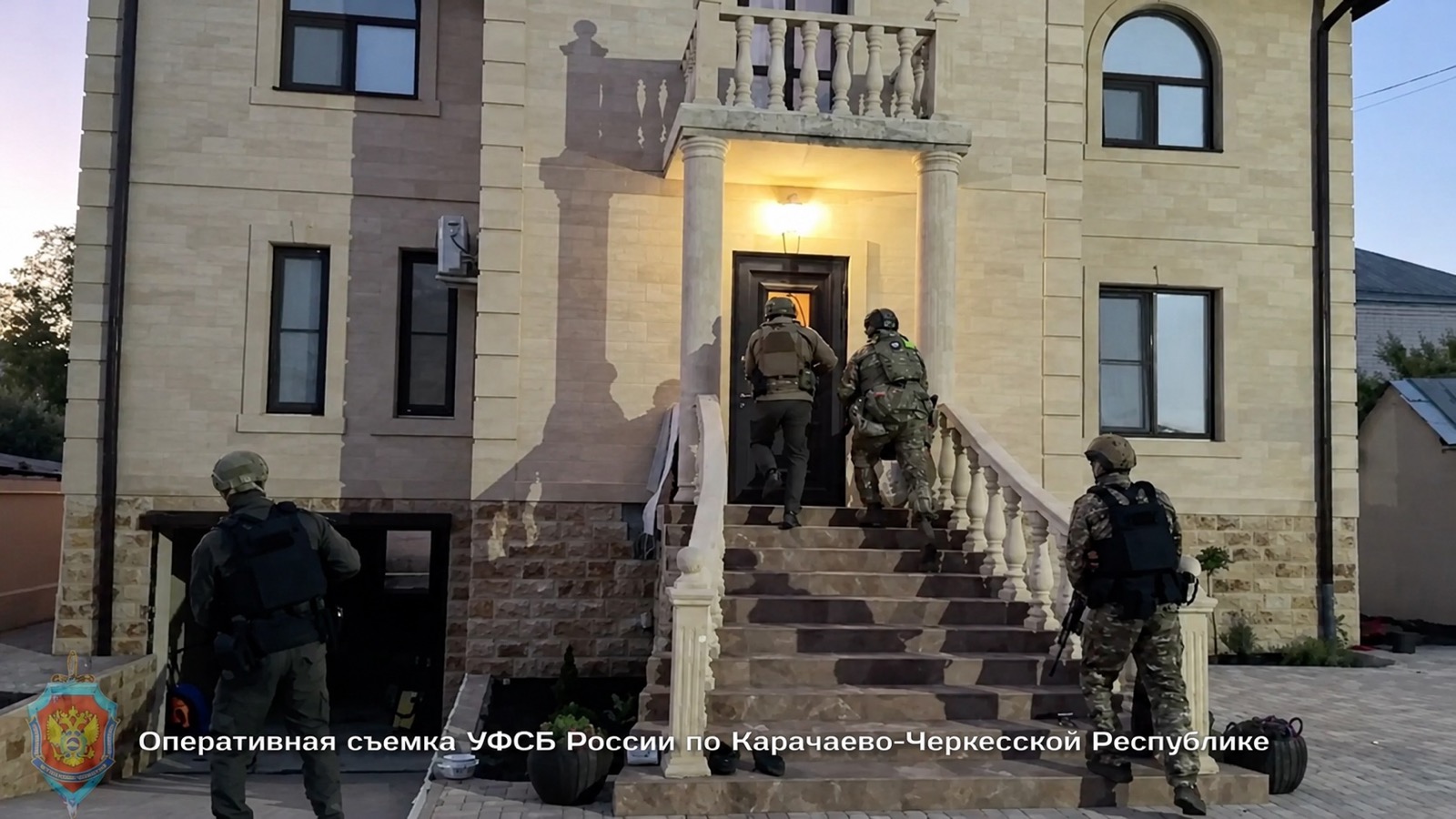
Earlier this week, the press service of the Russian Federal Security Service (FSB) for the Karachay-Cherkess Republic reported the arrest of 66 individuals in the region suspected of involvement in the activities of the At-Takfir wal-Hijra organization, banned in Russia. A criminal case has been opened against the suspects under Parts 1 and 2 of Article 282.2 of the Russian Criminal Code ("Organization of the Activities of an Extremist Organization and Participation Therein").
The agency's official statement reads:
"The Russian Federal Security Service (FSB) for the Karachay-Cherkess Republic, together with the Russian Ministry of Internal Affairs, has disrupted the activities of a deeply conspiratorial network of supporters of a destructive ideology aimed at the violent overthrow of the constitutional order of the Russian Federation." As a result of a series of operational and investigative measures, more than 60 members of an underground cell of an international religious extremist organization banned in Russia, who rejected secular laws and civil society institutions, were detained. A court decision has ordered that the detainees be held in custody for two months.
According to the FSB, the group's members have held meetings over the past six years, disseminated the organization's ideology, and recruited new supporters. The agency also claims that extremist literature and other materials were seized during the searches, confirming the detainees' involvement in the activities of the banned organization.
According to the intelligence agency, the alleged leaders of the organization pursued the goal of creating a "Worldwide Caliphate" through armed "jihad."
TASS, citing the FSB Directorate for the Karachay-Cherkess Republic, also reported that the activities of the alleged cell were allegedly coordinated by natives of the republic located abroad.
However, the published report provides no information about the alleged coordinators, their country of residence, the nature of their connections to the detainees, or any other details.
The court ordered pretrial detention for 65 suspects, and house arrest for one.
The North Caucasus has long been a region with one of the highest levels of operational control, which, according to security agencies, is necessary to counter the armed underground and religious extremism. In this context, claims of the existence of such a large and long-running network require particularly compelling evidence. However, in such cases, the information used by intelligence agencies to justify their actions typically remains unavailable for independent verification.
The activities of At-Takfir wal-Hijra, in which all the defendants are accused of participating, have been banned in Russia by a Supreme Court decision. However, in expert literature, this term is often used to refer not to a single international organization with a centralized structure, but to various autonomous groups united by a common takfiri ideology.
Similar questions have already arisen in other Russian criminal cases involving accusations of participation in At-Takfir wal-Hijra. For example, analyzing the so-called "Neftekamsk case," which was tried in Bashkortostan in 2021–2022, the "Memorial: Support for Political Prisoners" project noted that investigators do not always provide sufficient evidence of the existence of the organization banned by the Russian Supreme Court under the name At-Takfir wal-Hijra.
Vitaly Ponomarev, head of the program for combating fabricated Islamic extremism cases, noted that the criminal cases he knew of lacked information about the organization's structure, membership, internal hierarchy, and leadership, and the name "At-Takfir wal-Hijra" itself often barely appeared in the investigation materials. He believed it was necessary to distinguish between adherence to radical religious views and participation in a specific banned organization.
Human rights activists also drew attention to the nature of the evidence base in such trials. They assessed that charges were often based on religious studies, wiretapped conversations, communal prayers, and confessions from individual defendants. In a number of cases, the defendants later claimed that their confessions were obtained under duress, although investigators denied these allegations.
If the 66 detainees were indeed under investigation for several years, how convincing is the evidence of the existence of an organized extremist structure obtained during this period? asks a political scientist, who previously worked at a university in the North Caucasus, commenting on the official statements of the FSB Directorate for the Karachay-Cherkess Republic regarding mass arrests in the republic in an interview with a correspondent for the publication Novy DOSh.
According to the publication's source, the mass arrests were most likely preceded by lengthy surveillance of practicing Muslims who, for one reason or another, came to the attention of law enforcement agencies.
"Perhaps they were simply gathering for collective prayer," he suggests.
Regarding the evidence base, the expert points out that the published information so far only indicates that the investigation is citing confiscated "extremist literature" and the suspected involvement of the detainees in a banned organization. "The mere discovery of literature or other religious materials is not sufficient grounds for concluding the existence of an underground network," he notes, pointing to the established practice of applying Russian legislation on extremist materials.
"This practice has been highly biased for many years and often depends on the 'operational needs' of security and intelligence agencies. It's enough to recall the high-profile controversies surrounding attempts to designate certain Islamic religious texts and translations of the Quran as extremist, which were subsequently revised following widespread public outcry and the intervention of Chechen leader Ramzan Kadyrov. Thus, in Russia, virtually any texts and materials with Islamic content can be designated as extremist," the political scientist notes.
The publication's source is skeptical of the publicly presented information regarding the evidence in the case.
"I believe that the security forces have nothing serious to support the charges being brought. "Under some trumped-up pretext, as it seems to me, they detained these people, but, judging by the published information, no weapons or any other signs of preparation for violent actions were found," he continues.
"That's precisely why," the expert is convinced, "official reports only mention so-called 'extremist materials.' If more serious evidence had been discovered, it would undoubtedly have been immediately presented to the public."
The political scientist expresses concern that those detained "may be coerced, under threat of criminal prosecution, into sending them to war against Ukraine. If in Chechnya, for example, according to media reports and human rights activists, people are sent to war even after violating traffic rules, then in this case, such criminal prosecution, in my opinion, could also become a convenient tool of pressure," he concluded.