Makhachev triumphantly defended his UFC title and raised the Russian flag
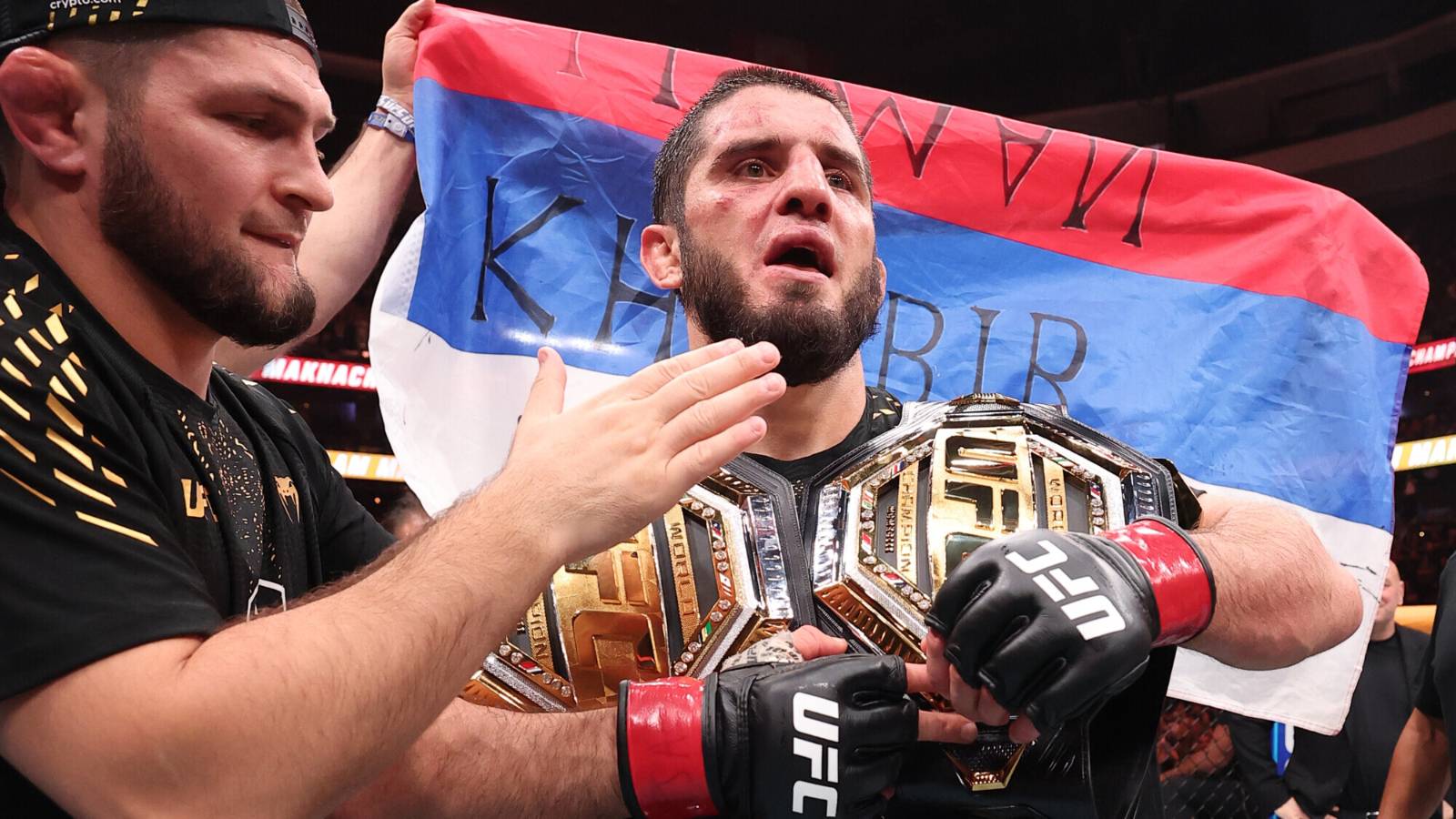
34-year-old Islam Makhachev, a native of Dagestan, Lak by nationality and UFC welterweight champion, defeated Irishman Ian Machado Gary at UFC 330 in Philadelphia. The fight at the Xfinity Mobile Arena lasted all five rounds.
The judges unanimously gave the victory to Makhachev - 49:46, 49:46 and 48:47. This was his first title defense since moving up to welterweight.
The fight turned out to be difficult for the champion. From the first minutes, Makhachev relied on wrestling and transfers to the ground, but Gary managed to get out of control several times. In the third round, the Irishman began to land more accurate kicks.
In the second round, Makhachev shocked his opponent with a kick to the head and sent him to the canvas. Gary managed to recover and continued the fight. In the fourth round, the champion again gained an advantage through wrestling.
In the final round, Gary went ahead, knowing that he would probably need an early finish to win. However, Makhachev did not allow his opponent to change the course of the fight and brought the fight to a victory on points.
The victory was Makhachev’s 17th in a row in the UFC. He set a new organization record, surpassing Anderson Silva's achievement of 16 wins in a row.
Now Makhachev’s professional record is 29 wins and one loss. For Gary, this is the second defeat in his professional career.
Makhachev is one of the main students of the legendary Dagestan coach Abdulmanap Nurmagomedov, Khabib’s father. He and Khabib trained together for many years under the guidance of Abdulmanap, who considered Makhachev one of his most promising students. After Abdulmanap's death in 2020 and Khabib's professional career, it was Khabib who became one of Makhachev's main mentors. Makhachev himself calls him his elder brother.
The Russian flag, which the team carried into the octagon after the victory, and Makhachev raised in front of the cameras, attracted no less attention from many of Makhachev’s fans than the fight itself.
Khabib and his entourage did not go to fights with the Russian flag for a long time, which became a reason for public reproaches and attacks from Russian nationalists. At the same time, it was not only about the Russian flag: the team did not always display the flag of Dagestan.
The flag itself, carried into the octagon after the victory, was unusual: on each of its three stripes the names of Islam Makhachev, Khabib Nurmagomedov and Usman Nurmagomedov were written.
Why this time Khabib’s team decided to demonstrate the Russian tricolor, one can only guess.
Over the past three decades, the Russian media and federal television, when reporting on offenses committed by people from the Caucasus, have often emphasized their nationality. When the same people achieved success - including in sports, representing Russia - their ethnic origin often disappeared from public description: on the screen and in the Russian press they became simply “Russians.”
These double standards have fueled ethnic tensions in Russian society for years. Against this background, the current demonstration of the Russian flag by Makhachev’s team no longer looks like just a sporting episode, but a gesture that is inevitably perceived in a broader national and political context.