"We’ve been killed": The newspaper where Anna Politkovskaya worked announces its forced closure
Russia’s *Novaya Gazeta* is ceasing operations. On November 9, the editorial team plans to vacate its office in the center of Moscow, shut down its servers, and publish its final issue. The journalists announced this decision on October 30 in a statement titled "We’ve been killed," citing pressure from Russian authorities and security services, eviction from their premises, and the blocking of their reader-donation system.
In a video released by the editorial team, they state that after more than 30 years of work, the journalists have been left "out on the street," without any means of subsistence, and under the constant threat of repression. The authors also paid tribute to their colleagues who were killed because of their professional work: Igor Domnikov, Yuri Shchekochikhin, Anna Politkovskaya, Stanislav Markelov, Anastasia Baburova, and Natalia Estemirova.
"Since the start of the hostilities, we—like all other journalists—have been silenced. For nearly five years of war, we managed to keep working while completely surrounded by security services. But now, it’s over. We’ve ended up in a 'kill zone,'" the statement reads.
The editorial team specifically noted that the shutdown of their donation system coincided with the receipt of an eviction notice. This system had been a primary channel for reader contributions, which in recent years served as one of the newspaper's main sources of funding. In an interview with RBC, editor-in-chief Sergey Sokolov explained that the payment processing companies refused to facilitate transactions, citing their own internal corporate policies.
The video concludes with the words: "But the final issue—will be published."
*Novaya Gazeta* was founded in 1993 with the support of former Soviet President Mikhail Gorbachev. The first issue was published on April 1 with a circulation of 100,000 copies. The publication became one of the most prominent independent Russian media outlets, known for its investigative reporting on corruption, human rights abuses, and the activities of the Russian authorities. In 2021, editor-in-chief Dmitry Muratov was awarded the Nobel Peace Prize, sharing the honor with Filipino journalist Maria Ressa.
Throughout its years of operation, the editorial team frequently faced threats and attacks against its journalists. Following the start of Russia’s full-scale invasion of Ukraine, this pressure intensified dramatically.
After the onset of Russia’s full-scale invasion of Ukraine, the pressure on the editorial staff mounted. On March 28, 2022, the newspaper announced the suspension of its publication following a second warning from Roskomnadzor (the Russian federal media regulator). In September of that same year, Moscow’s Basmanny District Court revoked the publication’s print registration, and the *Novaya Gazeta* websites were blocked. Subsequently, the editorial team produced *Novaya Gazeta. Zhurnal* (Novaya Gazeta. Magazine) with a circulation of 999 copies.
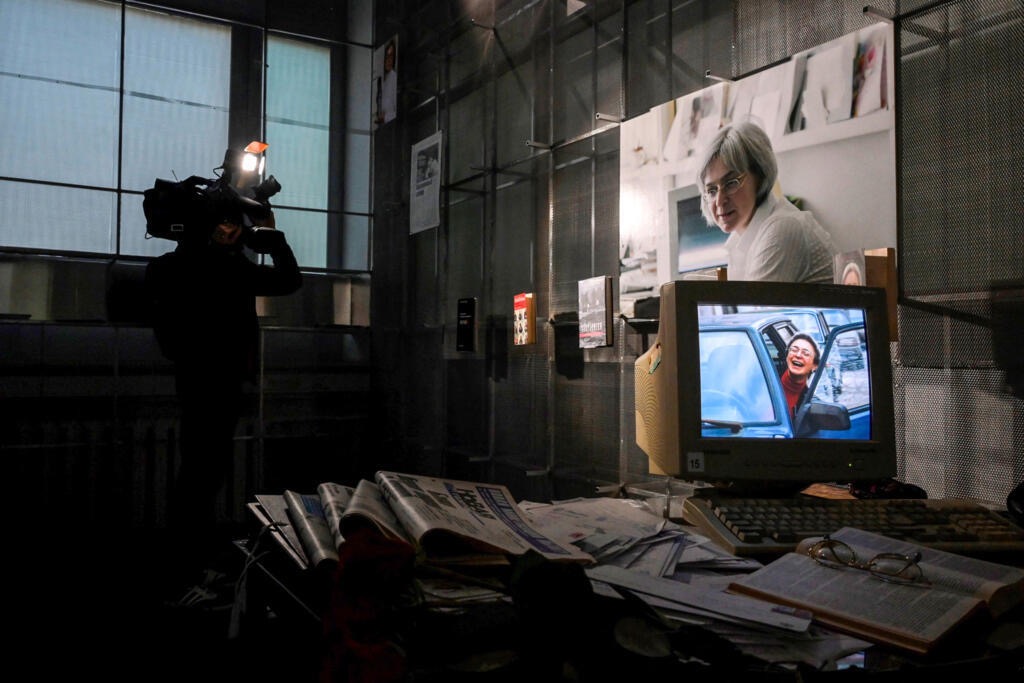
On September 4, 2026, the Russian Ministry of Justice added the online publication *Novaya Gazeta* to its registry of "foreign agents." In April, the newsroom was subjected to searches in connection with a case involving the alleged unlawful use of personal data. In October, it was revealed that the journalists were being evicted from their office on Potapovsky Lane—a location where the publication had been based for 29 years. This also necessitates the closure of a museum dedicated to journalist and human rights activist Anna Politkovskaya, which had been housed in what was once her office.
A significant chapter in the history of *Novaya Gazeta* is its coverage of the Russo-Chechen wars—particularly the second conflict—as well as its reporting on widespread human rights violations in the North Caucasus. During the second Russo-Chechen war, the publication became one of the few major Russian media outlets to consistently report on events in Chechnya—including the killing of civilians, torture, abductions, and other crimes committed by security forces.
These were the very issues addressed in the reporting of Anna Politkovskaya, who was killed in Moscow on October 7, 2006. She traveled repeatedly to Chechnya—then under the control of Russian forces—to document the accounts of those who had suffered at the hands of the Russian military and to shed light on crimes that the authorities preferred to keep quiet. Her dispatches from Chechnya became some of the publication’s most significant work, and Politkovskaya herself became a symbol of independent journalism and the struggle for human rights in Russia.
Following Politkovskaya’s murder, Natalia Estemirova—a staff member at the human rights center "Memorial" in Chechnya—continued to write for *Novaya Gazeta* about the Russo-Chechen wars, documenting abuses by security forces and human rights violations in the republic. She was killed on July 15, 2009.
*Meduza* reported on the newspaper’s closure, compiling reactions from journalists, writers, and cultural figures. Journalist Ksenia Sobchak described the shutdown as a blow to Russian society, admitting that she struggled to believe it had actually happened.
"The closure of *Novaya Gazeta* is a gut punch. I don’t want to believe it, but I have to," Sobchak wrote. She also expressed hope that, one day, the publication might be able to return—both to the media landscape and to its offices at Chistye Prudy.
Writer Boris Akunin recalled a debate over whether Russia could be considered a totalitarian state as long as an independent press continued to operate within its borders. He noted that the existence of *Novaya Gazeta* was often cited as an argument against such a classification.
"People who, while in Russia—rather than at a safe distance—conduct themselves with courage and dignity, command immense respect," Akunin remarked.
Literary critic Galina Yuzefovich compared the outlet’s departure to the loss of a vital landmark—a beacon that helped people gauge what was happening in the country.
"Yet another—not just a marker, but a true milestone, a bright, prominent lighthouse—has been swept away by a murky tide. Thank you, dear colleagues. Thank you for everything. There has never been anyone better than you, there is no one better now, and it is far from certain that there ever will be," she wrote.
Reporters Without Borders (RSF) also responded to the closure of *Novaya Gazeta*. The organization’s director general, Thibaut Brutin, stated that for more than 30 years, the publication had faced attacks from the Russian authorities, yet it continued its work, serving as an example for journalists in countries around the world.
"Above all, *Novaya Gazeta* was—and will always remain—the primary symbol of free journalism: independent, demanding, and rooted in pluralism. It was a model for many colleagues across the globe," the RSF head said in a statement.
He added that the newspaper’s closure would not diminish its capacity to inspire journalists.
"We are *Novaya Gazeta*. And there are many of us," the RSF director general concluded.