Pashinyan suggests possibility of early elections linked to constitutional reform and outlines timeline for peace with Azerbaijan
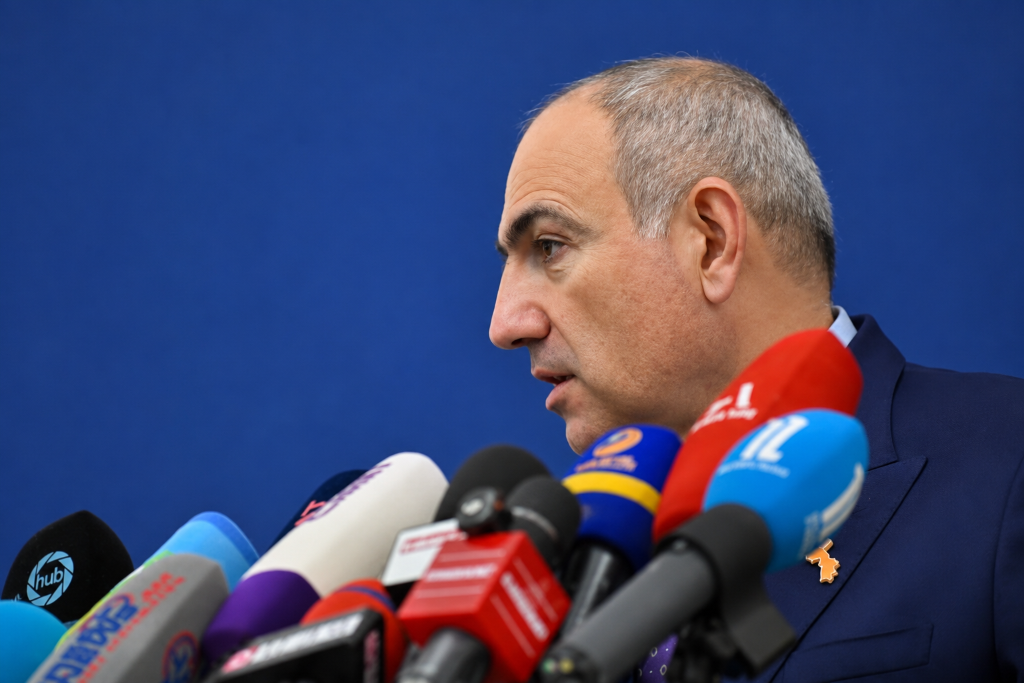
Armenian Prime Minister Nikol Pashinyan made a series of significant statements while speaking with journalists on Thursday, October 22. He addressed issues concerning constitutional reform, relations with Azerbaijan, a peaceful settlement, and the government’s future political agenda.
Pashinyan announced that the authorities would soon publish a draft of a new Constitution, which would then be subject to public discussion. He emphasized that amending the Basic Law is a matter of Armenia’s internal agenda—a point he also raised during a meeting with the Azerbaijani side in Bishkek.
"I told the Azerbaijani side that it is unacceptable for us that issues related to our Constitution are constantly being brought up by Azerbaijan, as this is our own internal agenda," the Prime Minister noted.
According to Pashinyan, the Azerbaijani side acknowledged that the Constitution is an internal affair of Armenia. However, Baku expects Yerevan to take Azerbaijan’s position into account during discussions on a peace agreement. The Prime Minister stated that this should not hinder the implementation of the Armenian government’s plans.
"So, when Azerbaijan says such things, are we supposed to just say, 'Fine, we’ll abandon our agenda and stop moving in this direction'? No—we must continue on this path, and we must have a new Constitution," he said.
The authorities intend to submit the draft to parliament and seek the opposition’s support for the reform. Pashinyan described the reform as fundamental to the country’s future. "We will try to convince our colleagues in the opposition that this is a very important and fundamental issue—a matter of defining and resolving the question of the long-term viability of the Armenian state," the Prime Minister stated.
He did not rule out the possibility of early parliamentary elections should an agreement with the opposition prove unattainable.
"We will attempt to persuade them. If that fails, we will pursue other scenarios, which could include holding early elections. And who said such a scenario is off the table?" Pashinyan remarked, outlining his potential course of action.
He views the adoption of a new Constitution and the conclusion of a peace treaty with Azerbaijan as commitments made to the citizens—commitments whose fulfillment depends on public support. Should the people fail to back this path, Pashinyan indicated that his "political mission would be exhausted."
The Prime Minister explained that the need for a new Constitution stems from a desire to ensure the stability of Armenian statehood for the long term.
"It is important to me that we resolve this issue not just for a year, two years, five years, or even ten years, but for decades and centuries to come," he emphasized.
Armenia’s Constitution was adopted in 1995, with subsequent amendments made in 2005 and 2015. The latter reform established a parliamentary system of government. Pashinyan has previously advocated for the adoption of a new fundamental law, including the removal of a reference to the Declaration of Independence from the preamble. Adopting a new Constitution would require a referendum, the scheduling of which must be supported by at least two-thirds of the members of the National Assembly. The draft document has not yet been made public.
On the same day, Pashinyan also touched upon a potential timeline for the signing of a peace treaty with Azerbaijan. According to his assessment, this could happen in 2027–2028.
"I believe we should sign a peace treaty sometime between 2027 and 2028," the Prime Minister stated.
He also announced that the TRIPP project, which concerns the development of regional communications, has moved into the practical implementation phase. Pashinyan noted that infrastructure preparations and negotiations on a peace agreement are proceeding in parallel.
"Of course, the two are unrelated, but we are already launching the TRIPP project," he remarked.
The head of government stated that opening regional transport routes is essential for strengthening Armenia's economic resilience. He added that the process of ratifying an agreement with the United States regarding the TRIPP project has begun in the National Assembly of Armenia.