Pashinyan Rejects Opposition Accusations of Unilateral Concessions to Azerbaijan
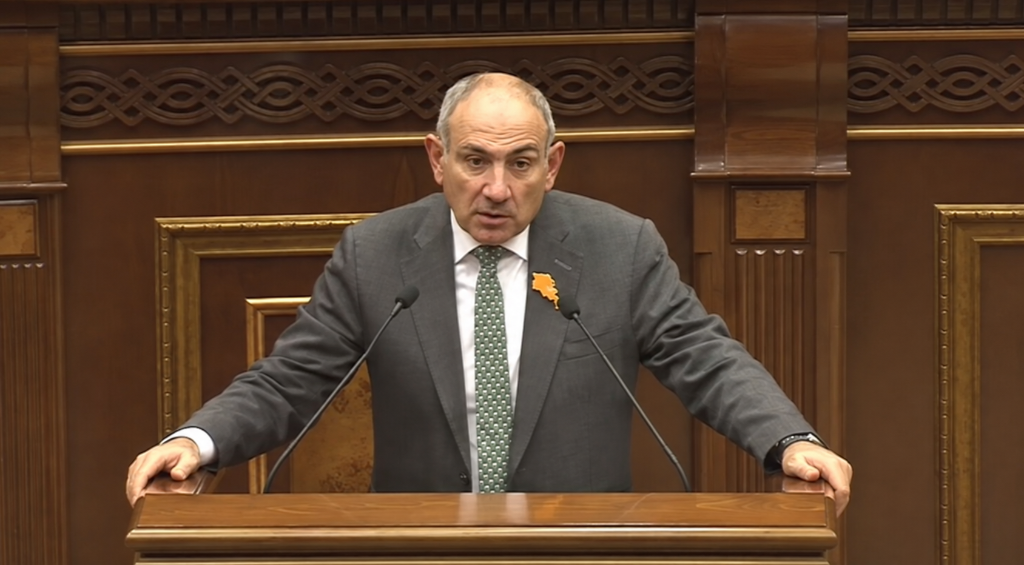
Armenian Prime Minister Nikol Pashinyan has stated that his government has not made, and does not intend to make, any territorial concessions to Azerbaijan. He made these remarks in parliament on November 18, while responding to questions from lawmakers.
The statement came in response to criticism from the opposition faction "Strong Armenia," whose representatives have accused the authorities of making unilateral concessions to Baku.
Pashinyan explained the government’s position by referencing the concept of a "Real Armenia," under which state policy must be based on the republic’s internationally recognized borders.
"We view our policy and our responsibilities as pertaining to the internationally recognized territories of the Republic of Armenia. In this regard, yes, we can say that we have not conceded anything, nor will we concede anything. There is no need for such a thing, and such an agenda does not exist at all," the Prime Minister emphasized.
He also pointed to a "legally binding document that was ratified in this very chamber."
"I am referring to the regulations governing the joint activities of the two countries' border delimitation commissions," the head of government noted.
Tigran Abrahamyan, secretary of the opposition faction, has also been critical of the government. In early November, he stated that Azerbaijan is securing concessions while the signing of a peace agreement remains delayed. A primary point of contention is the drafting of a new Armenian Constitution; the opposition argues that amending it has effectively become an additional demand imposed by Baku.
"The current reality refutes the promises of peace made by the 'Civil Contract' party. In effect, we are facing yet another demand for concessions—the amendment of the Constitution—yet peace has not been established. Moreover, we are moving further away from peace; the Republic of Armenia is drifting further from peace." "This is not peace; these are concessions—concessions without peace," Abrahamyan said on November 2.
At the same time, he articulated his faction’s position even more firmly, concluding that "everything we could possibly concede, we have already conceded."
"Enough is enough. Azerbaijan—partly due to statements coming from Armenia and the conciliatory stance Armenia has adopted—sees, time and again, that it can demand and obtain even more," Abrahamyan asserted.
Another point of contention is the fate of the former enclave of Tigranashen (Karki). In September, Pashinyan suggested that the question of the settlement’s exact location remained open. Narek Karapetyan, leader of the "Strong Armenia" party, demanded that it remain under Armenian control, accusing the Prime Minister of being prepared to yield to Baku’s demands.
"You shouldn't be saying, 'Don't do this—there will be war; don't do that—there will be war; don't accept 10,000 people—there will be war'—every single minute. That is not how diplomacy is conducted," Karapetyan stated.
During that same parliamentary session on November 18, Pashinyan engaged in a heated exchange with another faction member, Anush Mirzoyan. The MP held the Prime Minister responsible for the deaths of Armenian service members.
"Armenian mothers and fathers did not want their sons to die under Turkish Bayraktar drones," she said.
Pashinyan agreed with her, linking the loss of life to the continuation of the Karabakh movement.
"Yes, you are right. But as long as the Karabakh movement continued, people's children would have died under Bayraktar drones—whether they wanted that or not," the Prime Minister replied. He also emphasized: "I am saying that Armenia is abandoning the Karabakh movement."
Earlier, in August 2026, Armenia and Azerbaijan initialed a peace agreement in Washington. One of the contentious issues remains Baku’s demand that Armenia amend its Constitution, as it contains provisions that the Azerbaijani side interprets as territorial claims. Yerevan is currently drafting a new Basic Law; however, the opposition fears that this would amount to a concession to Azerbaijan without any guarantee of a definitive peace.
Pashinyan recently announced that the government plans to publish a draft of the new Constitution in November. Following this, the authorities intend to hold public discussions, gather input from citizens, and continue consultations until the document has been sufficiently reviewed by the public.
The Prime Minister also suggested that the ruling majority might leverage public support for the reform to exert pressure on those who oppose the constitutional changes. According to Pashinyan, if the authorities become convinced that the new Constitution facilitates a peaceful settlement—while the opposition continues to oppose it—this would signify that the government’s opponents do not support peace with Azerbaijan.