Five Crimean Tatars Speak of Repression in Court Before Sentencing
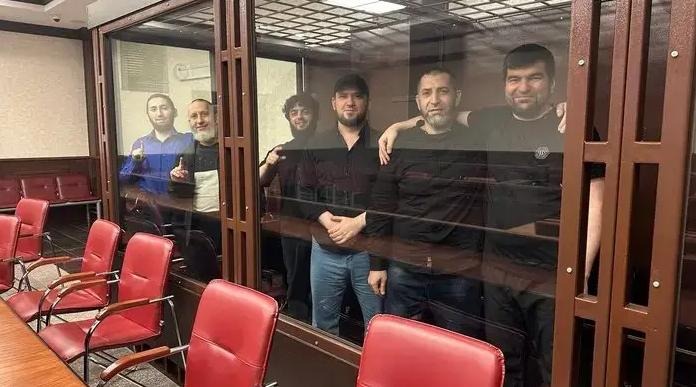
The Southern District Military Court in Rostov-on-Don has sentenced six Crimean Tatars from Bakhchysarai to prison terms ranging from 15 to 19 years, to be served in a strict-regime penal colony, in a case involving alleged ties to the organization Hizb ut-Tahrir. In their final statements, five of the defendants asserted that the criminal prosecution is a form of pressure exerted on Crimean Tatars due to their religion and ethnicity. Remzi Nimetulaev declined to make a statement.
Ruslan Asanov was sentenced to 19 years in a penal colony, with the first four years to be served in a prison (a more restrictive type of detention facility). Remzi Nimetulaev received an 18-year sentence, with the same initial period to be spent in prison. Seidamet Mustafaev, Eldar Yakubov, Abdulmedzhit Seitumerov, and Amethan Umerov were each sentenced to 15 years.
Journalist Anton Naumlyuk, founder of the Ukrainian outlet *Grati*—who published excerpts from the defendants' final statements—noted that this is the fifth group from Bakhchysarai to be convicted in connection with the Hizb ut-Tahrir case. According to his data, more than 120 Crimean Muslims have served or are currently serving sentences as part of this case.
Amethan Umerov, a father of five, recalled in his final statement that in 2019, he had traveled to Moscow with other Crimean Tatars to protest against the repression taking place in Crimea.
"I am… not here because of what I am charged with." "I am… here because I did not remain silent, because I did not stand idly by while others were oppressed. I am not a terrorist. I am a son of a people who know how to wait. You call this terrorism; I call it helping those in distress. You call it a conspiracy; I call it the unity of a people and love for one’s brothers. A time will come when it will be shameful to even read these verdicts aloud. I am simply waiting," said Umerov.
Abdulmedzhit Seytumerov—the third of the brothers in the family of historian Shukri Seytumerov—also spoke of the systematic persecution of Muslims in Crimea. His brothers, Osman and Seytumer Seytumerov, were arrested in March 2020 and subsequently sentenced to 17 and 14 years in prison, respectively.
"Like clockwork, every six months, Muslims in Crimea are detained and accused of participating in a banned organization—based on the testimonies of anonymous witnesses, 'expert' analyses, and audio recordings. Each case is a carbon copy of the last. By 'finding' these alleged terrorists, the authorities demonstrate that they are 'working'—that they are earning their keep. In this way, they secure promotions and new ranks," stated Seytumerov.
In his statement, Ruslan Asanov linked the persecution of Crimean Tatars to the Russian occupation of the peninsula in 2014.
"In March 2014, following the forceful seizure of Crimea, we—the Crimean Tatars—became easy targets for security officials, who built their careers, earned bonuses, and gained new ranks on the backs of shattered families and ruined lives... Before 2014, I lived in Crimea under Ukrainian rule, and I had never heard of 'terrorism' or 'extremism'." “And as soon as Russia arrived, all of this suddenly appeared,” he said.
Eldar Yakubov, a father of six and the eldest of the six men convicted, also described the situation as persecution based on ethnicity and religion. He noted that in Crimea, it is not only men who are being prosecuted on terrorism charges, but also Muslim women.
All six individuals were detained by security forces on February 29, 2024, following searches of their homes. Prior to their arrest, they had been detained on several occasions while participating in demonstrations in support of other Crimean Tatars who were in custody. Mustafayev had collaborated with the civic movement “Crimean Solidarity,” filming court hearings for the group’s materials.