"Half of Ossetia at War": A Demographic Catastrophe Inside Russia
A large-scale investigation published by TRT in Russian lays bare the human cost of Russia's war in Ukraine for the Republic of North Ossetia, a small region with a population of approximately 700,000, where, according to figures presented at a meeting of an internal interdepartmental government commission, between 43,000 and 45,000 people took part in the fighting.
Based on interviews with a current official and a combat veteran, whose identities are being withheld for security reasons, the material represents some of the most detailed first-hand evidence to date of what war is doing to Russia's ethnic minorities.
The investigation's key finding is astonishing: if the figures cited are accurate, up to half of all Ossetian men of working age—between 22 and 45—have served in the war. According to Rosstat, the size of this demographic group does not exceed 95,000–100,000 people.
What the official figures say—and what they're not saying
The data presented at the interdepartmental commission exists against a backdrop of strictly controlled official statistics. According to the Caucasian Knot monitoring project, by April 13, 2026, authorities had officially confirmed at least 9,000 deaths in southern Russia, 582 of whom were from North Ossetia. The BBC project, which tracks casualties using open sources, estimates the total number of Russian deaths at over 212,000, of which at least 1,303 were from North Ossetia.
"Maybe someone died a long time ago, and they're only reporting it now," a civil servant said in an interview with TRT in Russian, describing how information is published sparingly. "This isn't a death toll—it's a count of the obituaries the authorities managed to publish."
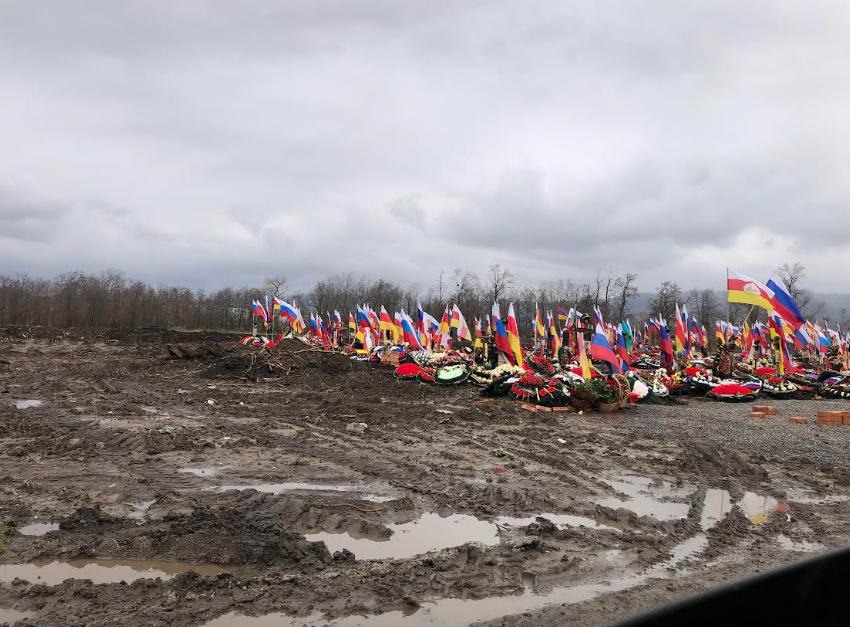
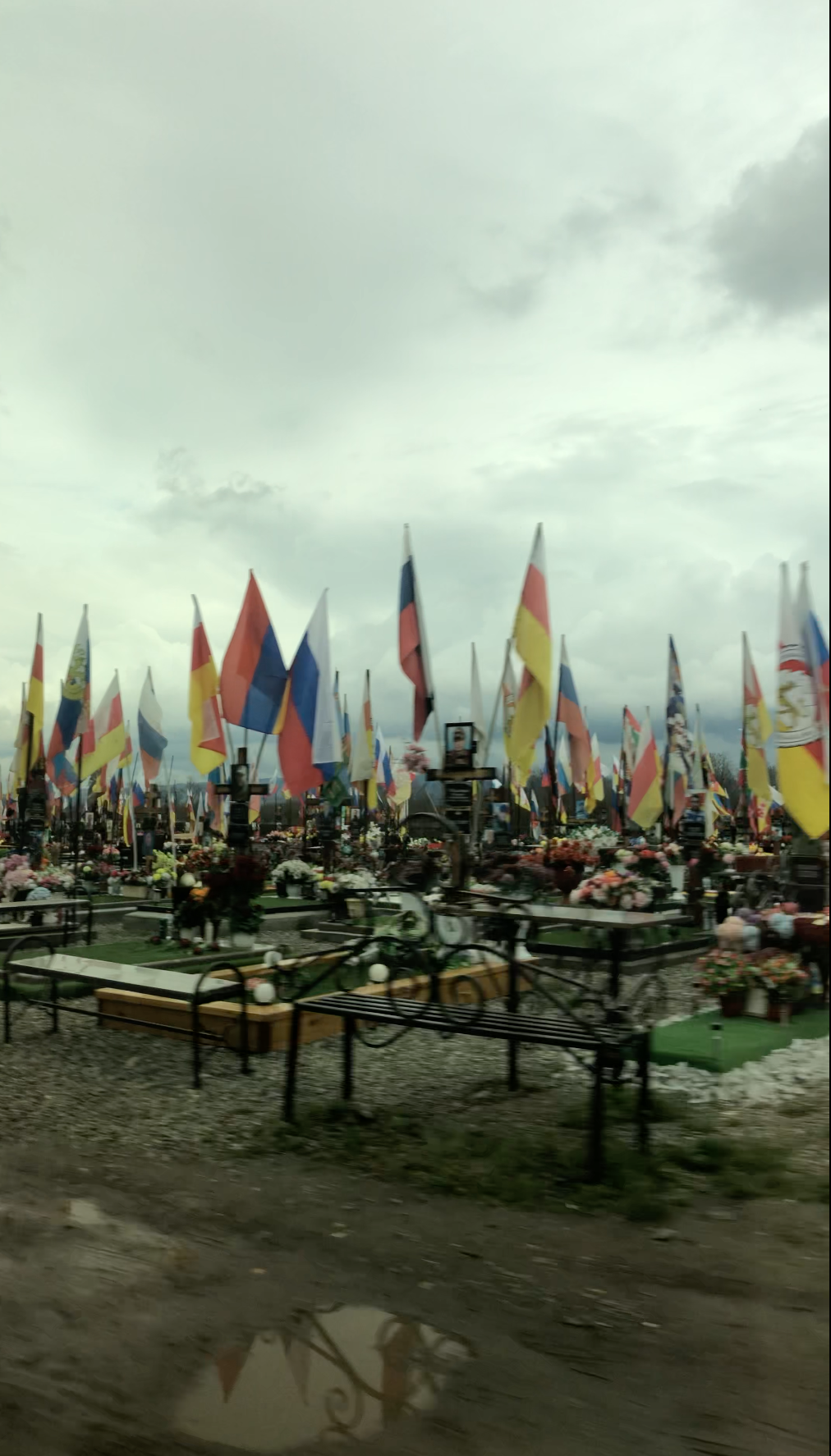
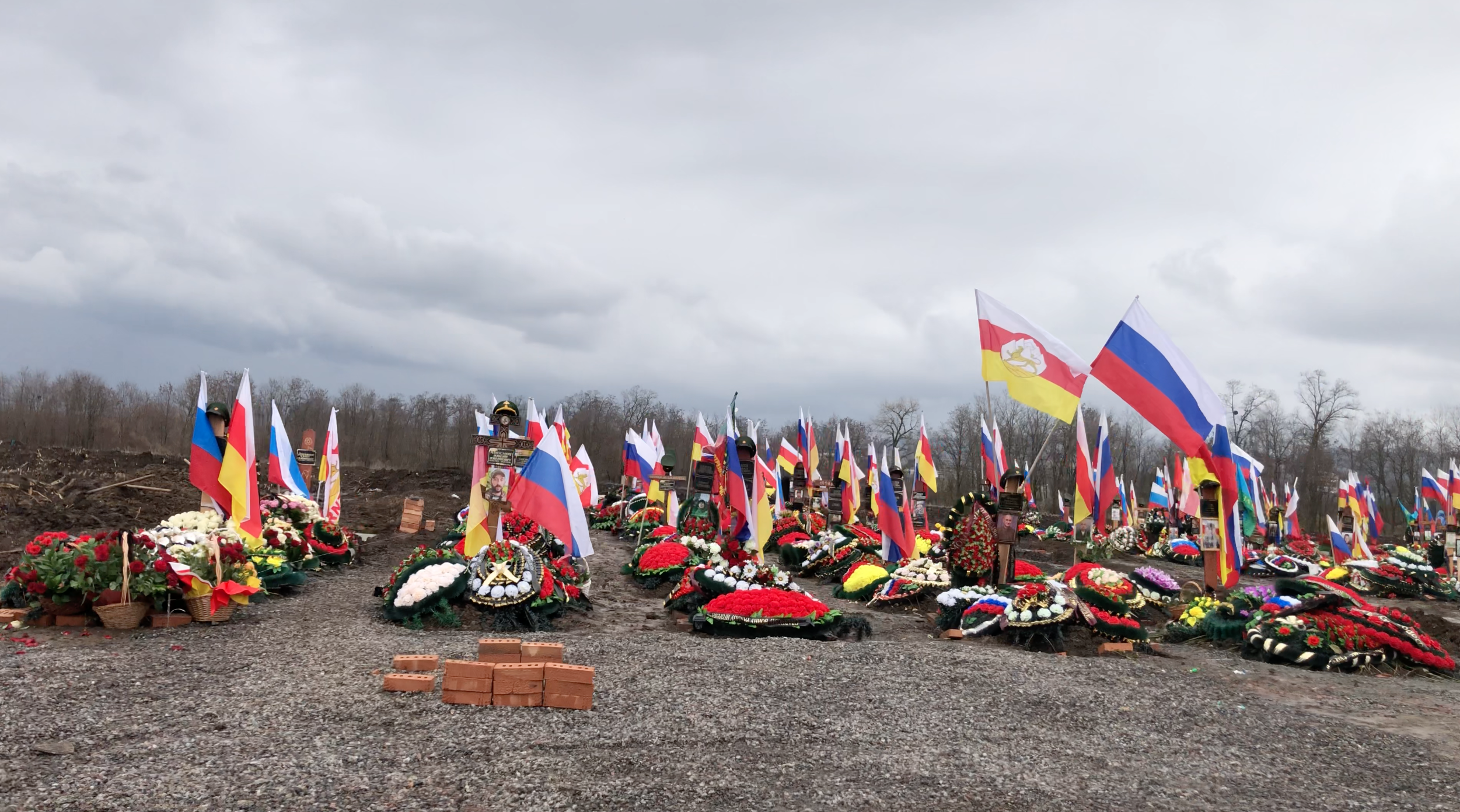
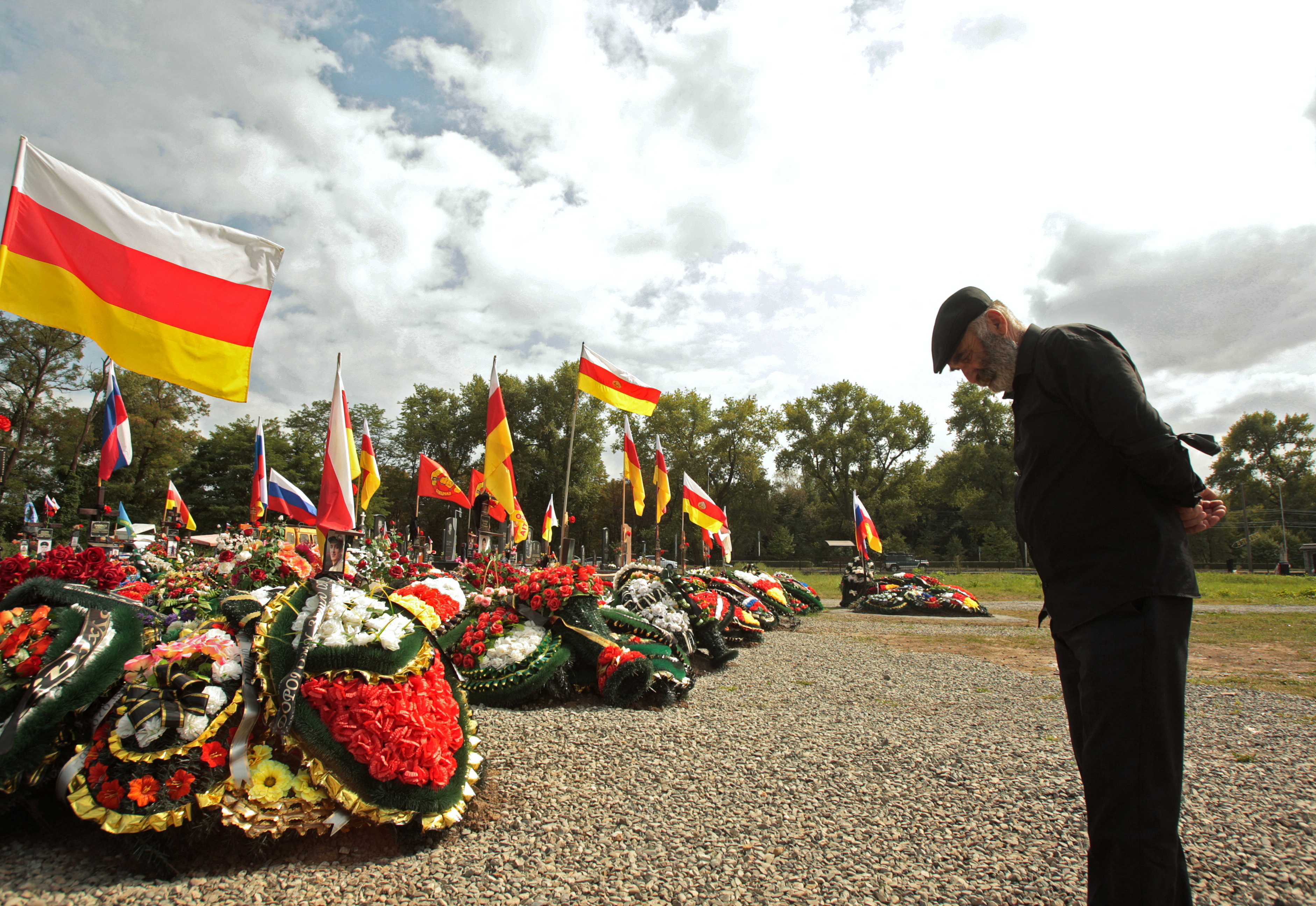
A new cemetery for those killed in the "SVO" on Kartsinskoye Highway, on the outskirts of Vladikavkaz, April 2026
"Nothing personal—we were paid."
The second key source is a veteran in his thirties who underwent several rotations from 2022 to March 2025, including four months with the "Akhmat" formation. (Incidentally, this is further evidence of the inflated number of Chechen residents participating in the "SVO," as the Chechen authorities claim as "their own" everyone who trains at the so-called Special Forces University in Gudermes and is sent through local units of the Russian Ministry of Defense.)
His account of arriving at the front resembles a cattle market: a column of men was unloaded at an abandoned farm, given weapons without ammunition, after which commanders from various units came to "select" the fighters.
His motivation is crystal clear: "I needed to earn money and, preferably, return alive." No ideology, no convictions—pure pragmatism.
He describes a chain of systemic failures: a commander who deliberately filed him as missing in action, expecting to send him on an assault; a chance rescue by an Armenian commander who assigned him a few months of guard duty at a school near Bakhmut; and a subsequent transfer from a unit he describes as composed of criminals. The commander who tried to eliminate him was later demoted to platoon commander, sent on an assault, and killed.
The veteran describes the most dangerous role on the front briefly: "Stormtroopers." When asked why drones or artillery can't do this job, he replies: "Forward—and that's it. You go, and by the time you get there, more than half of them are gone."
Life in the Forest
The description of everyday life is devoid of any romanticism. There are no tents: "A tent will kill you if a shell lands thirty meters away." Pitfalls are dug by hand by seven men, reinforced with logs. There are no first-aid stations: "A soldier is his own medic." He only manages to wash himself on rare days off in the nearest town. In the Zaporizhzhia region, his unit was quartered in the home of an Ossetian family. The locals, he says, "were against us all." Entering the city was only permitted with weapons.
Regarding the "second war"—within his own side—he speaks frankly: "Sometimes the command is so bad that you want to go anywhere, just not stay with them." He describes an incident in which a drunken nationalist contract soldier opened fire on soldiers from ethnic minorities, but didn't hit anyone. The command knew he was "sick, a drug addict," and did nothing.
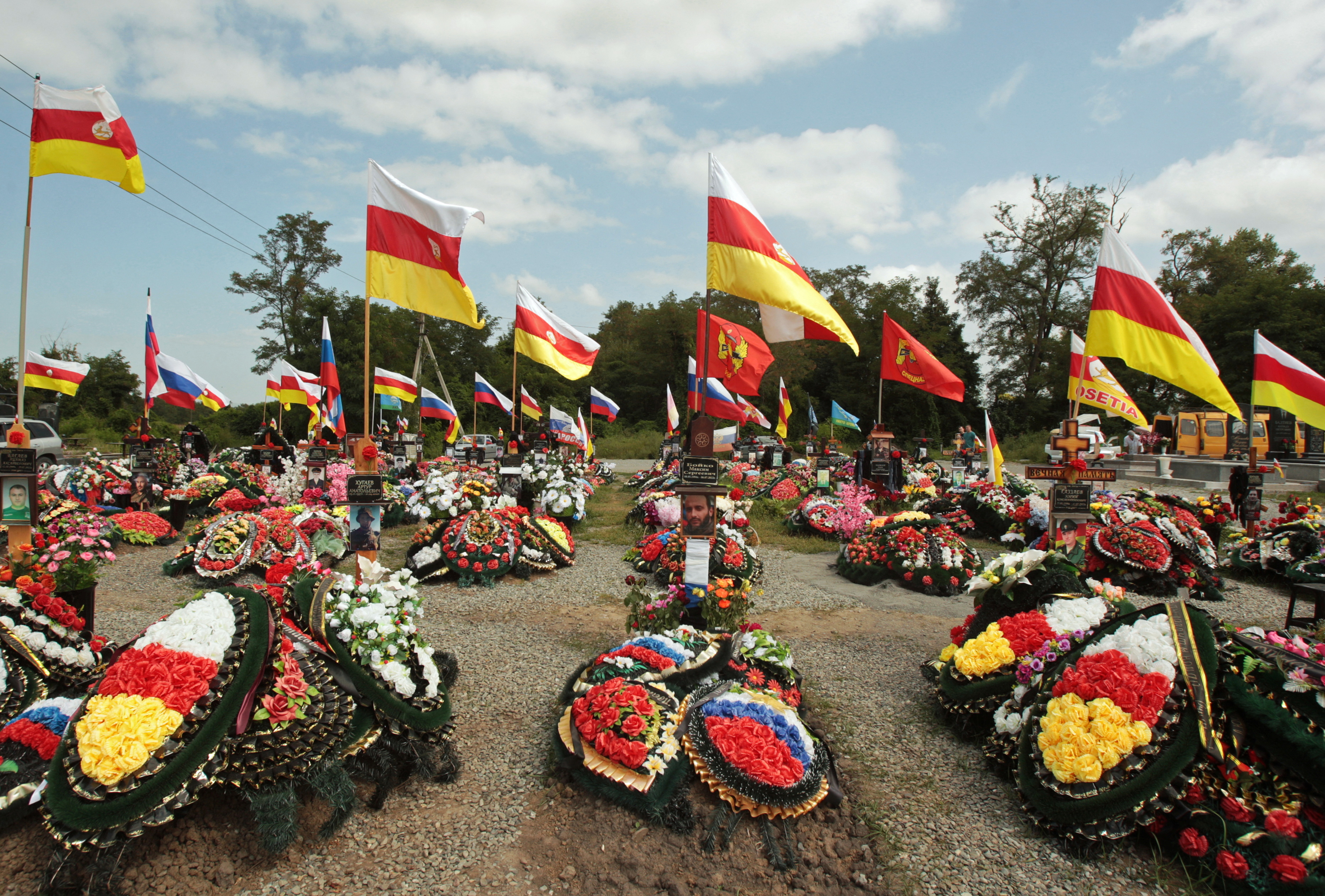
Eastern Cemetery in Vladikavkaz, Photo: Reuters
The Demography of Silence
An anonymous Russian demographer, in a commentary broadcast by TRT in Russian, calls the scale of the mobilization a potential critical breach for this small population. "If these estimates are close to reality, we're talking about an extremely severe blow to the reproductive core," the expert says, describing a chain reaction of consequences: first, a decline in marriages and births; then, the return of veterans with injuries, addictions, and disabilities, making it difficult to start families; and then, in 20-25 years, a demographic "pitfall" when the small generation reaches reproductive age.
Valery Dzutsati, an associate professor of political science at Augusta University in the US, attributes the lack of a noticeable public reaction to a combination of factors: a lack of information, the atomization of society, economic incentives, and the cult of World War II.
"Russia is waging this war largely as a mercenary war. There's a perception that people are going there for the money—and that it's their choice," he says. He also admits that mobilization may be disproportionately higher in regions where protests are unlikely.
"From the center's perspective, it's logical to send more non-Russians to the front—especially from regions where protests aren't expected," Dzutsati says in an interview with the publication.
Political journalist Ruslan Totrov goes further, arguing that Ossetia's high involvement is linked to a deep historical assimilation into the Russian imperial project and a collective identity built around military heroism.
"Ossetia is the most assimilated people in the Caucasus, loyal servants of the Russian Empire, essentially its vanguard," he says. According to him, the consequences will be long-term: "I'm not sure that after all this, Ossetia will be able to recover at all. Not only as a biological project, but also as a political one."
A new cemetery for those killed in the "SVO" on Kartsinskoye Highway, on the outskirts of Vladikavkaz, April 2026
Growing Dissent – in the Comments
The investigation also documents the emergence of a new online discussion among Ossetians, sharply at odds with the official agenda. In a March 2026 Facebook discussion, blogger Timur Tskhurbati wrote that "funeral billboards along the roads are becoming commonplace" and called for a ban on sending men without children to the front. Commentator Igor Kudziev demanded that the head of the republic publicly advocate for an end to recruitment: "Ossetians have paid in full for the 'Russian world.'" Another participant in the discussion stated that "Ossetia is destroying itself under the false slogans of defending its native land—it is not native, but foreign."
In July 2024, more than ten Ossetian public organizations signed an open letter to the head of the region, Sergei Menyailo, calling on Vladimir Putin to ban the recruitment of Ossetians for war and to carry out the early demobilization of those already at the front.
The letter directly referenced the 1944 precedent, when, as the authors claimed, the Soviet leadership allegedly acted to "preserve the gene pool of small peoples." TRT in Russian adds a clarification: in reality, in 1944, the Soviet state deported and exterminated these peoples, not protected them.
68-year-old David Beriev visits the grave of his son Vitaly, a Russian serviceman killed in Ukraine, at the Eastern Cemetery in Vladikavkaz, August 2022. Photo: Reuters