North Caucasus Regions Rank Worst in Russia for Salary Trends

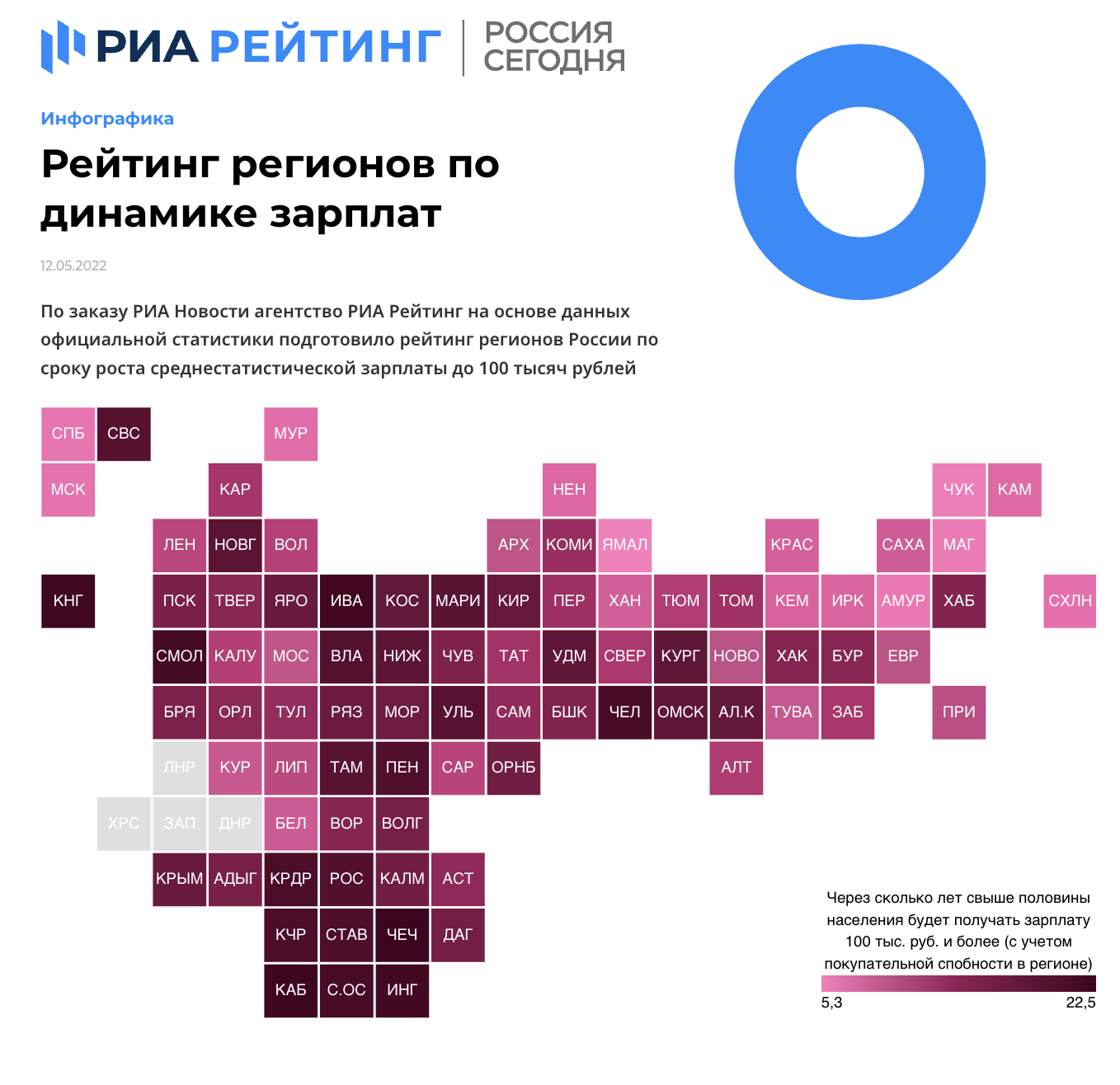
On May 12, the RIA Rating agency published a ranking of Russian regions based on salary trends. Using statistical data, researchers calculated how many years it would take for each region to earn half its workers 100,000 rubles per month. Seven regions of the North Caucasus were in the bottom ten.
Ingushetia ranks last, 85th. In the republic, it would take 15.4 years to reach a median salary of over 100,000 rubles. (Unlike the average salary, which is calculated taking into account the extremes, i.e., the highest and lowest incomes, the median salary is based on data more closely representative of the income of the majority of the population.)
Chechnya ranked 84th. Here, half of the workforce would reach a salary of 100,000 rubles in 13.9 years.
Dagestan ranks third from the bottom (10.8 years). It is followed by Kabardino-Balkaria (10 years), North Ossetia (9.5), Crimea (9), Karachay-Cherkessia (8.9), Ivanovo Oblast (8.2), Kalmykia (7.9), and Sevastopol and Stavropol Krai (7.8 years each).
The best wage dynamics are traditionally observed in the Yamalo-Nenets Autonomous Okrug, where half of the workforce already earns over 100,000 rubles per month. It will take 3.7 years for 75% of the working-age population to reach this level.
The Chukotka, Khanty-Mansi, and Nenets Autonomous Okrugs, as well as Magadan Oblast, are also among the top five by median wage. In all these mining regions, it will take less than two years for half of the workforce to reach 100,000 rubles in wages.
Moscow is in 14th place (4 years). The Ukrainian territories, the LPR, and the DPR are not included in the ranking. As Novy Dosh reported, last year RIA Rating recorded the Caucasus's negative leadership in two other indicators: the lowest wages and the highest unemployment rate in the country. Thus, in 2024, the average salary in small and medium-sized towns in Chechnya was 29,800 rubles, in Ingushetia – 32,700, in Dagestan – 34,700, in the Kabardino-Balkarian Republic – 37,300, and in the Karachay-Cherkess Republic – 40,600 rubles. In large cities, salaries are, on average, 13% higher than in the provinces.

Последние новости
Russian interest in trips to Chechnya has grown by 15% over the past year
Society
Russian interest in trips to Chechnya has grown by 15% over the past year
28 October 2026

Russians are increasingly choosing Chechnya as a travel destination, with the number of trips to the republic rising by 15% over the past year. This is according to a joint study by the mobile operator MegaFon and the online booking service Ostrovok, which focuses on tourism in regions with a distinct cultural character.

Armenia Reaffirms Reluctance to Return to CSTO Following Bordyuzha’s Call for Its Expulsion
Politics
Armenia Reaffirms Reluctance to Return to CSTO Following Bordyuzha’s Call for Its Expulsion
28 October 2026

Armenia has no intention of resuming its participation in the Collective Security Treaty Organization (CSTO). This was stated by the country’s Foreign Minister, Ararat Mirzoyan, on October 28, in response to a suggestion by the organization’s former Secretary General, Nikolai Bordyuzha, that Yerevan should be expelled from the bloc.

Two pro-Kremlin figures from Georgia living in Russia aim to unite the peoples of the two countries
Politics
Two pro-Kremlin figures from Georgia living in Russia aim to unite the peoples of the two countries
28 October 2026

On October 28, the "Unity of Russians and Georgians" foundation will be unveiled in Moscow. Its founders include former Georgian Prosecutor General Otar Romanov-Partskhaladze and Nikolai Kartozia, while Mamuka Pipia—leader of the pro-Kremlin movement "Solidarity for the Sake of Peace"—has been appointed as its chairman. Pipia discussed the creation of the organization in an interview with the outlet "MIR-info."

The Netherlands to Fund Efforts to Find People Missing in the Karabakh Wars
Human rights
The Netherlands to Fund Efforts to Find People Missing in the Karabakh Wars
27 October 2026

The Netherlands will provide new financial assistance to support efforts to locate people who went missing during the Armenian-Azerbaijani conflict. The funding will be channelled through the International Commission on Missing Persons (ICMP), which works to locate burial sites, identify human remains and develop mechanisms to establish the fate of missing people.