Reporters Without Borders (RSF) has warned of China's hidden strategy of influencing media in Georgia
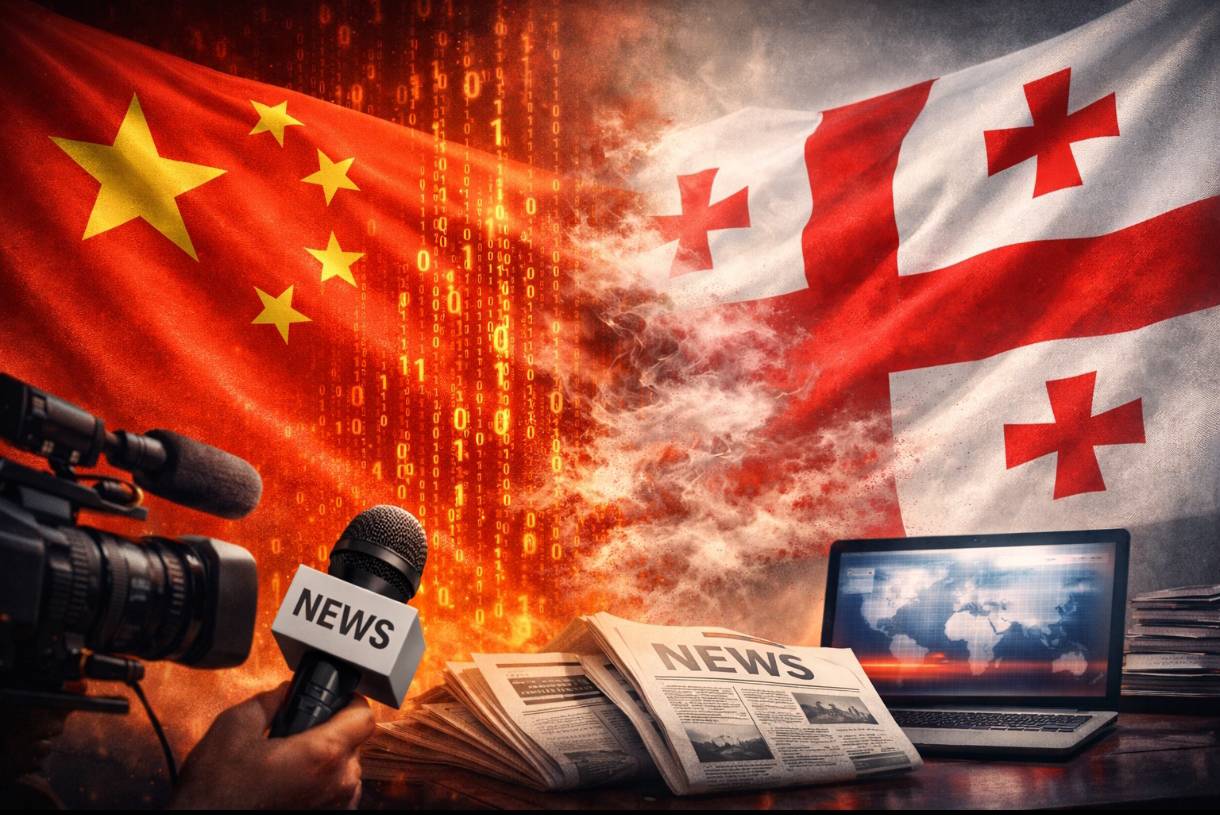
The international organization Reporters Without Borders (RSF) warns of China's gradual strengthening of its influence over Georgia's information space. According to RSF's analysis, since 2022, Beijing has not created its own media outlets in the country, but has instead operated through local platforms—primarily pro-government or pro-Kremlin.
The organization notes that this model of "diffuse influence" is particularly effective against the backdrop of the weakening of independent media. It promotes authoritarian narratives and undermines media pluralism.
The researchers cite the "Chinese Panorama" program on the Georgian television channel "Objective TV" as a prime example. The program consists almost entirely of content from the Chinese state-owned China Media Group and is dedicated to showcasing China's achievements—economic, cultural, and diplomatic. However, topics related to human rights or protests are absent.
According to RSF, the channel received funding from the Chinese Embassy in Georgia, despite a ban on foreign funding of television and radio broadcasters (except for advertising) in the country since April 2025. However, the authorities have taken no action against Obiektiv TV, despite parallel investigations into independent media outlets under similar suspicions.
"Beijing has no need to establish its own media organizations in Georgia: it uses local media to relay its narratives. This interference isn't limited to disinformation, but also takes the form of the subtle incorporation of a foreign state's official narrative into local media content and opaque relationships with some of them to increase their influence," said Jeanne Cavelier, head of RSF's Eastern Europe and Central Asia desk.
Experts note that Chinese influence is growing alongside Russia's already-existing influence. Following the outbreak of war in Ukraine and the rise of anti-Western rhetoric in Georgia, Chinese narratives have become more prominent, and local media have increasingly reprinted materials from the English-language newspaper Global Times, which is affiliated with the Chinese Communist Party.
As researchers emphasize, such publications are often disseminated without attribution to Russian sources, despite their content largely echoing Kremlin talking points. This indicates the emergence of a media environment in which Chinese and Russian propaganda mutually reinforce each other. An additional factor was the signing of a strategic partnership agreement between Tbilisi and Beijing in 2023, which expanded cooperation in various areas and strengthened China's presence on the public agenda.
RSF also notes the overlap between Chinese rhetoric and statements by individual Georgian politicians who present Beijing as an alternative to the West. Three key narratives circulating in the media space stand out: the image of China as a partner respectful of sovereignty, its role as a potential mediator in territorial issues, and the idea of Georgia as a "bridge" between East and West.
Against this backdrop, the overall state of the media environment in the country is deteriorating. According to the organization, more than 600 violations of journalists' rights were recorded from October 2024 to November 2025. Over the past two years, Georgia has fallen to 114th place out of 180 countries in the world press freedom index. In these conditions, Reporters Without Borders warns, foreign influence strategies are gaining fertile ground for further consolidation in the Georgian information space.