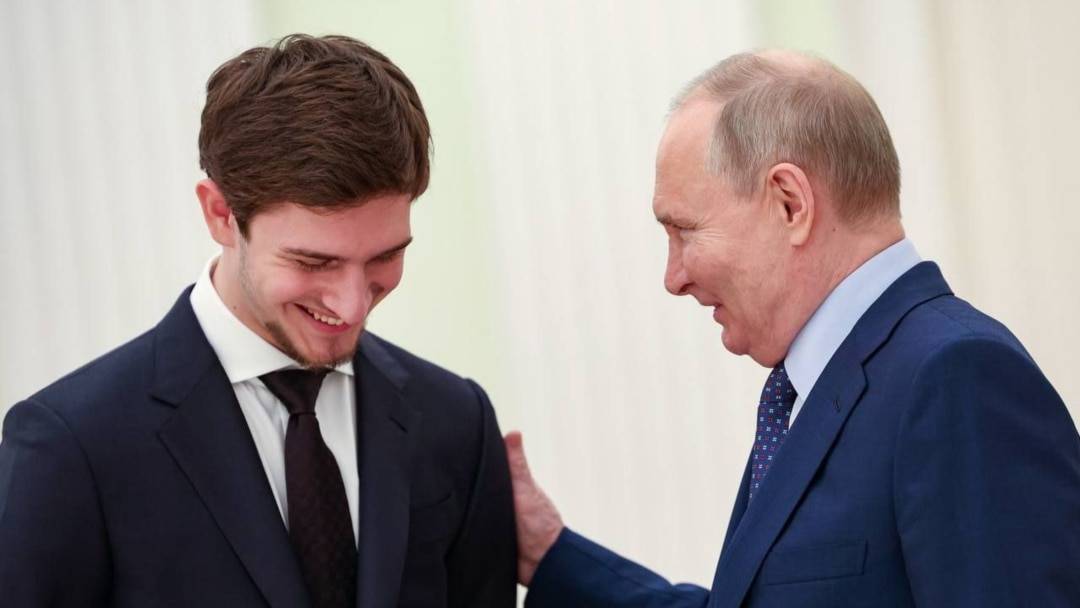
Kadyrov’s son obtained Serbian citizenship under the surname Musayev; the Anti-Corruption Foundation (FBK) is calling for his passport to be revoked
Ali, the second son of Chechen leader Ramzan Kadyrov, has obtained Serbian citizenship using documents issued under the name Ali Ramzanovich Musayev. This is according to an investigation by the Anti-Corruption Foundation (FBK), published on Alexei Navalny’s YouTube channel. Investigators state that the younger Kadyrov has been using this surname for years to travel abroad, and his new Serbian passport now allows him to enter the Schengen Area without a visa.
The decision to grant citizenship was made on July 10, 2025, and signed by Serbian Prime Minister Đuro Macut. The country’s official state gazette lists the recipient as Ali Ramzanovich Musayev, born on December 14, 2006, in the Chechen village of Tsentoroy. He was 18 years old at the time.
The FBK noted that his date and place of birth, as well as his first and patronymic names, match those of Ali Kadyrov. The investigators assert that no separate individual with these details exists; rather, the surname "Musayev" is used by members of the Chechen leader’s family for international travel.
Furthermore, the outlet *Agentstvo* reported that Ali Kadyrov officially changed his surname to Musayev through a Chechen civil registry office in December 2024. Thus, the investigation concerns not merely a coincidence of personal data, but the deliberate use of this surname as an alternative identity for members of the Kadyrov family.
According to the FBK, Ali Kadyrov has taken more than 100 international flights—mostly to Dubai—under the surname Musayev. He typically traveled via private jet. According to the investigators, similar documents exist for other family members: Ramzan Kadyrov’s wife, Medni; his sons, Adam and Akhmat; and his daughter, Tabarik.
“No such person as Ali Ramzanovich Musayev exists, nor has one ever existed,” the authors of the investigation stated, after comparing information from the Serbian official gazette with the biographical details of the Chechen leader’s son.
Other members of the Russian establishment have also obtained Serbian passports. The Anti-Corruption Foundation (FBK) identified several new Serbian citizens, including relatives of defense industry owner Nikolai Kolesov; MMA fighter and United Russia party member Fedor Emelianenko; Makhachkala City Assembly deputy Muslim Amiraslanov; Gazprombank First Vice President Elena Burmistrova; and Yevgeny Zobnin, an aide to State Duma deputy Alexander Babakov.
Citizenship was also granted to relatives of Chechen businessman Musa Bazhayev and family members of Natalya Shevchik, a United Russia deputy and deputy chair of the Tyumen Regional Duma. According to the FBK, some of Kolesov’s relatives hold stakes in defense enterprises that are currently under sanctions.
The investigators point out that Serbian law allows for a simplified naturalization process for foreigners deemed to be of “special interest” to the republic. In such cases, applicants are exempt from the standard naturalization procedure, which typically requires obtaining a residence permit and waiting several years. It was on this basis that the Serbian authorities made their decision regarding Ali Musayev.
The scale of this practice has also been examined by the investigative unit of Radio Free Europe/Radio Liberty. According to their findings, more than 300 Russian citizens have obtained Serbian citizenship since the beginning of 2022 through a procedure linked to the country’s national interests. Among them were individuals subject to international sanctions.
The Anti-Corruption Foundation (FBK) is demanding that the decision to grant citizenship to Ali Kadyrov be overturned and his Serbian passport revoked. The foundation also intends to push for a review of other instances where citizenship was granted to Russians linked to the Russian authorities, the defense industry, or corrupt schemes. The organization plans to submit formal requests regarding these matters to the Serbian authorities and representatives of the European Union.
This is not the first time that Serbian authorities have revisited a decision to grant citizenship to Kadyrov’s relatives. In April 2026, the Serbian government rescinded a previous decision to naturalize his nephew, Yakub Zakriev. This action followed, by just four days, the emergence of reports in the media regarding the citizenship that had been granted to him.