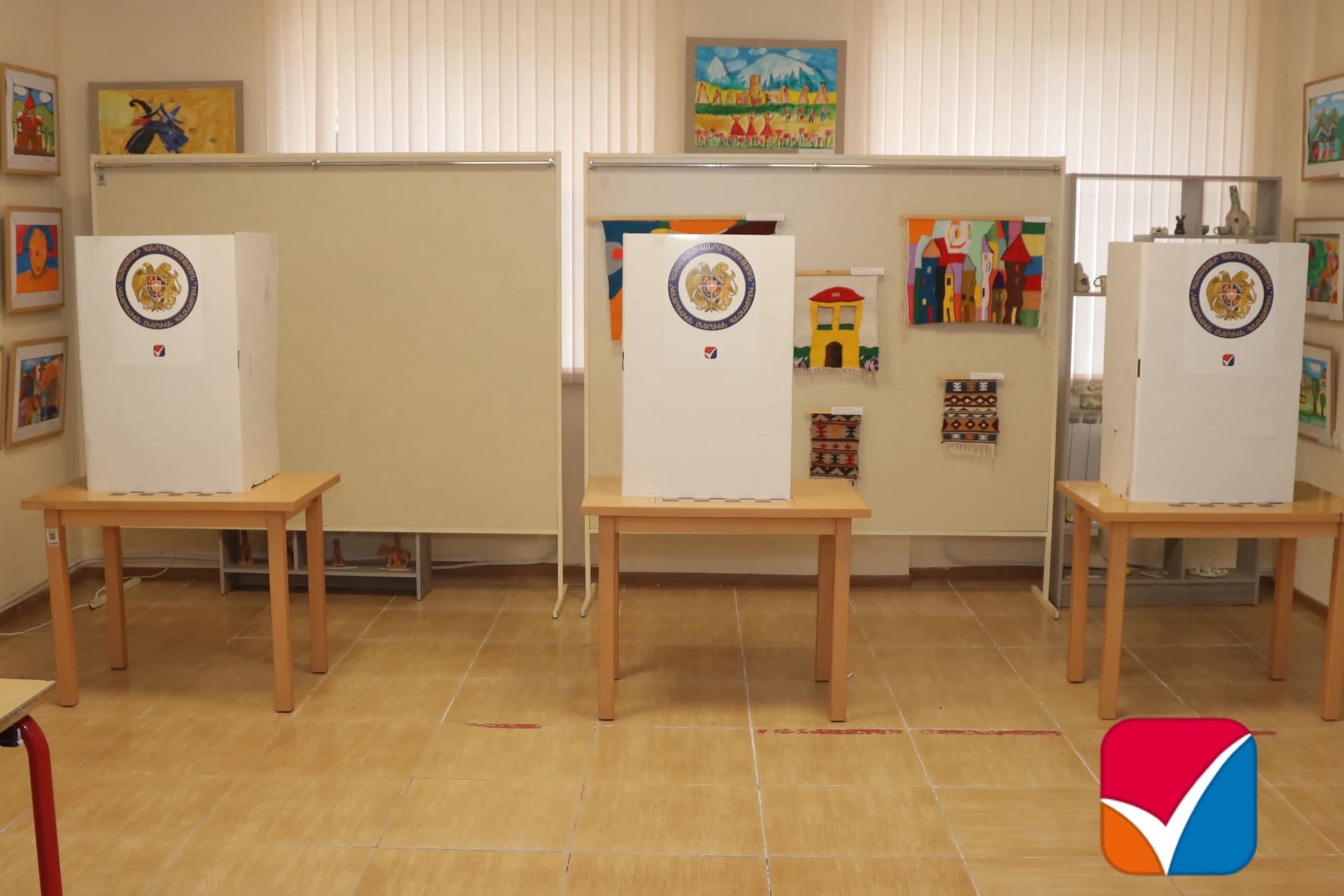
Local government elections are being held in 21 communities (municipalities) across Armenia. In five communities, Prime Minister Nikol Pashinyan’s ruling Civil Contract party is running unopposed. The highest voter turnout was recorded in Stepanavan, where 58.36% of eligible voters had cast their ballots by 5 pm.
Voting is taking place in ten provinces across the country. In 19 communities, members of local councils are being elected under the proportional representation system, while in Fioletovo and Shamiram the majoritarian system is being used. Polling stations opened at 8 am and are due to close at 8 pm.
According to Armenia’s Central Electoral Commission, voter turnout in Stepanavan stood at 37.95% by 2 pm. Over the following three hours, it rose by more than 20 percentage points. By 5 pm, turnout in Tsaghkadzor had reached 49.88%, followed by Yeghegnadzor at 49.74%, Meghri at 45.75% and Artik at 44.72%. The lowest turnout was recorded in Fioletovo, where 16.60% of eligible voters had cast their ballots by that time.
One of the defining features of this election campaign has been the reduced number of political forces taking part. In Armavir, Vardenis, Garni, Akhuryan and Vayk, Civil Contract is the only party contesting the elections. In 11 of the 19 communities, the number of competing parties has fallen compared with the 2021 elections, according to the news outlet 1in.am. In addition, 28 candidates have withdrawn from the race.
Local analysts attribute this to organisational problems within the opposition and its limited capacity to run campaigns in the regions. Political commentator Hakob Badalyan told Panorama.am that some opposition forces may have decided not to participate because they do not expect to win and are unwilling to spend resources on campaigns with little prospect of success. In his assessment, the opposition is hampered by weak organisational structures and an insufficient presence on the ground.
Opposition representatives, meanwhile, have complained of alleged pressure on their candidates. Kristine Vardanyan, a member of the Armenian Revolutionary Federation (Dashnaktsutyun), told CivilNet that pressure was being exerted not only on candidates on opposition lists but also on their relatives. In some cases, she said, this had caused problems with their employment. Representatives of other opposition groups have also reported attempts to persuade candidates to withdraw from the elections.
On election day, Armenia’s Central Electoral Commission called on politicians, the media and other participants in the electoral process to refrain from statements and publications that could be considered election campaigning or counter-propaganda.
“The Central Electoral Commission of the Republic of Armenia calls on political figures, the media and other participants in the electoral process to refrain, until voting ends at 8 pm, from making statements or distributing materials that could be perceived as election campaigning or counter-propaganda,” the commission said in a statement.
According to Armenpress, by 5.45 pm Armenia’s Ministry of Internal Affairs had received 13 reports of possible electoral violations. No details were provided about the incidents or the communities in which they allegedly occurred.
Ahead of the elections, Armenia’s Anti-Corruption Committee carried out investigative actions in cases involving alleged voter bribery. In particular, Arsen Gevorgyan, a candidate representing the Strong Armenia party, was detained in Stepanavan. He is accused of bribing voters. Party representatives reject the allegations and claim that the case is politically motivated. The Anti-Corruption Committee has declined to disclose further details, citing the interests of the preliminary investigation.