Exhibition on Deportation of Meskhetian Turks Opens in Baku
An exhibition titled Meskhetian Turks — In the Footsteps of a Lost Exile, dedicated to the 1944 deportation of Meskhetian Turks from their ancestral homeland and their subsequent dispersal across different countries, has opened in Azerbaijan’s capital, Baku.
The exhibition, organised by Turkey’s Ministry of Foreign Affairs and the International Union of Meskhetian Turks (DATÜB), is being held at the National Museum of History of Azerbaijan. Baku is the second venue for the project after Istanbul.
The opening ceremony was attended by Turkey’s ambassador to Azerbaijan, Birol Akgün, Azerbaijan’s deputy culture minister Saadat Yusifova, DATÜB chairman Ziyatdin Kassanov, lawmakers, academics and other guests.
Akgün said the exhibition not only tells the story of the deportation but also preserves the memory and identity of the Meskhetian Turkish people, their longing for their homeland and their determination to endure despite the hardships they have faced.
“We, the Turks of Turkey and Azerbaijan, regard the historical pain of our brothers as our own shared pain. As we have done yesterday and today, we will continue tomorrow to stand together with our suffering but proud brothers,” the ambassador said.
Kassanov, meanwhile, thanked Turkey, Azerbaijan and other Turkic states for accepting and supporting Meskhetian Turks following their deportation.
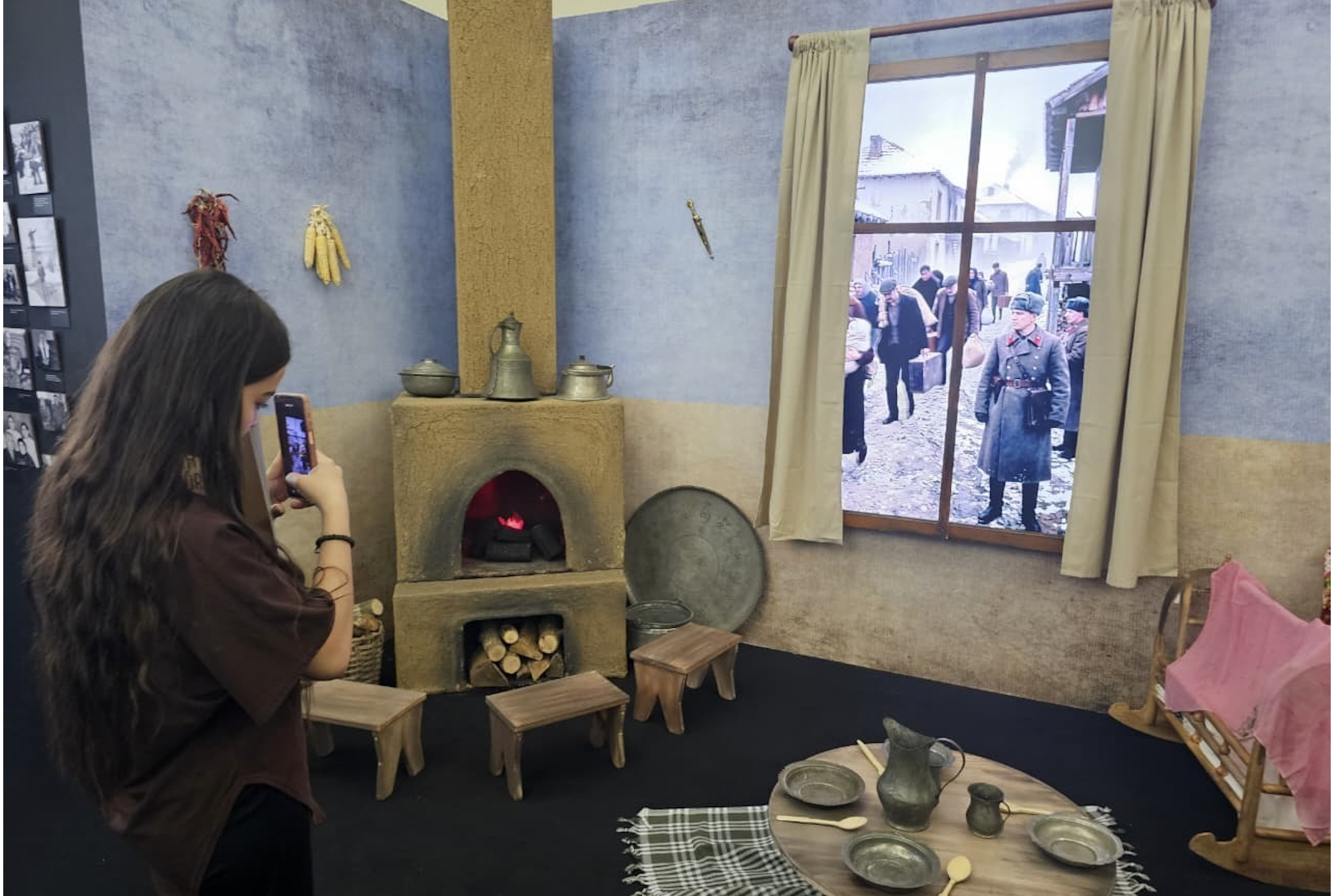
The exhibition consists of seven sections and presents the deportation of Meskhetian Turks in its historical and cultural context. It combines digital art, sound, video and interactive elements, presenting the deportation not only as an event of the past but also as part of a collective memory that remains relevant to present and future generations.
The first section focuses on the history of Meskheti and the political developments in the region. The second recreates the morning of November 14, 1944, when Soviet soldiers arrived at a Meskhetian Turkish family’s home and ordered its residents to leave, giving them two hours to pack.
The following sections depict the transportation of people to railway stations and their departure in trains to unknown destinations.
The final section features a contemporary map showing the countries where Meskhetian Turks live today, along with data on their population and living conditions.
A willow tree growing in Meskheti is one of the exhibition’s symbols. In Meskhetian Turkish culture, the image of the tree is associated with exile, renewal and the ability to take root again in a new place.
The organisers say the project aims to preserve the collective memory of the deportation and raise international awareness of the history of the Meskhetian Turks.
The exhibition first opened on June 12 at the Atatürk Cultural Centre in Istanbul, with the participation of Turkish Foreign Minister Hakan Fidan. Beste Gürsu is the author and curator of the project, while composer Fahir Atakoğlu wrote the music specifically for the exhibition.
The exhibition will remain open in Baku until August 28. Its next presentation is scheduled for November 14, 2026, the anniversary of the deportation of the Meskhetian Turks. It will be held at Ankara’s historic Old Railway Station.
The 1944 deportation
The deportation of Meskhetian Turks began on November 14, 1944. Under a decision of the Soviet State Defence Committee signed by Joseph Stalin, the population of Meskheti and neighbouring areas was forcibly expelled from the Georgian Soviet Socialist Republic. The operation was carried out by the NKVD under Lavrentiy Beria.
More than 90,000 people were deported, primarily to Uzbekistan, Kazakhstan and Kyrgyzstan. They were transported in freight trains, and many died during the journey and in the first years following their resettlement.
In recent years, the issues of deportation, forced displacement and historical memory have become increasingly prominent in Azerbaijan’s public and political discourse.
In December 2025, an international conference on the cultural heritage and right of return of Azerbaijanis expelled from Armenia was held in Baku with government support. In an address to participants, President Ilham Aliyev specifically referred to deportations and mass violence that, according to Baku’s position, Azerbaijanis had faced during the 20th century.
In July 2026, the agenda expanded to another historical issue. At the international conference Cultural and Ethnic Diversity: Lessons from History, Contemporary Challenges in Shusha, participants raised the issue of the mass expulsion of Circassians from the Caucasus in the 19th century and called on Russia to recognise those events as genocide. The conference also featured criticism of Russia’s contemporary nationalities policy.
The conference prompted a strongly negative reaction in parts of Russia’s expert and political communities, where it was described as an initiative directed against Moscow.
The opening in Baku of an exhibition on the deportation of Meskhetian Turks adds another sensitive historical issue to the relationship between Russia and Azerbaijan. Unlike the Circassian issue, this concerns events during the Soviet period: the forced deportation of the Meskhetian Turks was carried out directly by the Soviet authorities under Stalin. Moscow has so far issued no official response to the opening of the exhibition.