Russian Supreme Court bars country's only anti-war party from parliamentary election
Russia's Supreme Court has cancelled the registration of the federal candidate list of the liberal Yabloko party for September's State Duma elections, removing the country's only officially registered political party that openly opposes the war in Ukraine. The ruling has not yet entered into force and can still be appealed.
The court granted a lawsuit filed by the pro-Kremlin nationalist party Rodina, led by State Duma lawmaker Alexei Zhuravlev. Prosecutors supported the request to remove Yabloko from the ballot.
Yabloko chairman Nikolai Rybakov said the party would appeal the decision.
"Excluding Yabloko from the election means refusing dialogue with people who ask questions the authorities do not want to answer," he said after the hearing.
The case lasted most of the day. Rodina accused Yabloko of violating campaign finance rules and intellectual property legislation, while also raising allegations related to extremism and what it described as "LGBT propaganda."
Among other claims, the plaintiffs argued that Yabloko had unlawfully used the phrase "If only there were no war" from playwright Alexander Volodin's Five Evenings without permission from the copyright holder. They also alleged that the party's logo improperly borrowed elements from El Lissitzky's iconic poster Beat the Whites with the Red Wedge.
Rodina further claimed that Yabloko had received undeclared campaign support, including from foreign sources, and spent around 88 million roubles (about $1.1 million) on online campaigning outside legally designated election funds.
Yabloko rejected all allegations. Rybakov said no evidence had been presented to support the claims and described the proceedings as an unconstitutional attack on freedom of thought and an attempt by political rivals to eliminate an opponent.
Although prosecutors supported removing the party from the election, they rejected Rodina's allegations of extremism, saying no evidence had been presented to substantiate them.
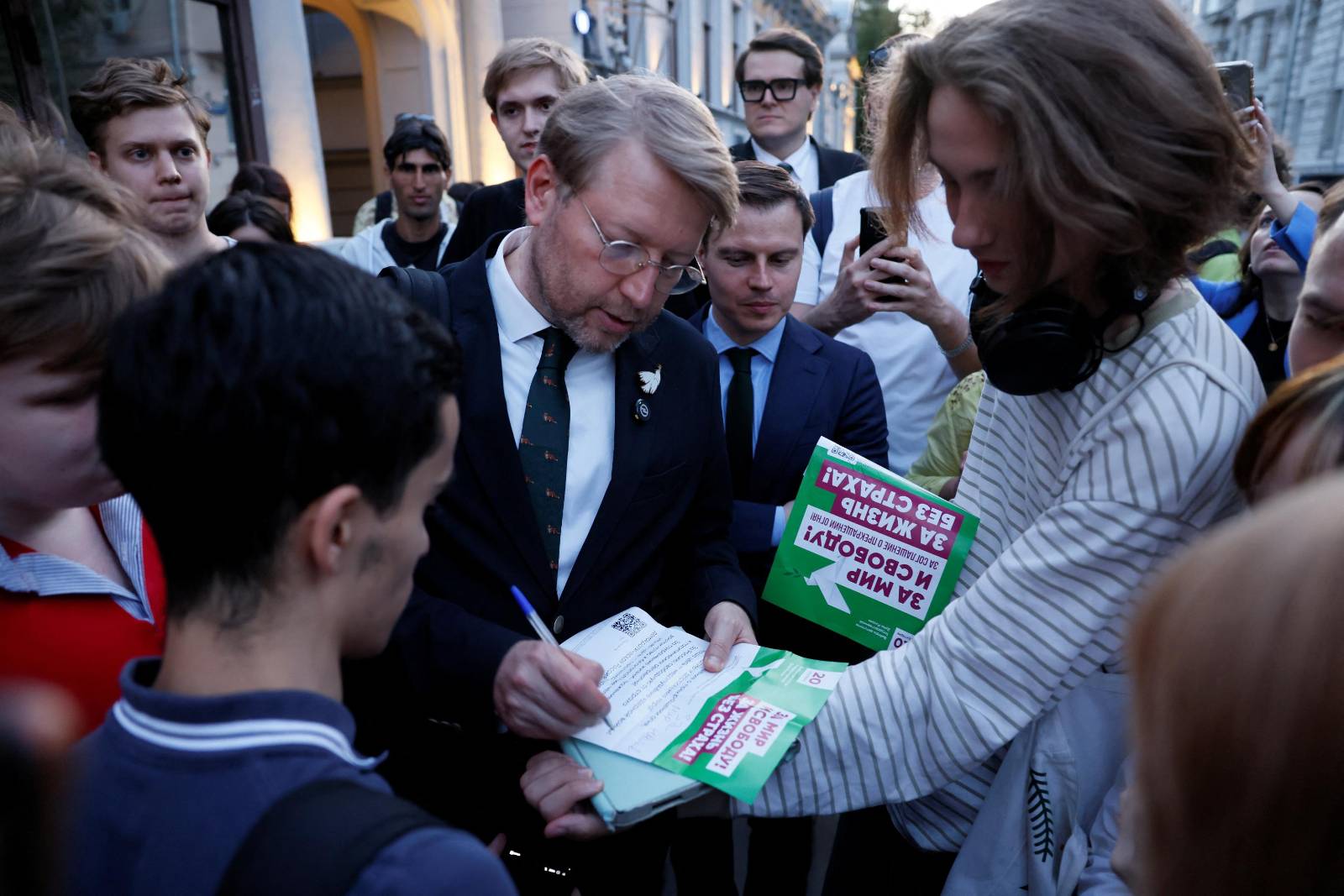
Several hundred Yabloko supporters gathered outside the Supreme Court during the hearing. Reuters reported that many were young people. Some carried apples—the party's symbol—while one demonstrator was wrapped in the Russian flag. Police monitored the gathering.
One supporter, identified only as Yevgenia, told Reuters she wanted to demonstrate that many Russians continued to support ending the war.
"We believe it is important to show that there are many of us and that we stand together in supporting this party because we all want peace," she said.
Rybakov said the court ruling reflected the authorities' concern over growing public demand for peace.
"It is obvious that the demand for peace and freedom has become much stronger than the authorities expected," he said.
According to a July survey by the independent Levada Center—which Russian authorities have designated a "foreign agent"—66% of respondents said they supported the actions of Russia's armed forces in Ukraine, the lowest level recorded since February 2022. At the same time, accurately measuring anti-war sentiment in Russia remains difficult because public criticism of the war can result in criminal or administrative prosecution.
Russia's only registered anti-war party
Since Russia launched its full-scale invasion of Ukraine on Feb. 24, 2022, Yabloko has consistently called for an immediate ceasefire and a negotiated political settlement. Throughout the war, it has remained the only officially registered political party in Russia to publicly oppose the continuation of the conflict.
All other parties represented in the State Duma have backed Russia's invasion and related government policies.
Once one of Russia's leading liberal political movements, Yabloko no longer holds seats in the federal parliament but retains a limited presence in regional and municipal legislatures.
The space for legal anti-war political activity in Russia has continued to shrink. In July, opposition politician Boris Nadezhdin, who attempted to campaign on an anti-war platform, was designated a "foreign agent" by Russian authorities before later leaving the country.
Longstanding opposition to the Chechen wars
Yabloko's anti-war position predates Russia's invasion of Ukraine by decades.
The party opposed the use of military force during the First Chechen War. After Russian troops entered Chechnya in December 1994, Yabloko lawmakers led by party founder Grigory Yavlinsky publicly condemned the campaign and travelled to Grozny for negotiations.
Following those talks, Chechen President Dzhokhar Dudayev agreed to hand over the bodies of Russian soldiers killed during the failed assault on Grozny on Nov. 26, 1994, as well as several servicemen captured during the operation whom, according to Yabloko, the Russian authorities had effectively abandoned.
The party continued to advocate a political settlement throughout the conflict and remained critical of federal military operations during the Second Chechen War, a stance that put it at odds not only with the Kremlin but also with other parties identifying themselves as democratic or liberal. The Union of Right Forces (SPS), whose leaders included Boris Nemtsov, Sergei Kiriyenko and Anatoly Chubais, supported the second military campaign. Chubais accused Yavlinsky of betraying Russia, declaring that "the Russian army is being reborn in Chechnya."
Yabloko still maintains branches across the North Caucasus
Despite its declining role in national politics, Yabloko continues to operate regional branches throughout the North Caucasus, including in Dagestan, Ingushetia, Chechnya, North Ossetia, Kabardino-Balkaria, Karachay-Cherkessia and Stavropol Krai.
The party's regional organisations have repeatedly reported pressure from the authorities.
In North Ossetia, the regional branch was dissolved following a lawsuit by the Justice Ministry before being reinstated after a court ruled in 2013 that the ministry had acted unlawfully.
Party activists in Dagestan have also reported repeated harassment. In 2012, police surrounded the party's office in Makhachkala and detained regional leader Artur Babayev. He was detained again in 2015 together with his brother. According to Yabloko, police informed him that he had been placed on a preventive watch list until 2060. Another Dagestan activist, Nametkhan Babayev, was later detained. At the time, the party's federal leadership said there were no legal grounds for the actions taken against its members.
The Supreme Court's decision affects not only Yabloko's federal election campaign but also a political party that continues to maintain organisational structures across the North Caucasus and has consistently opposed both the Chechen wars and Russia's full-scale invasion of Ukraine.
Yabloko has said it will appeal the ruling.