Armenian Prime Minister's Visit to Russia: Putin and Pashinyan Talked "Frankly and Directly" and Trolled Each Other a Little
Armenian Prime Minister Nikol Pashinyan is visiting Moscow. This is his 32nd visit to the Russian capital since 2018 and his first this year.
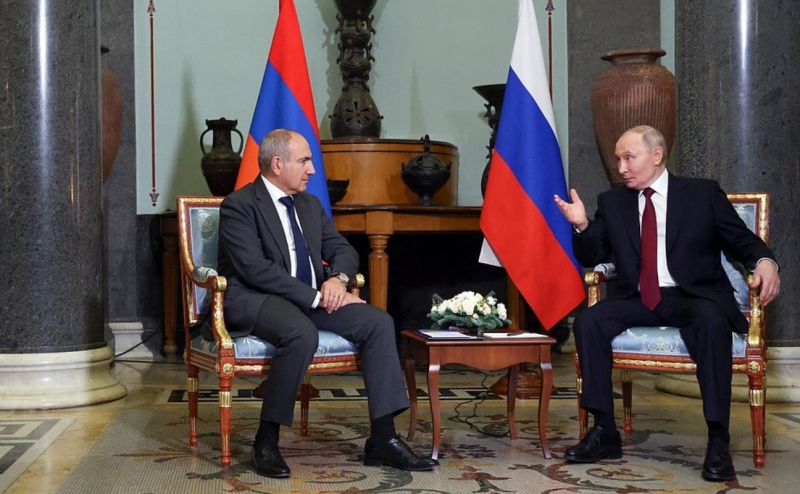
On April 1, the Armenian guest held talks with Russian President Vladimir Putin in the Kremlin. Putin told his interlocutor that he was very glad to see him in Moscow. He thanked Pashinyan, emphasizing that their dialogue is always honest.
"We have a dialogue where we always speak honestly and directly," Putin said.
According to media reports, the key topics of the conversation were Yerevan's ties with the EU, Armenia's non-participation in the CSTO, and the country's elections. Several sensitive issues were also reportedly touched upon.
During a discussion of trade and economic relations, Putin noted that by the end of 2025, trade turnover between Russia and Armenia had decreased from $11 billion to $6.4 billion. A significant share of this—approximately $1.2 billion—was made up of agricultural products, including fruits, vegetables, and wine. Despite the decline, the Russian leader emphasized that trade with Armenia still exceeds that with Azerbaijan, viewing this as a sign of the continued importance of bilateral ties. He specifically highlighted energy as a key area of cooperation.
The meeting's political agenda also touched on the upcoming parliamentary elections in Armenia, which will be held on June 7. Putin expressed hope that forces oriented toward cooperation with Russia will be able to participate, noting that the electoral process should not negatively impact relations between the two countries. Pashinyan, for his part, stated that he expects relations to further strengthen following the vote. In response to Putin's comments about the desirability of certain political forces participating in parliamentary elections, Pashinyan emphasized Armenia's commitment to democratic principles and freedom of social media. He stated that only Armenian citizens have the right to participate in elections. He also addressed the absence of political prisoners in Armenian jails in response to the Russian president's comment about the detention of individuals with Russian passports. Putin alluded to Russian citizen and billionaire Samvel Karapetyan, who was held in custody and is now under house arrest in Yerevan on charges of plotting a coup.
Considerable attention was paid to Yerevan's foreign economic policy. Putin pointed to the sharp increase in Armenian exports to the Eurasian Economic Union, which has increased tenfold in recent years, and emphasized that simultaneous participation in customs unions with the EU and the EAEU is impossible. Pashinyan agreed with this, clarifying that full membership in both unions is ruled out, but at the current stage, Armenia is striving to combine various areas of cooperation. He also assured that cooperation with the European Union would not jeopardize relations with Russia. Putin, in turn, expressed hope that the EU and the EAEU would be able to establish cooperation in the future, although he acknowledged that such attempts had been made even before the conflict in Ukraine and had been unsuccessful.
A separate set of talks focused on regional security and relations with Azerbaijan. The Armenian leader thanked Moscow for facilitating the peace process and stated the need to end the independence movement in Nagorno-Karabakh.
"I publicly announced in the Republic of Armenia that we should not continue the 'Karabakh movement,' because peace has already been established between Armenia and Azerbaijan," Pashinyan said.
He noted that US President Donald Trump had contributed to the conflict resolution, adding that Putin "also played and continues to play a key role" in this process.
According to him, the normalization of relations between Yerevan and Baku creates the conditions for more dynamic development of ties with Russia. In this context, he also noted the importance of rail links through Azerbaijan, which contribute to strengthening economic ties.
Tensions also arose during the discussion of Armenia's participation in the pro-Russian military bloc, the Collective Security Treaty Organization (CSTO). Pashinyan explained the suspension of membership by citing the inability to justify to his people the bloc's inactivity in the Karabakh crisis. Putin called "everything related to Karabakh" "the most sensitive issue," emphasizing that Moscow is aware of Yerevan's grievances against the CSTO. He recalled that in Prague in 2022, Armenia itself recognized Karabakh as part of Azerbaijan, so it would be inappropriate for the bloc to interfere in a process that "has acquired an intra-Azerbaijani dimension." Nevertheless, Putin believes that recognizing Karabakh as part of Armenia "made sense"—"from the standpoint of organizing peaceful life." He added that now, thanks to the efforts of Pashinyan and Azerbaijani President Ilham Aliyev, "it has been possible to stabilize relations."
Interestingly, before his planned visit to Moscow on Wednesday, Pashinyan posted a mysterious video on his social media profiles titled "Not a Wiretap 18+3+3." In the video, he mimes talking on a cell phone and says the following: "No, brother, I can't give you these three, frankly speaking, because I've decided to give these three to the people. Those other three? Those other three, frankly speaking, I've also decided to give to the people. And the remaining 18, frankly speaking, I've also decided to give to the people. Well, basically, they've already been given; they're leaving with their travel vouchers in hand. Okay, friend, okay."
According to social media users, the video may have been published in the context of the upcoming parliamentary elections.