Beslan, 22 Years On: Remembering the Tragedy and the Debate Over Its Investigation
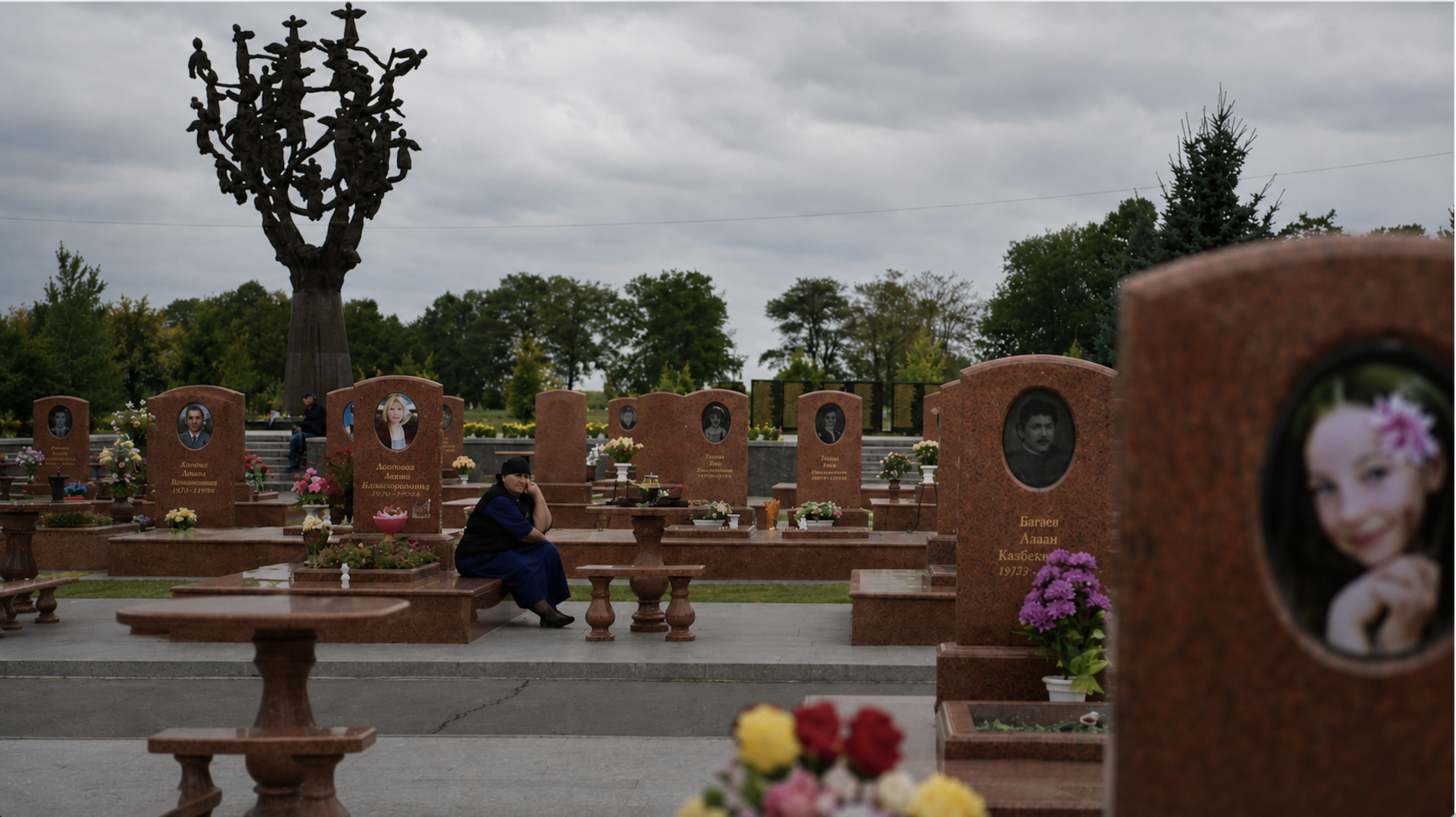
A three-day vigil in memory of the victims of the terrorist attack on School No. 1 ended in Beslan on Wednesday. The commemorations began on September 1, the anniversary of the school siege, and concluded on September 3, marking the anniversary of the operation to free the hostages. The main events were held at the former school building and at the City of Angels memorial cemetery. At 1:05 p.m. — the time when the first explosions tore through the school’s gymnasium 22 years ago — a minute of silence was observed.
On the first day of the vigil, the Mothers of Beslan committee held its traditional annual press conference. Members spoke about the ongoing investigation, assistance for former hostages, efforts to preserve the memory of the tragedy and their campaign to establish a special legal status for victims of terrorist attacks in Russia. One of the new developments in the investigation, according to the committee’s co-chair Aneta Gadiyeva, is that investigators are again examining the number of people involved in the seizure of the school. “Today, investigative authorities are inclined to believe that the total number of terrorists was greater than 32,” she said.
According to the Mothers of Beslan, the investigation gained new momentum after survivors and victims’ relatives met President Vladimir Putin two years ago and subsequently met Alexander Bastrykin, the chairman of Russia’s Investigative Committee. Investigators have also returned to the task of establishing the identities of members of the militant group. Among the dead attackers was previously believed to have been Abu Farukh, a man said to have come from Saudi Arabia. But his identity has not been conclusively established, according to the committee. Gadiyeva said investigators had again sent a request to Saudi authorities.
“Saudi authorities say that he is presumably their citizen, but they have some relatives who could confirm whether it was him, and they refuse to assist our investigative authorities,” she said. “The investigators have now sent another request.”
Committee representatives also said investigators had clarified details surrounding Sultan Gurazhev, a local police officer who was seized by the attackers on their way to North Ossetia. According to the Mothers of Beslan, investigators established that Gurazhev was a third cousin of Ruslan Khuchbarov, one of the leaders of the militant group. Gadiyeva said that during investigative proceedings and in court, Gurazhev had not confirmed the family connection. “It turns out that Gurazhev was Khuchbarov’s third cousin, but for some reason he did not confirm this during investigative proceedings or in court,” she said. “He said that he had simply ended up there by chance.”
The press conference also addressed the health of former hostages and assistance for survivors. According to committee members, a comprehensive rehabilitation program for people who survived the attack has been extended until 2030, while funding for medical treatment has increased. Susanna Dudiyeva, the chair of the Mothers of Beslan, spoke about sanatorium-based rehabilitation and said such assistance was now also available to the children of former hostages. “Sanatorium rehabilitation is, I would say, proceeding successfully,” Dudiyeva said. “There are some problems and some nuances, but these are all issues that can be resolved. It is very encouraging that the children born to former hostages of the Beslan tragedy are now receiving sanatorium rehabilitation.” She added that such rehabilitation was almost unavailable to victims of other terrorist attacks in Russia.
Another issue was the preservation of the memory of the tragedy and the creation of a memorial center on the grounds of the former school. Committee members described the project as one of the results of their long-running work. According to the organization, more than 9,500 people visited the Beslan School No. 1 International Cultural and Patriotic Center for Terrorism Prevention between April and August. Dudiyeva said preserving the school, creating a museum on its grounds and collecting materials documenting the tragedy had been among the committee’s central objectives.
“The Museum-Center for Terrorism Prevention is also the result of the work of the Mothers of Beslan,” she said. “We set ourselves the goal of preserving the school, creating a museum on the school grounds, collecting the full truth about the Beslan tragedy and presenting it in the museum. We also sought to support the construction of a church in the school courtyard. All of this has been achieved.”
The press conference also addressed the development of the museum’s collection and housing for survivors. At the same time, committee members said one of the unresolved issues remained the lack of a special legal status for victims of terrorist attacks in Russia. Elvira Tuayeva, a member of the Mothers of Beslan, said the organization would continue to press for the adoption of such legislation, stressing that it should apply not only to victims in Beslan or North Ossetia. “We will continue to fight for this status,” she said. “Not only for the victims of the Beslan attack. Not only for North Ossetia, where there have been more than 13 terrorist attacks, but for the whole of Russia.”
A sharply different assessment of the events in Beslan 22 years ago — and of what followed the tragedy — was offered during this year’s anniversary by Ella Kessayeva, the head of the Voice of Beslan. In a Facebook post, Kessayeva began by remembering the children and adults who came to the school on the morning of September 1, 2004, but never returned home. She again raised questions which, in her view, have not received full answers over the past two decades.
“It all began in Beslan. Twenty-two years ago, children and adults came to the school in the morning and never returned home. The main question remains: how was this allowed to happen? Why was the school left unprotected? Why did hundreds of people become hostages? Why was fire opened during the operation to free a building where children were being held? Why, after 22 years, is there still no complete and honest answer to these questions?”
Kessayeva said the long-running struggle by victims, including the work of her organization, had been an effort to establish the truth rather than to seek revenge. “We were not seeking revenge. We were seeking the truth. We brought documents, testimony and evidence. We appealed to the courts and state authorities. We spoke about what happened and why it must never happen again.”
Kessayeva went on to describe Beslan as a warning that, in her view, politicians and public figures failed to heed. She argued that the tragedy did not prompt the international community to draw the necessary conclusions.
“Beslan was a warning. But politicians around the world and public figures treated this tragedy superficially. They expressed sympathy — and then acted as though Beslan had never happened. They behaved as though they had failed to understand what had happened and the threat to the world that the tragedy had revealed. Yet they could not have failed to understand. And still they continued to cooperate with evil, strengthening it through financial and political support. Do they understand this now, when the full monstrosity of that evil has been revealed to the world? After Beslan came the strengthening and crystallization of evil.”
Kessayeva also referred to what she said should have followed the tragedy, pointing to established mechanisms for investigating crimes and reiterating a demand for an international investigation. “The world has long had effective ways of confronting evil: investigation, trial and establishing those responsible,” she wrote. “We asked for an international investigation. But our appeal was ignored. Did Beslan not deserve an international investigation? There was a chance to stop evil.”
Kessayeva was particularly critical of what she believes has happened to School No. 1 two decades after the attack. She accused the Mothers of Beslan of being used to speak on behalf of victims and linked this to the transformation of the former school into a museum. “Twenty years later, with the help of those appointed to speak on behalf of the victims — the Mothers of Beslan — the school was cleared out and turned into a museum,” she wrote. “A place without memory. With a myth of heroism.”
Kessayeva linked the absence of what she considers a full investigation and accountability to subsequent events, again raising the question of the consequences of impunity. “But now history itself answers the question we have been asking for all these years: what happens when a crime goes unpunished? Impunity breeds new crimes,” she wrote. “We were not heard. And today it is no longer possible to say that we did not warn anyone.”
Kessayeva heads Voice of Beslan, a civic group formed by former hostages and relatives of those killed in the attack. For years, the group has sought a fuller investigation into the circumstances of the siege and challenged the official account of several key events. Its activists have appealed to Russian and international institutions, calling for investigations into the circumstances of the first explosions, the use of heavy weapons during the storming of the school and the actions of security forces. Voice of Beslan has also staged public protests. One of its better-known actions involved a sign reading “Putin’s Course,” with an arrow pointing toward the school.
In 2016, several women who had lost children and other relatives in the attack entered the school gymnasium during memorial events wearing T-shirts bearing the words: “Putin is the Butcher of Beslan.” The women were detained and held administratively liable. In the years that followed, activists said they had faced pressure from security agencies and viewed the authorities’ actions as an attempt to intimidate them.
On the morning of September 1, 2004, an armed group seized School No. 1 during a ceremonial event marking the start of the school year. Children, parents and teachers were taken hostage. The siege lasted for nearly three days. At about 1:05 p.m. on September 3, the first explosions occurred in the gymnasium, after which an operation to free the hostages began. A total of 334 people were killed in the attack, including 186 children. Another 810 were injured. The circumstances surrounding the first explosions and the subsequent storming of the school almost immediately became the subject of dispute between official investigators, victims and independent investigators.
One of the best-known alternative investigations was conducted by Yury Savelyev, a doctor of technical sciences, professor and member of a federal parliamentary commission established to investigate the circumstances of the attack. Savelyev prepared a separate dissenting report whose conclusions were not included in the commission’s final findings. In 2006, his analysis of the Beslan tragedy was published by Novaya Gazeta.
One of the central questions examined in his study was the cause of the first explosions on September 3. Official investigators maintained that they were caused by improvised explosive devices planted by the attackers. Savelyev disagreed. Based on witness testimony, photographs, video footage and other evidence, he concluded that the first explosions may have been caused by an external impact on the school. Another of Savelyev’s key conclusions concerned the number of people involved in the seizure. Based on his research, he concluded that the group may have been significantly larger than the officially stated figure of 32.
More than two decades later, that possibility has again been raised — this time by the Mothers of Beslan, citing information they say has come from the official investigation.
Another central issue in Savelyev’s study was the use of heavy weapons during the operation to free the hostages. He examined evidence concerning the use of flamethrowers, grenade launchers and tanks and concluded that such weapons may have been used while living hostages were still inside the school. That account also differed from the official position, which maintained that heavy weapons were used only after no living hostages remained inside the building.
Today, 22 years after the school was seized, sharply different assessments of the Beslan tragedy and the extent to which its circumstances were fully investigated continue to coexist. Representatives of the Mothers of Beslan point to progress in the investigation, support for survivors and efforts to preserve the memory of the victims. Ella Kessayeva of Voice of Beslan, meanwhile, maintains that the most fundamental questions remain unanswered.