Victory Day over the “World’s Second Army”: 30 Years Ago, Russia and Ichkeria Signed the Khasavyurt Accords
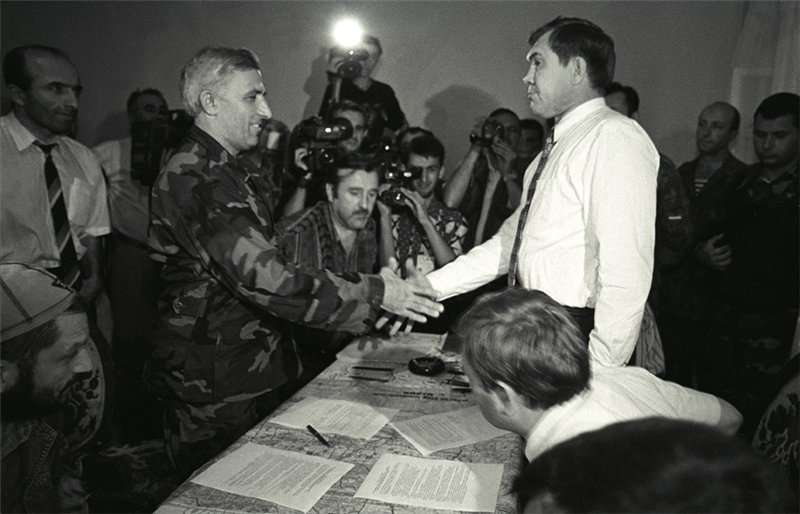
On August 31, 1996, in the Dagestani city of Khasavyurt, near the border with Chechnya, Russian Security Council Secretary General Alexander Lebed and Chief of Staff of the Armed Forces of the Chechen Republic of Ichkeria General Aslan Maskhadov signed an agreement that brought the First Russian-Chechen War to an end. The accords were reached with the mediation of the Organization for Security and Co-operation in Europe (OSCE), represented by Tim Guldimann, a Swiss diplomat and head of the OSCE Assistance Group in Chechnya.
The agreement was directly preceded by the Chechen forces’ Operation Jihad. On August 6, they entered Grozny and took control of a significant part of the city. Russian forces found themselves in a difficult position, and Moscow was forced to begin negotiations.
For Boris Yeltsin, ending the war was a forced fulfillment of an election promise. During his campaign for a second presidential term, he had promised to end a war that was unpopular with Russian society at the time. After Shamil Basayev’s seizure of Budyonnovsk in June 1995 and the capture of Pervomayskoye by a group led by Raduyev in January 1996, it became clear that the war could not be fought exclusively within Chechnya and could spill over into Russian territory at any moment.
The Khasavyurt Accords provided for a cessation of hostilities and the withdrawal of Russian troops from Chechnya by December 31, 1996. The final determination of the principles governing relations between Russia and the Chechen Republic was postponed until December 31, 2001. Moscow did not formally recognize Ichkeria’s independence, but in practice the accords established a situation in which the Russian authorities had lost their influence over Chechnya. The Russian army left the republic more than a month before the deadline set out in Khasavyurt.
For a significant part of the Russian military leadership, armed forces and political establishment, Khasavyurt was a painful and humiliating defeat. The Russian army had invaded Chechnya to restore control over the republic by force, but after almost two years it was forced to withdraw in disgrace, having not only failed to achieve that objective but also lost its aura as the world’s second army, having been defeated not by regular armed forces but by relatively small Chechen resistance units that were thousands of times — incomparably — inferior to it in manpower and even more so in weaponry.
The Chechens won the war without even a minimum of either military or political support from the international community, which regarded Russia’s military aggression against Chechnya as its “internal affair” and effectively financed it by providing the Russian government with billions of dollars in loans through the International Monetary Fund.
Many in Russia’s security and political establishment viewed Khasavyurt not as a final settlement, but as a forced concession and temporary defeat. The idea of revenge remained alive until 1999, when a new Russian-Chechen war began and Moscow once again sent troops into Chechnya.
For supporters of Chechen independence, August 31 is Victory Day of the Chechen army. The date is associated with the launch of Operation Jihad and the return and complete liberation of the Chechen capital and the entire republic from the Russian army.