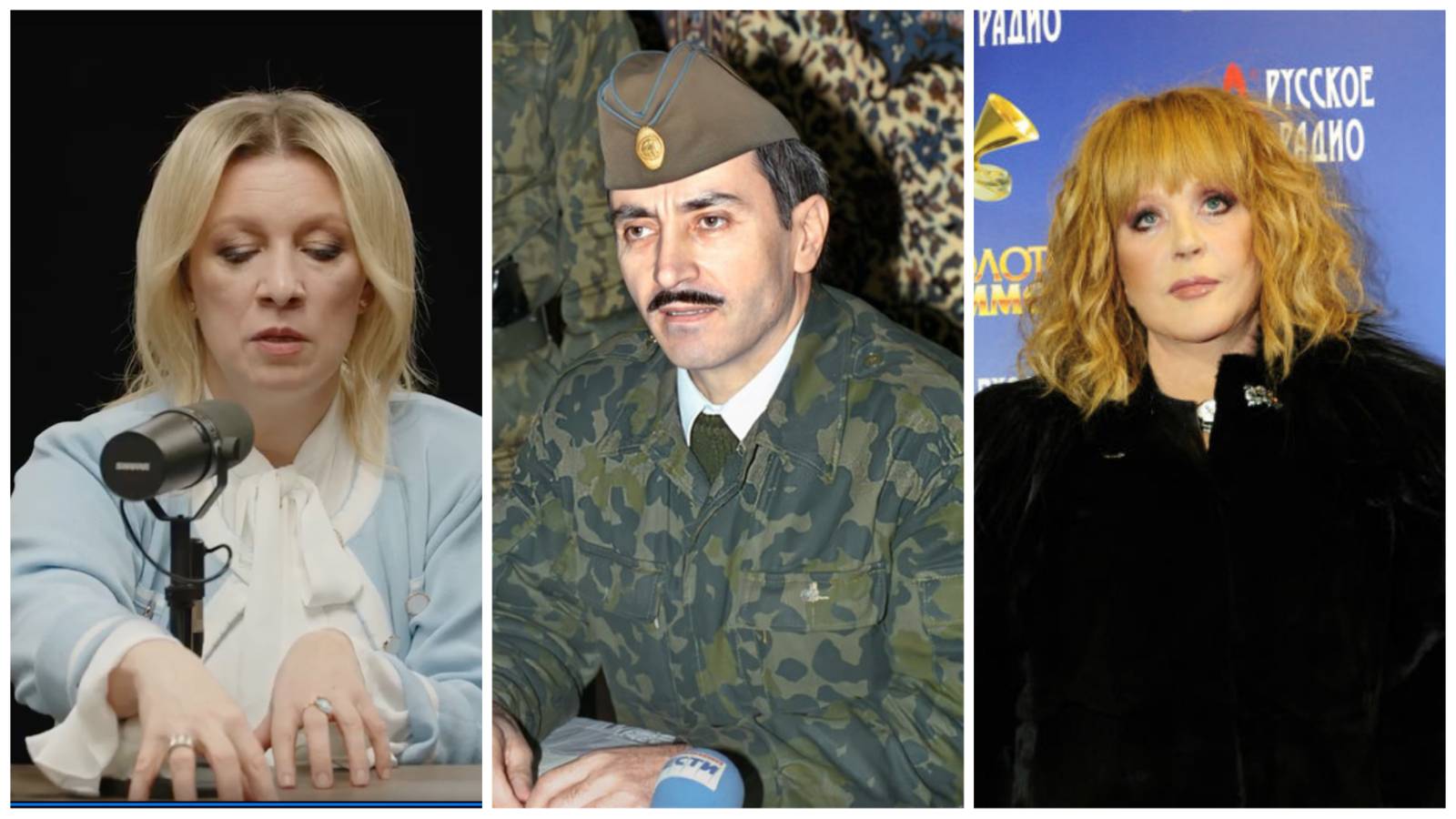
"Holes" in Zakharova's Memory: Why Do Pugacheva's Words About Dudayev Still Stir Some People Up?
Russian Foreign Ministry spokesperson and poet and songwriter Maria Zakharova has once again, and not for the first time, commented on Alla Pugacheva's controversial interview last year, which, incidentally, turned 77 today.
Now, the celebrated and talented diplomat has joined a podcast with a man who is no less confidently pursuing his fame in the field of state propaganda, but who is making his name in this field with talents that are far from diplomatic (though few associate Zakharova herself with diplomacy), but rather more prosaic. Vitaly Borodin, head of the federal project on security and anti-corruption, hasn't distinguished himself much in his direct responsibilities—fighting corruption—but he has excelled in compiling denunciations of various prominent individuals caught in unpatriotic attitudes toward the motherland, which is how he gained notoriety.
In March of this year, Borodin filed a lawsuit to protect his honor, dignity, and business reputation, seeking 5 million rubles in compensation for moral damages from People's Artist of the USSR Alla Pugacheva over her interview with journalist Gordeeva, in which she called the anti-corruption fighter "an informer and snitch."
But let's get back to the main point.
Maria Zakharova, like many Russian nationalists, is still "shaken" by that very part, or rather, one phrase, from the aforementioned interview related to the first president of Ichkeria, Dzhokhar Dudayev. For this, the Russian Foreign Ministry spokesperson accused the prima donna of distorting historical facts. In response to Borodin's question about her personal feelings toward the singer, Maria Zakharova replied that "no one ever allowed anyone to say anything proactively, aggressively, or in any way rudely until the insulting attitude toward the country and the people began, but when this began to be done with a distortion of the historical truth, and when facts began to be presented as lies, and lies were presented as facts."
"I apologize: what is she saying in this interview? That Dudayev, God forgive me, is the same terrorist with blood on his hands, who came to power and then simply engaged in something that has a clear international legal classification, including the classification under our legislation—international terrorism? What did she say about him? Who is he?" "Correct me, is this the same 'good guy' who gave birth to those very... there's no other name for it... bastards who held pregnant women, not small children, but newborns and women in labor? This is the same supposedly 'good guy' who later trained them to blow up apartment buildings, right, those thugs of his?" Zakharova fumed, occasionally supported by her interlocutor's approving comments.
"This is the bastard she supported," Borodin chimed in.
"This is the same 'good guy' who gave the orders to blow up buildings full of civilians—Guryanova Street in Moscow?... This is the same supposedly good guy, from Pugacheva's point of view, who gave the orders and planned terrorist attacks, on public transportation, the subway, underpasses, and so on? He was the mastermind behind it all. What do you mean?" the Foreign Ministry representative asked rhetorically. "Reconstructing" the historical facts distorted by Pugacheva, the interviewees mixed up everything: people, events, and even years. But do such "trifles" matter for propaganda? They think—perhaps rightly—that the rabble will swallow everything.