Unity by Decree: What Was Left Unsaid at Russia’s Council on Interethnic Relation
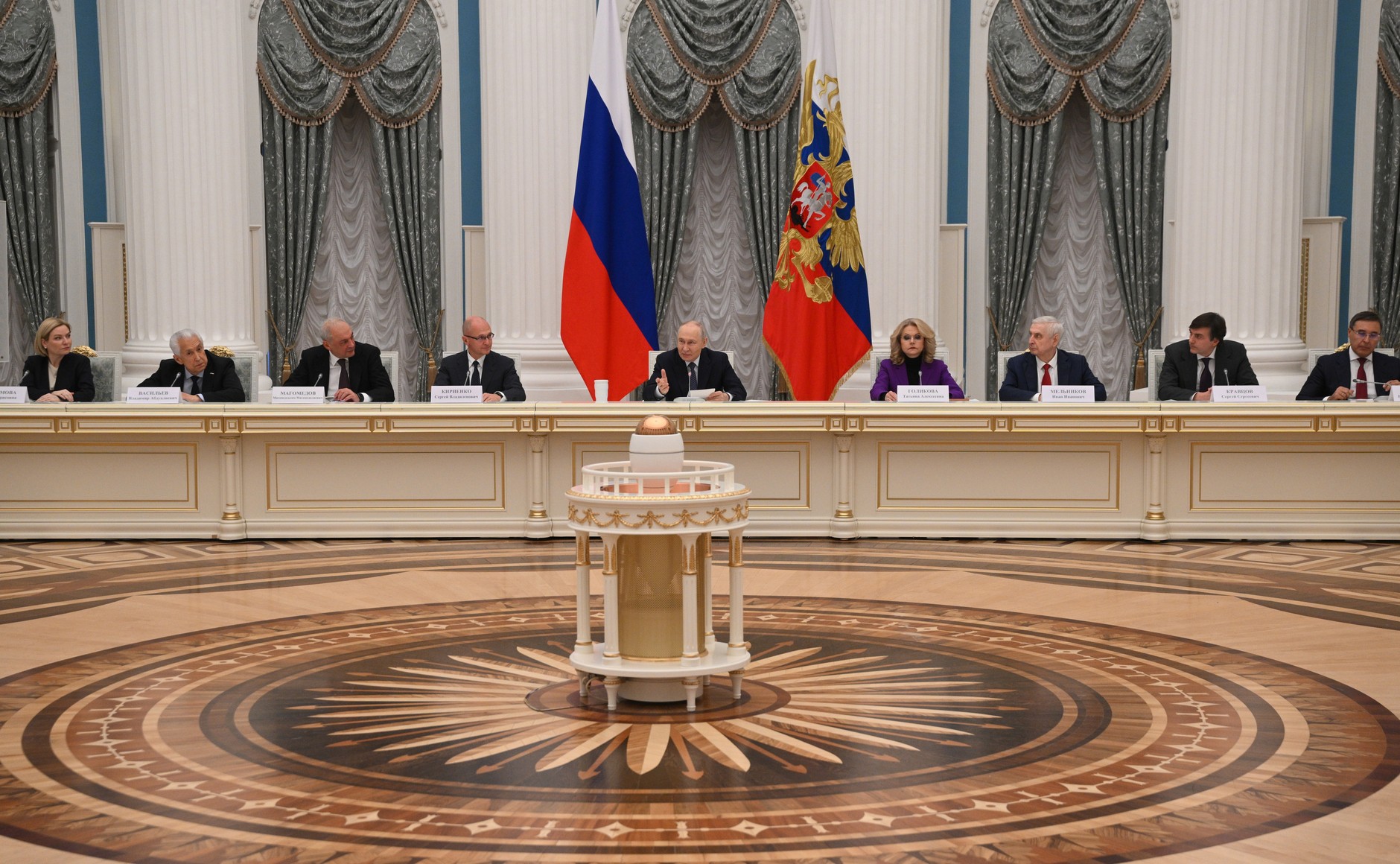
At a meeting of Russia’s Council on Interethnic Relations, President Vladimir Putin declared that the situation in this area was improving and proposed extending the Year of the Unity of the Peoples of Russia beyond 31 December. Participants in what was a conspicuously upbeat gathering spoke about friendship between peoples, serving together in the war against Ukraine, volunteering and preserving “traditional values”. But they had little to say about the causes of actual interethnic conflicts, systematic discrimination or the state of minority languages.
The Council’s meeting on 3 November was less an attempt to examine the real state of interethnic relations in Russia than a showcase for the Kremlin’s official vision of declarative unity.
Putin opened the meeting by praising the organisers of the Year of the Unity of the Peoples of Russia. Thousands of events had been held across the country, he said, which had “strengthened ties between peoples, nationalities and ethnic groups”. The president also claimed there was growing interest in learning national languages, traditional crafts and customs.
“The voice of every people, of every distinct culture, was heard as part of a single whole,” Putin said.
At the same time, the president argued that foreign forces were seeking to divide Russian society. According to him, this had been happening throughout the country’s history of more than a thousand years: geopolitical adversaries had sought to weaken Russia, reduce its strategic potential and, ideally, “dismember it”.
“I cannot say, dear friends, that these efforts have always been fruitless over the centuries. Some of the problems we are experiencing today are partly connected with their efforts and, to some extent, with our own shortcomings,” Putin added.
Yet behind this reassuring picture there was virtually no discussion of the problems that directly affect relations between ethnic groups: xenophobia, ethnic discrimination, regional inequality, the shrinking opportunities to study national languages, or disputes over historical memory.
Deputy Prime Minister Tatyana Golikova reported on the work of the government’s monitoring system for interethnic relations.
Between January and October 2026, she said, the authorities had identified 3,273 information risks relating to interethnic and interreligious issues. Regional authorities are now required to respond to such alerts within no more than four hours, Golikova noted. Previously, they had been given up to ten days.
“This is important,” she stressed.
The measures taken in response include passing information to the Interior Ministry and Roskomnadzor, holding explanatory conversations with those involved in conflicts, and publishing statements by regional officials and public organisations.
According to Golikova, the proportion of alerts processed on time rose from 69% in January to 89% in October.
Nikolai Kropachev, rector of St Petersburg State University, reported on the work of university consortia examining whether Russian legislation complies with the presidential decree on traditional spiritual and moral values.
More than 10,000 provisions of regulations need to be amended to bring the legislation into line with the decree, Kropachev said.
But the most revealing part of his speech concerned national languages.
Kropachev proposed compiling explanatory dictionaries for the state languages of Russia’s republics, setting out the meaning of traditional values. In his view, however, these dictionaries should be aligned with a Russian-language dictionary.
“How many explanatory dictionaries do you think there are in the republics? Just one, and even that was adopted before 2022,” the rector said.
He also complained that some regions enshrined their own values in legislation alongside those shared by the country as a whole.
“There are constituent entities of the Russian Federation which, in addition to all-Russian values, seem to place their own regional values on an equal footing with them,” Kropachev lamented, in a tone that sounded almost like an denunciation.
His remarks exposed one of the central contradictions in Russia’s nationalities policy. On the one hand, the authorities speak of preserving cultural diversity; on the other, they seek to create a single value system whose content is defined in Moscow.
Artyom Gusev, a Russian-language teacher, offered an upbeat assessment, saying that 76 languages are taught in Russian schools and that the number increases every year. He did not say by how much, nor did he provide another figure essential to understanding the scale of the country’s linguistic diversity: Russia is home to around 200 peoples and ethnic groups — almost three times the number of languages taught in schools.
It would also have been appropriate in this context to recall that, in 2018, the Russian authorities effectively changed the rules governing the teaching of national languages in schools. Following the adoption of amendments to the law, their study became voluntary: parents were given the right to decide whether their children would learn their native language or the state language of their republic. In some republics, this was seen as a threat to the survival of national languages in the school curriculum.
The dispute had begun a year earlier, following a statement by Putin in Yoshkar-Ola. The president said it was unacceptable to force children to study a language that was not their own. Prosecutors subsequently launched inspections of schools in Russia’s national republics. Tatarstan became the focus of the dispute, as Tatar had previously been compulsory for all schoolchildren there, including children from Russian-speaking families.
Opponents of compulsory national-language teaching — including some Russian-speaking parents in the republics — complained that it placed an additional burden on children, allegedly left them with less time for core subjects and made it harder to prepare for exams. In Tatarstan alone, more than 1,700 appeals and complaints were received during prosecutors’ inspections in 2017.
National activists, however, saw a much more serious threat than an excessive school workload. They warned that Russian, which remained compulsory for everyone, would enjoy a privileged position, while Tatar, Bashkir, Chuvash and other republican languages would gradually be pushed out of schools. If the study of a language depended on an application from parents, the number of children learning it could decline year after year. That would also reduce opportunities to pass the language on to future generations — and, ultimately, its chances of survival.
In Tatarstan, the republic’s State Council opposed the original draft legislation. Mintimer Shaimiev, the republic’s former president, described the initiative as unconstitutional. In Bashkortostan, the World Kurultai of Bashkirs also opposed the amendments, while activists held rallies and pickets.
In the North Caucasus, the law drew criticism primarily from Circassian organisations. In Kabardino-Balkaria, more than 200 academics, teachers and public figures backed a resolution demanding the resignation of lawmakers who had voted for the amendments. More than 100 Circassian diaspora organisations in Turkey and other countries signed an appeal opposing the law. Activists in Chuvashia and Buryatia also voiced concerns about the future of their national languages.
Following public outcry, the original draft law was softened, but its central principle remained intact. On 3 August 2018, Putin signed Federal Law No. 317-FZ, making the study of native languages and the state languages of Russia’s republics dependent on parental choice. Russian, however, remained compulsory for all pupils.
The law did not ban national languages, but it deprived the republics of their previous ability to guarantee that every schoolchild would study them. This tension — between parents’ right to choose and the right of national communities to preserve their languages — became the central issue in a debate that continues to this day.
Another revealing moment came during the speech by Khazret Sokhrokov, head of the International Circassian Association.
He proposed producing a series of materials highlighting the “authentic, positive nature of the history of Russian-Circassian relations”. The initiative would mark the 470th anniversary of Kabarda’s incorporation into the Russian state, which is due to be commemorated in 2027.
Sokhrokov said that attempts to “vilify history” had become more frequent in recent years, focusing on its “grey episodes” while overlooking its brighter chapters.
But the history of Russian-Circassian relations is not limited to the alliance between Prince Temryuk Idarov and Ivan the Terrible, or the service of Adyghe princes to the Russian state. It also includes the Caucasian War, mass violence and the expulsion of a large proportion of the Circassian population to the Ottoman Empire.
These events remain a fundamental part of Circassian historical memory.
Unity in the Trenches, Problems Beyond Them
A recurring theme in the participants’ speeches was the claim that the war in Ukraine had brought together people of different nationalities.
Viktor Vodolatsky, a member of the State Duma, said:
“You don’t ask about someone’s nationality in the same trench. What matters is whether you can trust your comrade with your life.”
He spoke about Cossack units in which people from different ethnic backgrounds serve together, as well as Orthodox and Muslim prayer rooms located in the same dugout.
Towards the end of the meeting, Putin cited the results of sociological surveys which, he said, showed a significant decline in interethnic tensions in Russia.
“The combined share of those describing the situation as ‘tense’ or ‘explosive (conflict-ridden)’ has fallen 2.1-fold, from 27 — almost 28 — per cent to 13 per cent of respondents,” Putin said.
The proportion of respondents giving a favourable assessment, he added, had increased 2.8-fold, from 5.9% to 16.6%.
Putin nevertheless acknowledged that tensions persisted.
“At the same time, research also shows that a degree of tension in this area remains within society,” he said.