Kobakhidze at the Euronews EU Enlargement Summit: "We Are Not Puppets"
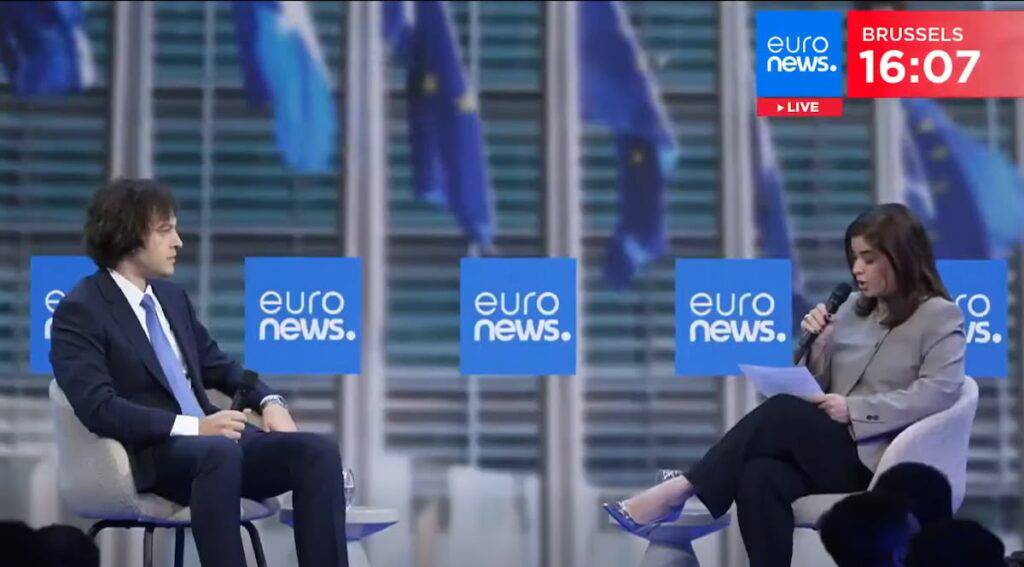
Georgia remains committed to joining the European Union, but it expects Brussels to change its approach to its relationship with Tbilisi. Prime Minister Irakli Kobakhidze made these remarks at the Euronews EU Enlargement Summit in Brussels, while responding to questions from journalist Maria Tadeo.
Tadeo asked the Prime Minister to explain why the Georgian authorities continue to speak of European integration while simultaneously criticizing European institutions and labeling their representatives as "European bureaucrats." Kobakhidze replied: "Because we are optimistic that they will change."
Tadeo questioned whether all the member states of the bloc would be willing to adjust to Georgia.
"You are an intelligent man. You know that the 27 [member states] are not going to say, 'We will change to adapt to Georgia.' They will say, 'You want to join our club; you need to change.' If you don't want that, you have the right not to be here. [...] But if you are here, it is because you want to be part of the club," the journalist said.
Kobakhidze stated that Tbilisi wishes to join the EU "with dignity," and he compared the current relationship with Brussels to Georgia’s position within the Soviet Union.
"Georgia was part of the Soviet Union for about 70 years. And we remember those times—I was very young, but I still recall when Moscow would issue a directive, and Georgia was expected to follow it. That is not an appropriate approach in a democratic society. We want a different kind of approach in Europe." "And, once again, we remain optimistic that this will change—that this approach will shift," the Prime Minister emphasized.
At the summit, Kobakhidze also proposed that European Commission representatives engage in a public debate covering democracy, the rule of law, human rights, the economy, and transparency. He asserts that the assessments of the Georgian government contained in the European Commission’s upcoming report are politicized and do not reflect reality.
"We are critical of European bureaucrats. We are proposing a public discussion—a public debate—with representatives of the European Commission, because we believe that the contents of the report do not align with reality. Let us debate this; let us hold a public discussion with the European Commission representatives. This is a politicized report," Kobakhidze stated.
According to him, the Georgian side is prepared to discuss the grievances raised by European institutions openly, rather than behind closed doors. The Prime Minister further insisted that any concerns regarding Tbilisi’s laws and decisions should be addressed directly with the Georgian authorities.
"If anyone wishes to see a change in Georgia’s conduct, they ought to speak with us; the problem, however, is that they are not engaging with us—they are not prepared to talk to us," he said.
Separately, a journalist asked Kobakhidze about the government’s plans to seek a ban on five opposition parties. Citing Ukraine and Moldova—where political parties have previously been banned—the Prime Minister remarked, "So, we intend to catch up with them."
He characterized the proceedings as a matter of constitutional law, stating that the Georgian government expects legal, rather than political, commentary from EU representatives. Kobakhidze noted that the case is currently under review by the Constitutional Court of Georgia.
Tadeo also touched upon the Prime Minister’s relationship with European leaders, noting that some of them are unwilling to even be photographed with him. In response, Kobakhidze assured her that he has photos taken with everyone.
The Euronews summit on European Union enlargement took place in Brussels on November 3, 2026. It served as an international discussion forum organized by the European television channel Euronews, rather than an official event hosted by EU institutions. The summit brought together representatives from European bodies, leaders from EU member states and countries aspiring to join the union, as well as experts and business representatives. Participants discussed the prospects for EU enlargement, the progress of reforms in candidate countries, and issues related to security, democracy, and the economy in the context of integration.