Fyodor Shchukin confirmed as head of Dagestan, ending his interim tenure
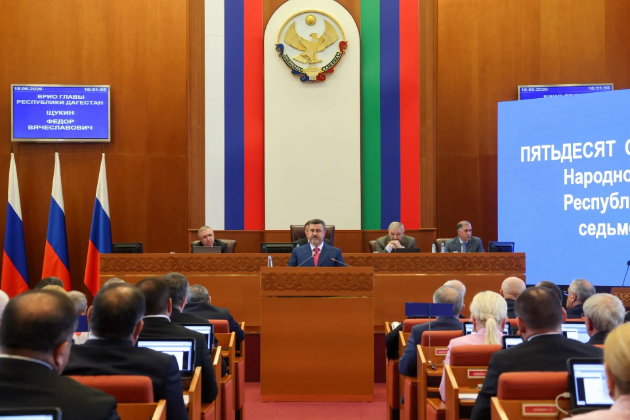
Dagestan’s People’s Assembly today confirmed Fyodor Shchukin as head of the republic for a five-year term. Of the 87 deputies who took part in the vote, 78 supported the former chairman of Dagestan’s Supreme Court, who had been serving as acting head of the region since May. Four votes went to parliament’s deputy speaker, Kamil Davdiev, and another four to Samir Abdulkhаlikov, head of the Communist Party faction. One ballot was declared invalid.
Shchukin has therefore shed the “acting” title. The vote, however, was not a genuine political contest: the two additional candidates received four votes each, while the overwhelming majority of deputies predictably backed the candidate previously approved by the Kremlin.
On 23 September, Vladimir Putin submitted three candidates for the post of head of the republic to the regional parliament. The presence of several contenders did not amount to real competition for power: the decisive stage of the selection process had taken place long before the vote.
The process that led to Shchukin’s confirmation reflects changes in Russian regional politics over the past two decades.
In 2004, following the Beslan terrorist attack, Russian President Vladimir Putin abolished direct elections for regional heads. From 2005, governors and heads of republics were appointed by regional parliaments on the nomination of the president.
In May 2012, shortly before leaving the presidency, Dmitry Medvedev reinstated direct elections for regional heads as part of a political reform he had announced. However, restrictions on candidates remained, including the municipal filter. Dagestan, like some other regions, operates under a special procedure: the head of the republic is elected by deputies from candidates put forward by the Russian president.
This system preserves the outward trappings of elections while leaving the Kremlin with the power to determine who will lead a region. Dagestan’s residents cannot directly elect their head of government, and the regional parliament cannot independently draw up the list of candidates.
The change in Dagestan’s leadership came amid public discontent with Sergei Melikov and widespread flooding in spring 2026.
Heavy rains inundated homes and roads, disrupted electricity supplies and damaged public utilities. The situation was exacerbated by the breach of an earthen embankment at the Gedzhukh Reservoir in Derbent District. A federal-level state of emergency was declared in the republic.
The disaster exposed longstanding problems in the region, including inadequate drainage, unauthorised construction, vulnerable utility networks and shortcomings in building oversight. Thousands of residents suffered damage to their homes and property, faced supply disruptions and had to seek assistance from the authorities.
The conduct of senior officials attracted particular attention. During a visit by Melikov and Yuri Chaika, the presidential envoy to the North Caucasus Federal District, to the flooded Primorskaya substation in Makhachkala, a carpet was laid out for them so they would not have to stand in the mud. The episode became a symbol of the gulf between the leadership and residents struggling with the consequences of the flooding.
It would nevertheless be wrong to conclude that the floods alone caused Melikov’s departure. A possible change of leadership had been discussed even before the disaster, and his term was due to end in autumn 2026. However, the natural disaster intensified questions about the effectiveness of regional governance and added to the political context surrounding the reshuffle.
On 30 April, Putin met representatives of Dagestan and announced that Sergei Melikov would move to another job. This came despite Melikov’s previous assurances that he had no intention of leaving office before his term expired. On 4 May, the president signed a decree accepting Melikov’s resignation at his own request and appointed Fyodor Shchukin acting head of Dagestan.
At the same time as appointing Shchukin, Putin also brought Magomed Ramazanov into the regional leadership as chairman of the republic’s government.
Ramazanov is a native of Dagestan. He previously worked in Directorate K of the Russian Federal Security Service’s Economic Security Service and, before returning to his home republic, served as deputy presidential envoy to the Far Eastern Federal District.
Some observers and Dagestani social media channels had previously suggested that the Shchukin–Ramazanov pairing was an interim arrangement and that Ramazanov himself might eventually become head of the republic.