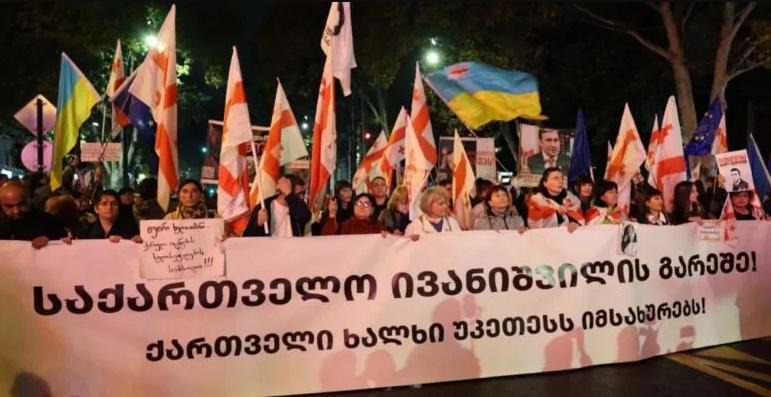
"Georgia Without Ivanishvili": Opposition Rallies Supporters Ahead of Large-Scale Protest on November 28
On the evening of October 25, an opposition alliance held a march in Tbilisi under the slogan, "Georgia Without Ivanishvili — The Georgian People Deserve Better!" Participants gathered near the first building of Tbilisi State University and marched to the Rustaveli metro station, where they announced the launch of a new campaign.
Nika Gvaramia, one of the leaders of the "Coalition for Change," urged supporters to ensure the largest possible turnout for the upcoming rally.
"November 28 must be a decisive, peak day. We must realize that the most important thing is the scale of participation. We should embrace this moment—a moment where, through sheer numbers, we can achieve our goal: a Georgia without Ivanishvili!" he declared.
Tamar Chergoleishvili, leader of the "Federalists" party, addressed the potential banning of five opposition parties and coalitions, attributing the move to the fear that Bidzina Ivanishvili—founder of the ruling party—harbors toward the free choice of the citizenry.
"Bidzina Ivanishvili is making such an audacious move, as if he expects us all to fall into despair. In reality, the situation is quite the opposite: by banning the alternative, Ivanishvili is acknowledging a crisis in his own legitimacy. He is effectively admitting that he no longer trusts the Georgian people—that he fears the free choice of the Georgian people—and his fear is entirely justified," Chergoleishvili emphasized. Levan Tsutskiridze, a representative of the "Freedom Square" party, urged protest participants to "stand shoulder to shoulder with political parties—not because they are infallible (only those who do nothing make no mistakes), but because without strengthening political parties, it will be impossible to achieve the changes we all strive for."
Giga Lemonjava, a member of the "Droa!" party, stated that the consequences of banning opposition forces extend far beyond the fate of the five specific political groups in question. In his view, this amounts to "the de facto annulment of the country’s own registration as a state."
"And the only force capable of stopping all this is you—the citizens of Georgia," Lemonjava concluded.
Luka Mishveladze, representing the "Girchi — More Freedom" party, expressed his support for the ongoing struggle of the protest movement, while Ana Kobakhidze of the "Strategy Agmashenebeli" party called for an even larger turnout on November 28 than at previous demonstrations.
The protest is taking place against the backdrop of a case currently before the Constitutional Court of Georgia, initiated by the ruling "Georgian Dream" party, which seeks to ban five opposition forces: the "United National Movement," the "Coalition for Change," "Strong Georgia — Lelo," the "Federalists" party, and "For Georgia"—a party founded by former Prime Minister Giorgi Gakharia. The plaintiffs accuse these groups of attempting to alter the constitutional order and undermine the country's independence. The opposition maintains that the case is politically motivated.
Hearings began on October 21 in Batumi. On October 23, the court rejected a motion by the "For Georgia" party to postpone the proceedings until November 13; representatives of the party had argued that the defense had not been granted sufficient time to prepare. The sessions will continue on October 26 and may last until October 30.