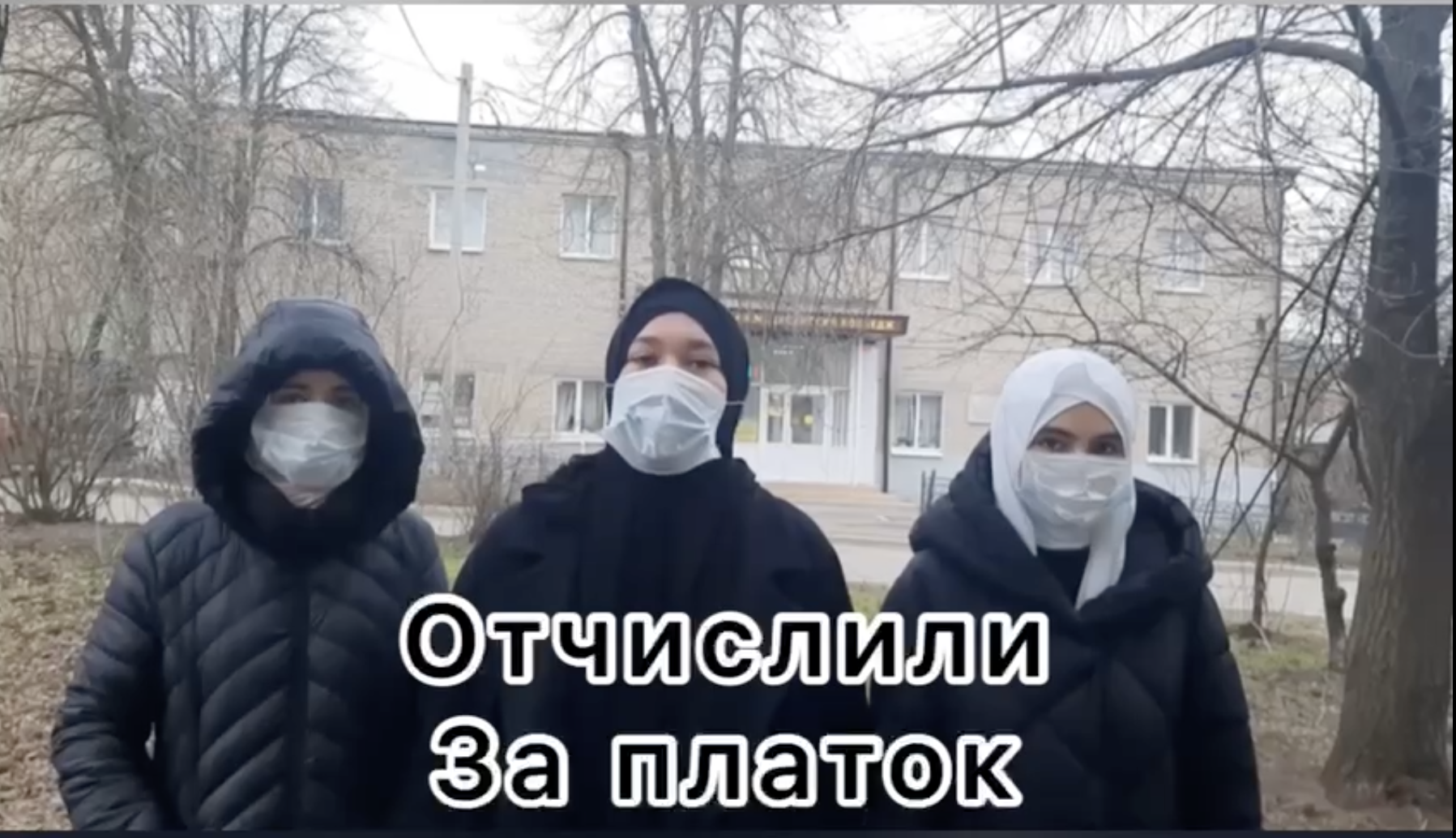
On January 12, the leadership of the Novocherkassk Medical College in the Rostov region expelled five Muslim students for “violating internal regulations.” Wearing a hijab was considered a violation.
Not sisterly
According to one of the expelled girls, there were a total of 10 Muslim women in the college wearing traditional headdresses. After comments from the teachers, five of them did not aggravate the relationship and took off their scarves. But the other five remained adamant, these are two Ingush residents of Novocherkassk and three natives of Dagestan.
Kizperi Magomedbekova had been studying nursing for four years, and in six months she would have received a college diploma. According to her, she only put on the hijab this academic year and immediately encountered open opposition from the administration of the educational institution. “From the first day, the head of the educational department began to make comments to me that I should not go to school in a headscarf, and demanded that I write an explanatory note. The teachers were gathering a council, they wanted me and other students to take off our headscarves, otherwise we would be expelled,” the Kavkaz.Realii publication quotes her as saying.
Sona was a second year student. According to her, teachers did not allow girls in hijabs to attend classes, but sent them to get permission to study, then they issued a warning, then a reprimand, and finally expelled them.
Freshmen from Novocherkassk said that upon admission no one warned them that the hijab would become a problem.
The girls did not remain silent. They protested the order of expulsion from the prosecutor's office, turned to the Don community of Dagestanis for help and filmed a video message. “We study well - “good”. We have very good relations with teachers and classmates... We were reprimanded for violating internal rules - wearing clothes with religious attributes, although there are no attributes on our clothes indicating religion. We don’t pray on college campus or talk about topics related to religion. We just want to learn and get an education,” they said.
Representatives of the community met with the college leadership, but did not find understanding there.
Personal dislike for the hijab
The story received resonance in the press, and the college leadership was forced to explain its position publicly. Acting director Igor Shikulya said that wearing clothes with religious attributes is “prohibited” at the college. According to him, according to the charter of the educational institution, students are required to wear medical clothing. “Our graduates work as midwives and nurses in surgical departments. Therefore, the issue of compliance with the rules of workwear is of fundamental importance,” he said in an interview with the Don 24 agency. “At the same time, the way back for expelled students is not closed. They can be reinstated if they follow generally accepted medical rules."
However, judging by some statements by representatives of the college administration, the problem is not only in medicine. The college's deputy director, Lyudmila Kostrova, said the institution prohibits wearing religious paraphernalia because it "has a negative impact on other students." The lawyer for the expelled girls, Magomed Nurbagomedov, noted that the head teacher was very radical: “She said that even if she was in the hospital and a nurse in a hijab approached her, she would kick her out. The head of the community talked to her, trying in vain to find a consensus. In his opinion, there is simply personal hostility. In Rostov there is a medical college, medical institutes, universities, where girls in hijabs do not have such problems.”
The lawyer said that he would file a lawsuit demanding that the expelled students be reinstated in the college if he could not reach a compromise with the management of the educational institution in pre-trial proceedings.
Law, statute and the Virgin Mary
The National Association of Lawyers of Russia (NAUR) noted that not all religious paraphernalia is prohibited in college. The building houses an Orthodox icon depicting the Virgin Mary in a headscarf. “The image on the icon is clear evidence that the headscarf is a unifying link for all women of different faiths in Russia,” said the NAUR. “Not only that: in appearance, it is the expelled students who are closest to the image of the Virgin Mary, which is placed above the front door of one of the classrooms of a “secular” educational institution.”
The Russian Ministry of Health, where Kommersant journalists approached with a request to comment on the conflict over the hijab, referred to the legislation. “Article 38 of the federal law “On Education in the Russian Federation” establishes that organizations carrying out educational activities have the right to independently establish requirements for students’ clothing, its general appearance, color, style, varieties, insignia, as well as determine the rules for wearing it,” - said the press service of the ministry.
Nevertheless, the head of NAYUR, Ruslan Nagiyev, believes that the college’s management violated the constitutional rights of female students by limiting their right to education. According to him, female students agree to a compromise - they are ready to wear white scarves or put on hats over the veil. “This practice already exists in educational institutions in other Islamic regions of the country - in Dagestan, Tatarstan,” Nagiyev noted. “But the college management insisted on a complete rejection of headscarves.”
“Ukrainian fascism” in Novocherkassk
On January 29, the head of Chechnya, Ramzan Kadyrov, stood up for the expelled students. Speaking at the celebration of the anniversary of the Islamic financial group Favorit, he said in Chechen that the Russian state protects Islamic values, but such unjustified deductions occur in some institutions. He then added in Russian: “Those who prohibit the building of mosques and the wearing of the hijab are part of Ukrainian fascism. We urge everyone to treat us with respect or we will be forced to take action."
On February 2, it became known that the girls were allowed to return to school. As Ruslan Nagiyev explained, “it was possible to reach a mutual agreement during pre-trial negotiations.” “This happened largely thanks to the participation of the permanent representative of the head of the Chechen Republic in the Rostov region, Ruslan Ganchaev. He was negotiating. The vice-governor of the region, Igor Guskov, also took part in them. A compromise solution has been found. Girls will attend college in clothes that, on the one hand, do not contradict the charter and rules of this educational institution, and on the other hand, do not violate the principles of the students’ religion,” the Caucasian Knot publication quotes Nagiyev.
Three students returned to college, two decided not to return.
Kizperi Magomedbekova and her Dagestani friends recorded a new video message in which they thanked Ramzan Kadyrov and other representatives of the leadership of Chechnya and the community for their help in resolving the issue.
The conflict in Novocherkassk is not the first case of discrimination for wearing a hijab. Similar problems arose among female students in Tyumen, Astrakhan, Kuban and other regions where large diasporas of Muslims from the Caucasus appeared among the predominant Christian population. At the same time, in Dagestan, the head teacher of a rural school became notorious for not allowing girls to attend lessons without headscarves. In Chechnya, a headscarf is mandatory for female students and employees of public institutions. As feminist human rights activists note, no matter what religion predominates in society and no matter what disputes arise in connection with this, women inevitably find themselves at the extreme, and their outfits are the center of attention.