The Kremlin has launched a trade war against Armenia. Yerevan considers this political blackmail
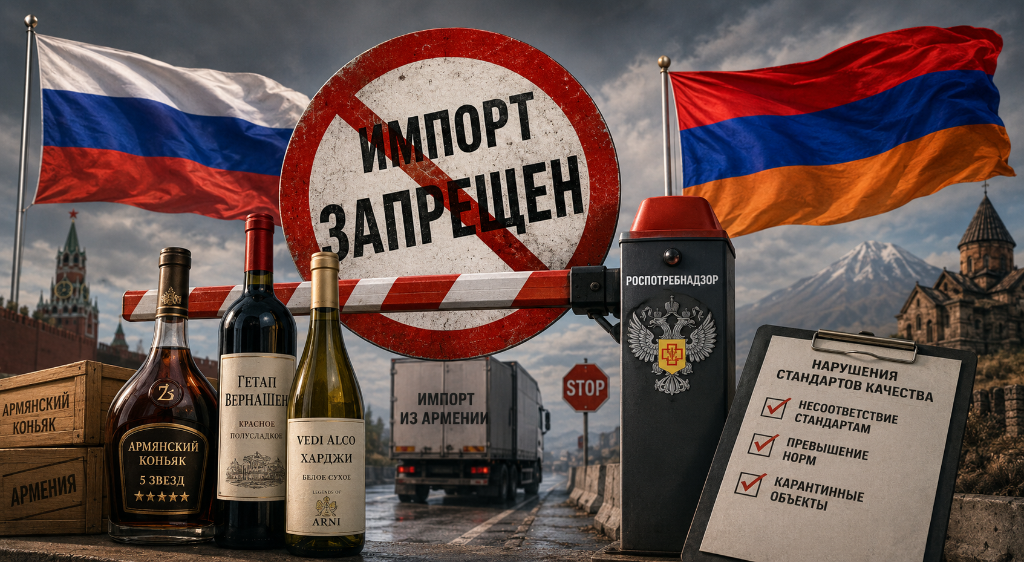
Rospotrebnadzor (the Federal Service for Surveillance on Consumer Rights Protection and Human Wellbeing) has suspended sales of several types of Armenian wine and cognac in Russia. The agency stated that the products were found to be "non-compliant with mandatory requirements," after which it issued orders to importers and retailers to withdraw the goods from circulation.
The restrictions affected products from three Armenian companies: VEDI-ALCO CJSC, Abovyan Brandy Factory LLC, and Shahnazaryan Wine and Brandy House LLC. Specifically, these included Getap Vernashen semi-sweet red wine, Vedi Alco Kharji dry white wine from the Arni Legends line, five-year-old Armenian 5 Stars Cognac, and seven-year-old Shahnazaryan XO Cognac.
Rospotrebnadzor did not specify the specific violations discovered. The agency's statement only mentions "non-compliance with mandatory quality requirements."
This is not the first instance of restrictions on Armenian products in recent months. Previously, Russian authorities restricted supplies of Jermuk mineral water, citing excessive hydrocarbon content. Rosselkhoznadzor (the Federal Service for Veterinary and Phytosanitary Surveillance) also raised concerns about the quality of Armenian flowers: according to the agency, more than 130 quarantine organisms were found in a batch of 96.2 million plants. Furthermore, Russia reported problems with the supply of fruits and vegetables from Armenia.
The bans come amid a rapid cooling of relations between Russia and Armenia. Following the Karabakh crisis, Armenian authorities began to actively seek closer ties with the European Union and discuss expanded cooperation with the West. In recent months, Moscow has increasingly criticized Nikol Pashinyan's foreign policy and his attempts to distance himself from Russia. State Duma Speaker Vyacheslav Volodin accused the Armenian authorities of an "anti-Russian policy," while Deputy Prime Minister Alexei Overchuk warned that further European integration could lead to a revision of Armenia's economic preferences within the Eurasian Economic Union, including the possible introduction of tariffs and rising energy prices.
On May 23, Deputy Chairman of the Russian Security Council Dmitry Medvedev joined the criticism. Commenting on Yerevan's attempts to simultaneously maintain EAEU benefits and develop relations with the EU, he wrote on the Max messenger:
"Those who try to sit between the stools risk landing painfully on their limp ass."
The day before, Armenian Prime Minister Nikol Pashinyan, commenting on such threats, stated that the current contract between Moscow and Yerevan sets out the terms of gas supplies until 2031. According to Pashinyan, Russia and Armenia have "clear strategic agreements" that do not allow for arbitrary price revisions.
In Armenia itself, the outbreak of the trade war two weeks before the parliamentary elections is being linked to Moscow's attempt to influence voter sentiment and strengthen the position of pro-Russian politicians.
"We're talking about Samvel Karapetyan, a Russian oligarch whom Moscow is effectively supporting in Armenia in these elections. This includes Robert Kocharyan and other pro-Russian forces. Russia is trying to influence local voters with such petty mischief—to scare them," says Armenian journalist and author of the "In the Center of the Objective" platform Roman Baghdasaryan.
According to him, the pressure is being exerted through restrictions on Armenian businesses and exports.
"Through businessmen, through companies like Jermuk, through flower growers. Moscow believes that thousands of people will be scared and will vote for pro-Russian candidates—Robert Kocharyan and others."
"The more votes Russia can secure through such pressure, sanctions, and, essentially, blackmail, the stronger the pro-Russian representation in the Armenian parliament will be," says Baghdasaryan.
However, the journalist is confident that such tactics could backfire and, on the contrary, strengthen the position of current Prime Minister Nikol Pashinyan and his party.