The Kremlin vs. Pashinyan: The Insider on the Russian Influence Network in Armenia
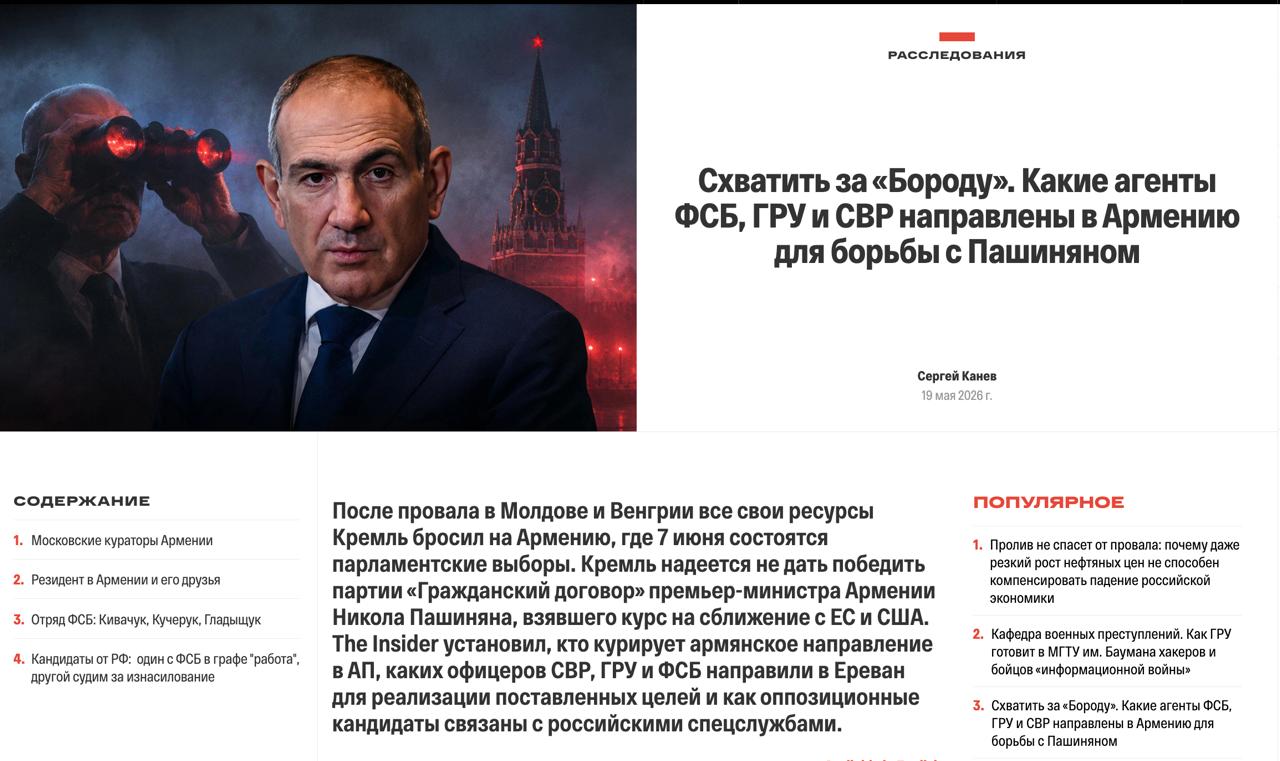
The Insider published an investigation today into the Kremlin's attempts to maintain influence in Armenia ahead of the 2026 parliamentary elections.
According to the publication's journalist, following the deterioration of relations with Nikol Pashinyan's government, Russian authorities have effectively transferred the Armenian affairs to the control of a new structure within the presidential administration responsible for political work in the post-Soviet space.
The Insider claims that the Russian Presidential Directorate for Strategic Partnership is coordinating this work. Documents obtained by the publication speak of the goal of "forming a pro-Russian infrastructure" in Armenia and "neutralizing Pashinyan's anti-Russian course."
According to the investigation, this involves more than just diplomacy or humanitarian projects. The authors claim that the structure works with media outlets, Telegram channels, public organizations, and political groups within Armenia. One of the documents speaks of the need to "create a sustainable network of loyal opinion leaders."
Journalists identify Vadim Titov, an official from Sergei Kiriyenko's team, as the head of the department. However, according to The Insider, the direct overseers of the Armenian direction are individuals connected to the intelligence services.
Among them is Valery Chernyshov, whom the publication links to the GRU. The Insider writes that he previously "engaged in sabotage training." Another person involved in the investigation is Dmitry Avanesov, allegedly responsible for "coordinating contacts with Armenian political and public circles."
The publication cites the names and some biographical details of politicians on whom Moscow is placing its bets.
The first person involved is former Armenian Defense Minister Arshak Karapetyan. After his resignation, he moved to Russia, where he founded the "Pan-Armenian Front" movement and began actively opposing the government of Nikol Pashinyan. The Insider reports that in documents from a Russian organization, Karapetyan listed the Russian FSB as his place of employment. He regularly appears in Russian media and accuses the Armenian authorities of damaging relations with Moscow.
The second is former Gyumri mayor Vardan Ghukasyan, leader of the Communist Party of Armenia and one of the most prominent representatives of the pro-Russian camp. The Insider recalls that in 2023, an Armenian court found Ghukasyan guilty of rape. Despite this, he continues to participate in politics and advocate for the closest possible union with Russia.
The investigation also mentions Gagik Tsarukyan, leader of the Prosperous Armenia Party, one of the country's most influential businessmen and a long-standing participant in Armenian politics. The Insider recalls that back in the Soviet era, Tsarukyan was convicted "for gang robbery and rape," but after the collapse of the USSR, the conviction was overturned—by then, the businessman was among the richest people in Armenia.
The journalist also cites another episode related to Tsarukyan. In November 2004, the car of Nikol Pashinyan, then editor-in-chief of the Armenian Time newspaper, was blown up in central Yerevan. Pashinyan himself publicly accused Tsarukyan of orchestrating the assassination attempt, claiming that one of the newspaper's publications was the cause. The criminal case was never solved.
The Insider cites these examples as an illustration of the personnel crisis among pro-Russian forces in Armenia: according to the investigation's authors, Moscow is running out of prominent politicians with stable support but without a significant reputational pedigree.
The author also publishes excerpts from internal materials that discuss the need to promote the narrative of "the unreliability of Armenia's Western partners" and heighten concerns about the country's security following the Karabakh crisis.
According to The Insider, some of the employees of the new Kremlin department had previously worked on Ukrainian and Moldovan affairs. Journalists link them to previous projects of Russia's political influence in the former Soviet Union.
"Armenia is Russia's last foothold in the South Caucasus," states one document cited by the publication. Another calls Armenia a "critically important area" for maintaining Russia's presence in the region.
The main conclusion of The Insider's investigation is that the Kremlin views the parliamentary elections in Armenia as an opportunity to maintain influence in a country that has consistently distanced itself from Moscow in recent years.
During a meeting with voters today, Armenian Prime Minister Nikol Pashinyan also referenced a publication about Russian billionaire Samvel Karapetyan's possible ties to the Russian Federal Security Service (FSB), calling him a "Kaluga oligarch."
"A person who is involved in Armenia's political processes is essentially secretly collaborating with the FSB," Pashinyan stated.
According to the prime minister, organizations linked to Karapetyan are spreading the idea of a million Azerbaijanis potentially resettled in Armenia. Pashinyan asserts that such an issue "has never been discussed" during negotiations between Yerevan and Baku.
The head of the Armenian government characterized these actions as "espionage and subversive activity." He also called on voters to prevent the "war party" from entering parliament.
Pashinyan also stated that political groups linked to Karapetyan effectively constitute an "intelligence network." He warned that all individuals who, in his opinion, cooperate with foreign intelligence services could face consequences from the state.