Armenian parties spent nearly half a million dollars on social media advertising. Karapetyan's party led the spending
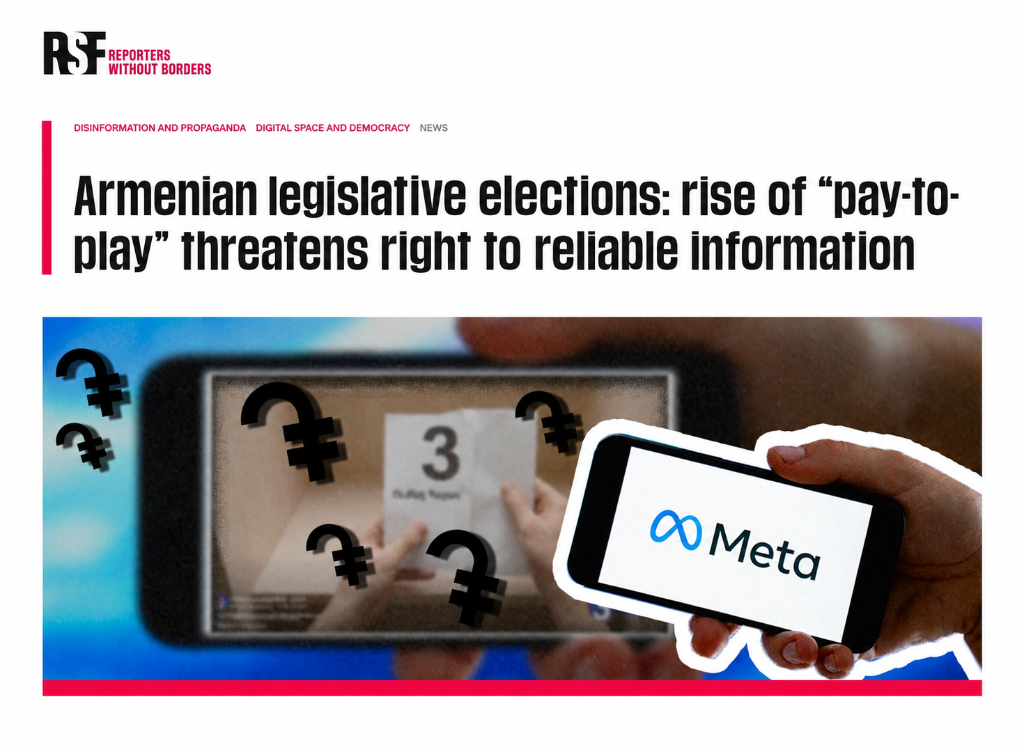
Reporters Without Borders (RSF) released a study on the parliamentary elections in Armenia, warning of the growing influence of opaque political promotion schemes online.
The report's authors point to the blurring of the lines between journalism, political advertising, and propaganda, making it difficult for voters to distinguish paid content from unbiased information.
According to RSF, a market for political influence has emerged on Facebook in Armenia, where reach and visibility for posts can be purchased in much the same way as advertising services.
Political Influence as a Commodity
The researchers focused on the activities of dozens of popular Facebook pages that previously published entertainment, humor, or everyday content but then began actively disseminating political messages. According to RSF, many of these pages operate in sync, simultaneously publishing materials either supporting or opposing specific political forces.
"When access to media depends on financial resources, both media pluralism and the public's right to reliable information are threatened," said Jeanne Cavelier, head of RSF's Eastern Europe and Central Asia desk.
According to the organization, some pages almost simultaneously published materials critical of Prime Minister Nikol Pashinyan, accusing him of worsening relations with Russia, and asserting the government's inability to engage in dialogue with society.
Special Focus: Samvel Karapetyan's Parties
One of the main subjects of the study was the Strong Armenia party of Russian-Armenian businessman Samvel Karapetyan.
RSF cites the events of May 23 as an example, when dozens of Facebook pages began publishing interviews with Samvel Karapetyan and materials supporting his political party within minutes.
According to the researchers, such synchronicity of publications may indicate the existence of organized networks for the dissemination of political content. The report also mentions the websites Newsarm.live, Fakt.am, Politico.am, and Pressmedia.am as resources involved in disseminating and amplifying such materials.
The organization also notes that it sent a request to representatives of the Strong Armenia party, but had not received a response at the time of publication.
This isn't just about the opposition.
The authors of the study emphasize that the problem isn't limited to one political force.
According to Ani Grigoryan, editor-in-chief of CivilNet's fact-checking unit, similar mechanisms were used to promote other political actors.
Furthermore, the ruling Civil Contract party also receives support from popular social media pages that publish anti-opposition material.
CivilNet investigators discovered links between several anonymous Facebook pages and individuals affiliated with the office of the Armenian Prime Minister.
Thus, this isn't about the activities of any one political camp, but rather about a broader practice of using digital influence networks in political struggles.
Hundreds of thousands of dollars on political advertising
A separate section of the study is devoted to advertising expenses on Facebook.
According to the Meta advertising library, political forces in Armenia spent approximately $480,000 on social media promotion from February to May 2026.
This amount was a record for the Armenian political market.
Of this, according to RSF, almost $291,000 went to the Strong Armenia party.
However, the organization suggests that the actual costs may be significantly higher, as some advertising is being placed through pages that do not disclose their political sponsors.
Artificial intelligence is increasingly interfering in the campaign.
Researchers cite the use of artificial intelligence technologies as another problem.
The CivilNetCheck project identified at least 12 Facebook pages that distributed videos created by neural networks, in which supposedly ordinary citizens expressed political views and criticized individual campaign participants.
According to Ani Grigoryan, many users perceived these videos as real and were unaware that the people depicted in them never existed.
"Many people perceived these videos as real," she noted.
Why this matters
RSF believes that what's happening in Armenia reflects a broader process common in many countries: political struggles are increasingly shifting to social media, where traditional transparency mechanisms are significantly less effective.
As a result, voters are confronted not only with political advertising but also with entire networks of influence that disguise campaigning as news, public debate, or the opinions of ordinary users.
Under these conditions, RSF believes, citizens' right to receive reliable information before elections is under threat.