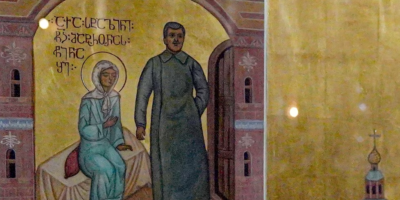
The Patriarchate of Georgia asked to remove the image of Stalin from the icon
The Patriarchate of Georgia made the first statement regarding the scandal associated with the icon of Matryona of Moscow, located in the Trinity Cathedral in Tbilisi. Let us remind you that the stamp of the icon depicts Joseph Stalin.
“Since Stalin’s meeting with Saint Matrona, due to lack of evidence, is not included in the canonical text of her life and is not recognized by the Russian Church, it is necessary to change the above-mentioned episode and take into account other details related to the canons of icon painting,” the statement says.
The Patriarchate also appealed to the leaders of the pro-Kremlin party “Alliance of Patriots of Georgia,” who donated the icon to the temple, with a request to make appropriate changes and with the caveat that otherwise the Patriarchate itself would do this.
Earlier, the head of the non-governmental organization Laboratory for Research of the Soviet Past, Irakli Khvadagiani, said that the scandal surrounding the icon broke out not because of a religious dispute, but because of the political aspect.
“Stalin exterminated millions of people, including believers of different faiths. In a civilized society, an attempt to present figures like Stalin in a positive way causes indignation,” Khvadagiani emphasized.
A petition “The icon depicting Stalin must be removed from the Trinity Cathedral” is being circulated on social networks. “Stalin’s so-called visit to Matrona is a story that has nothing to do with reality. It is completely incomprehensible why the leadership of the Trinity Cathedral allowed the image of the Soviet dictator to be kept in the temple. The era of Stalin's rule is associated with repressions, of which many of our compatriots became victims. We also consider this fact as an insult to the families repressed by the Stalinist regime,” the document says.
After the icon with Stalin appeared in the cathedral, it was doused with paint. Subsequently, a rally was held in Tbilisi near the house of activist Nata Peradze, who, according to the protesters, committed this offense. She, in turn, stated that she received threatening messages.