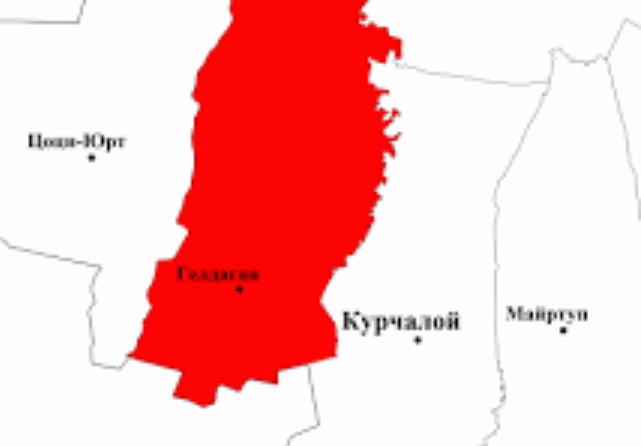
The kidnapping and subsequent disappearance of four residents of the village. Geldagan
November 1, 2001
***
Human Rights Center “Memorial” became aware of the kidnapping and subsequent disappearance of four residents of the village of Geldagan: three brothers Muzaev and their relative (the degree of relationship between them is unknown to Human Rights Center “Memorial”). All this happened back in May 2001.
The first to be kidnapped was Adlan Yakubovich Muzaev, born in 1961, who lived in a cottage on the territory of the village within the village limits. At about 4 a.m. on May 6 (or 7) armed men in masks entered his yard after knocking down the gate with an armored personnel carrier. They did not show documents or introduce themselves. They spoke Russian, without an accent. Having burst into the room, they lifted Adlan Muzaev out of bed and, beating him, took him out into the street. His wife Eliza was hit several times with a machine gun and locked in the bathroom. All this happened in front of their children.
In addition to the armored personnel carrier, ZAZ cars were involved in the theft. It was not possible to record the equipment numbers. According to witnesses (neighbors also observed what was happening), a helicopter was circling in the sky above the village at a low altitude at that time.
An hour after the abduction, the military commandant of the Kurchaloevsky district, Colonel Sergei Kislov, his deputy and the head of the FSB department arrived in the village. They went to Adlan Muzaev’s cottage, where local residents had already gathered, and demanded that his personal documents be given to them, since the kidnappers, in their haste, forgot to take them. People surrounded the military and demanded the release of an innocent man. The military commandant replied: “If he’s innocent, we’ll let him go.” Relatives refused to give up the passport. A few days later, Sharip Vakhaev took him and personally handed him over to the head of the FSB Directorate of the Kurchaloevsky District. Nazha Chukaev, the brother of the former head of the administration of the village of Geldagan, Saykhan (Azar) Edilkhanovich Chukaev, who was killed on the evening of May 1, petitioned for the release of Adlan Muzaev. On May 25, 2001, he informed the brother of the kidnapped Dombi Muzaev that he would be released the next day, but in the morning the Russian military killed Nazha Chukaev and his brother Nazhmutdin. And a week later, their other brother - Saipi Edilkhanovich Chukaev. The killers in military uniform waylaid him on the street of the village. After this, Adlan Muzaev’s relatives were no longer able to obtain any reliable information about him. They only managed to find out that the kidnapped person was initially kept for some time in the commandant’s office of the Kurchaloevsky district. Residents of Geldagana Bakish Umarov, Ezir-Ali Eskiev, Said-Emin and Khizir Gushaevs, who were detained that same morning and then released, spoke about this.
Muzaev's relatives contacted law enforcement and administrative authorities of Russia and Chechnya. In particular, they submitted applications to the military commandant's office, the police, the FSB, the General Prosecutor's Office and the prosecutor's office of the Chechen Republic. Hoping for help, they wrote a complaint addressed to Akhmad Kadyrov. They were unable to obtain any new information about the abducted person. At the end of 2009, his whereabouts had not been established.
Signs of Adlan Muzaev: height - about 180 cm, weight - 90 kg, dark hair, brown eyes; there are scars on the forehead and on the upper lip on the right. At the time of his arrest, he was wearing a white T-shirt and sweatpants.
On May 12, 2001, at about 4 a.m., three brothers were kidnapped in Geldagan: Zourbek Avtaevich Muzaev, born in 1962, Dourbek Avtaevich Muzaev, born in 1966, and Gairbek Avtaevich Muzaev, born in 1972. They were taken from their parents' house (Malorechnaya St., 23). In their statements, the relatives of the abducted people clearly identified the kidnappers as Russian military personnel. They arrived in two or three armored personnel carriers and ZAZ-452 (“tablet”) vehicles without side numbers or registration plates.
Witnesses to the abduction were the brothers' parents - father Avta and mother Aima, other family members, as well as neighbors. All three were lifted out of bed and, without being allowed to fully dress (Dourbek and Gairbek remained barefoot), were taken to the Kurchaloevskaya commandant’s office. The release of Khamzat, Gairbek and Ilyas Gerikhanov and Abubakar Umarov reported that the abducted persons were there. They turned out to be the last ones to see the Muzaevs. All three subsequently disappeared. That same morning, at approximately the same time, the Muzaevs were taken to the district commandant’s office (or the FSB department - both services were located in the same building). Before this, the Russian military killed their brother, uncle Hamdi Gerikhanov and his 19-year-old son Umar.
Relatives tried to organize a search. We contacted law enforcement agencies and the prosecutor's office. On August 15, 2001, on the fact of the kidnapping of the Muzaev brothers (Article 126, Part 2 of the Criminal Code of the Russian Federation), criminal case No. 39060 was opened, which was opened on October 15 due to the alleged “impossibility of identifying the persons involved in the crime” (Article 195, Section 3 of the Criminal Procedure Code RSFSR), was suspended. As of 2007, the whereabouts of the detainees could not be established. Memorial Human Rights Center does not have any more recent information.
From the book “People Live Here”, Usam Baysaev, Dmitry Grushkin, 2006.