“A Preventive Measure”: BBC Examines Reasons Behind Intensifying Repression in Azerbaijan
Over the past five years, the number of political prisoners in Azerbaijan has tripled, while average sentences in political cases have roughly doubled. This is the conclusion reached by the BBC after analyzing lists compiled by human rights defenders. In February 2023, the lists included 93 people, while by December of the same year the figure had risen to 254. Since June 2024, the figure has not fallen below 300, and in May 2026, the Institute for Peace and Democracy listed 328 people as political prisoners. At the same time, the average sentence in political cases, which ranged from four to six years in 2022–2025, approached 12 years this year.
The BBC describes the case of ethnographer and scholar Igbal Abilov as one of the most telling examples. An ethnic Talysh, he studied the culture and language of the national minority living in southern Azerbaijan. In the summer of 2024, he was first summoned to the State Security Service, then barred from leaving the country, had his passport and phone confiscated, and was soon arrested. Abilov was charged with treason, cooperation with foreign intelligence services, and incitement of national, racial, social or religious hatred. In May 2025, he was sentenced to 18 years in prison — the longest sentence handed down over the past five years to a person recognized as a political prisoner.
Abilov’s trial was held behind closed doors, while pro-government media accused the scholar of creating an “anti-Azerbaijani network” and having ties to the Armenian security services. He denied the charges and linked his persecution to his work to protect the Talysh language and culture. “Anyone who raises this issue can be branded a ‘traitor’ and deprived of their freedom for up to 18 years,” Abilov wrote from prison. His father said that his son spent the first month and a half in solitary confinement: “In the first days, he was not even allowed to sit or lie on the bed, and sometimes he had to sleep on the concrete floor.”
The Abilov case, the BBC notes, fits into a broader trend. Over the past two years, lengthy prison sentences have been handed down not only to people accused of violence or attempting to seize power, but also to journalists, academics and other government critics. Scholar Bahruz Samedov, who lived and taught in the Czech Republic, was arrested in the summer of 2024 and sentenced to 15 years on treason charges. Journalists from Abzas Media and the Azerbaijani service of Radio Free Europe/Radio Liberty received sentences ranging from 7.5 to nine years in 2025 on economic-crime charges that they described as politically motivated. Investigative journalists from Toplum TV received sentences ranging from 12 to 15 years in July 2026. In Ilham Aliyev’s 23 years in power, journalists had never before received such lengthy sentences.
Believers remain the largest group among political prisoners — 182 of the 328 people included on the May 2026 list. Human rights defenders have also warned of the risk of torture. “In Azerbaijan, mistreatment of prisoners or detainees has long been the norm: people are tortured when investigators try to extract confessions or the code to unlock a phone,” says lawyer and political émigré Samed Rahimli. According to him, “conditions for torture are now being created” as the number of political prisoners increases while international attention to what is happening remains insufficient.
Arif Yunusov, head of the Conflict and Migration Department at the Institute for Peace and Democracy, believes the actual number of political prisoners may be significantly higher. “Azerbaijan, in terms of democracy and human rights, is moving further and further toward Turkmenistan and is becoming a closed country,” he says. According to him, the authorities have restricted access to judicial information: “Everything has been classified, and it is impossible to obtain court decisions that are formally supposed to be posted on the website.”
At the same time, experts believe that the intensification of repression is linked not so much to the emergence of a political threat as to the authorities’ desire to suppress possible discontent in advance. After Aliyev’s victory in the 2020 Karabakh war, he gained enormous political capital and was effectively left without competitors inside the country. However, the economic situation remains difficult: despite oil and gas revenues, wage levels in Azerbaijan remain low, and in the first five months of 2026 the country’s economy did not grow compared with the same period last year.
“The state understands that the socio-economic situation is not good and is pursuing this policy preventively. An energy boom is not expected in the country, and the authorities do not have the ability to buy off the population with social payments,” Rahimli believes.
The BBC cites the international situation as another factor. After Russia’s war against Ukraine began, Azerbaijan became an important gas supplier to Europe, increasing its strategic importance for Western countries. In Rahimli’s view, Baku took advantage of the decline in attention to human rights: “The state realized that the international situation allows it to increase the number of political prisoners.” He adds: “The United States today is not interested in human rights, and in this situation, as Europe’s strategic position disappears, authoritarian regimes have begun to slip out of control.”
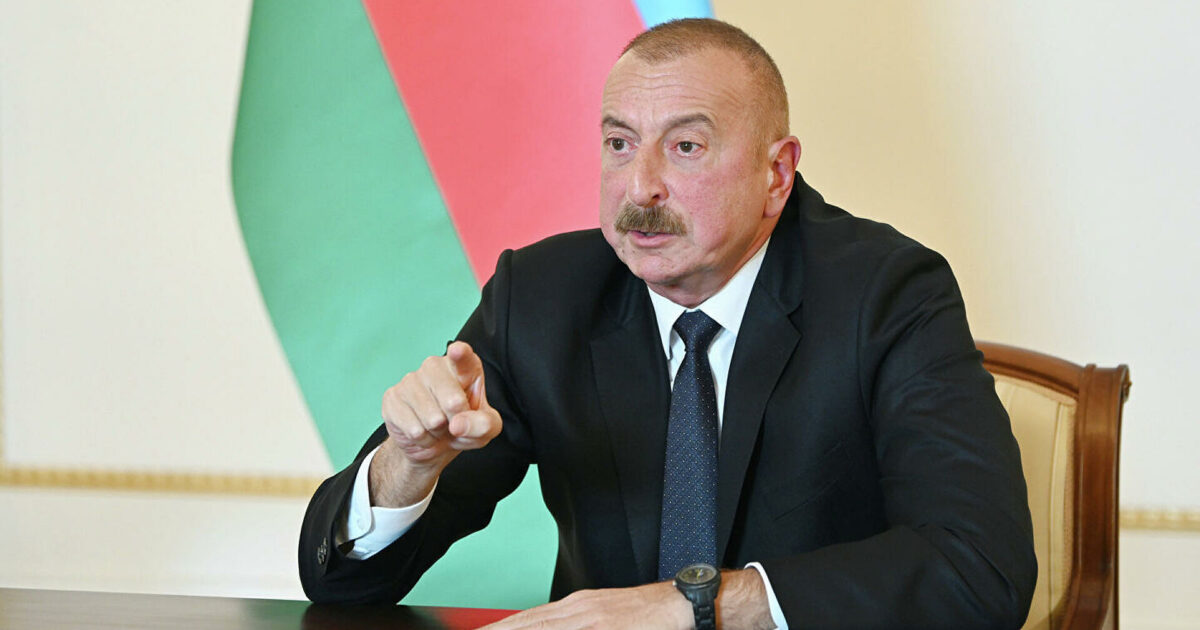
Aliyev routinely denies political motivations behind the persecution and attributes criminal cases against journalists to illegal foreign funding. In 2025, he also accused independent media and NGOs of attempting to stage a coup, saying that Western media had written “that Azerbaijan is a dictatorship, human rights are being grossly violated, the opposition are angels, and the government is the devil.”
At the same time, Baku is increasing its distance from international institutions. In 2025, Azerbaijan expelled several international organizations and foreign media outlets from the country, announced that it would refuse to recognize rulings by the European Court of Human Rights, and Aliyev did not rule out Azerbaijan’s withdrawal from the Council of Europe. According to the BBC, the current wave of repression is targeting opposition activists, journalists, academics, believers and members of national minorities. Experts identify the main reason for its intensification as a preventive strategy by the authorities — an effort to suppress potential discontent before it turns into a real political challenge to the regime.