Putin: Armenia's accession to the EU will mean its withdrawal from the Eurasian Economic Union
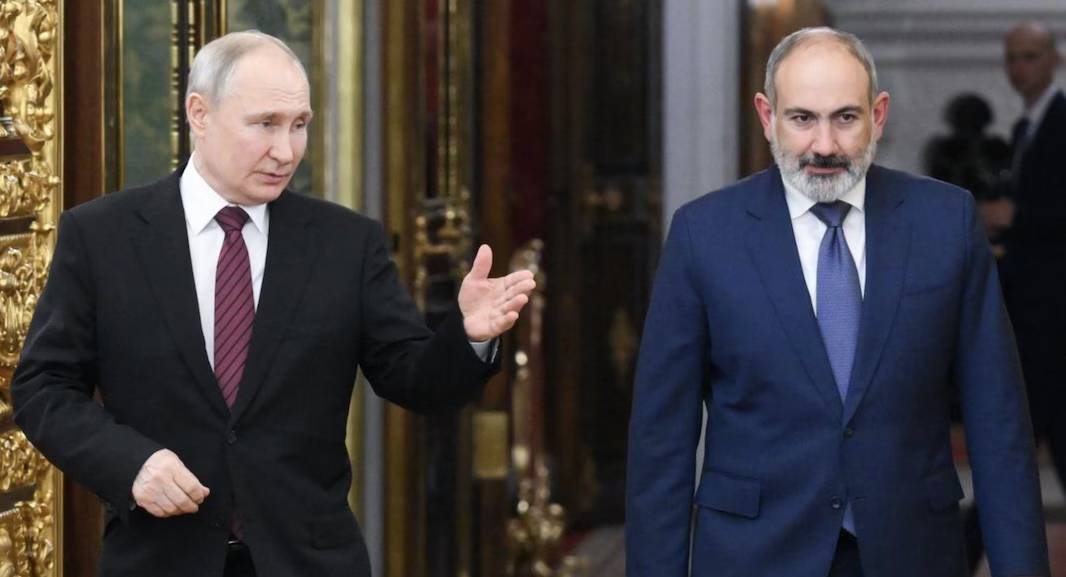
On September 1, Russian President Vladimir Putin held a bilateral meeting with Armenian Prime Minister Nikol Pashinyan on the sidelines of the Shanghai Cooperation Organization summit in Bishkek. The talks took place at the Ala-Archa state residence.
One of the main topics of the meeting was Yerevan's plans for rapprochement with the European Union and their possible impact on Armenia's participation in the Eurasian Economic Union. Putin stated that Moscow would respect Armenia's choice, but urged Yerevan to determine its future course as soon as possible.
"The sooner Armenia decides on its accession to the EU, the better," Putin said, noting that Russia needs to understand how to build relations with Yerevan going forward. He proposed holding a referendum in Armenia on the country's future economic course.
The Russian leader also outlined the conditions under which Armenia would be considered to have withdrawn from the EAEU.
"Adopting a law to begin the process of joining another economic organization effectively means declaring our withdrawal," Putin stated.
Pashinyan disagreed with this interpretation. He stated that Armenia had not notified its partners of its intention to leave the EAEU, and the procedure for such a withdrawal is expressly provided for in the EAEU Treaty. He stated that the country must notify other members of the union of such a decision six months in advance.
"The EAEU Treaty clearly states the appropriate course of action if a country decides to leave the EAEU. [...] It stipulates that if a country decides to leave the EAEU, it must notify its partners six months in advance. [...] We have not yet informed our partners that we intend to leave the EAEU," the Armenian prime minister concluded.
He added that Armenia has not yet made a final choice between the EAEU and another economic integration organization. He stated that the country should be able to consider various options, but there is currently no real alternative to the EAEU.
Putin also reiterated that it is impossible to be a member of both the EAEU and the European Union due to differences in product requirements and technical standards.
"Some issues, such as regulation of agricultural products, regulation of various technical norms and standards—they are completely inconsistent between the EAEU and the EU. We've experienced this repeatedly; attempts—even when we had more or less normal relations—to negotiate some kind of compromise with the Europeans led to nothing, nothing. They are quite tough negotiators, quite stubborn. And so we haven't found a way to resolve almost any of the issues," Putin lamented.
He also emphasized the importance of the EAEU for the Armenian economy, noting that since the republic's membership in the union, its GDP has grown from $10.6 billion in 2015 to $29.2 billion in 2025, while exports to union countries have increased tenfold. According to him, the EAEU market accounts for approximately 36% of the republic's foreign trade turnover.
Furthermore, since the beginning of 2026, trade turnover between Russia and Armenia has reached $2.5 billion, Putin added. Calling Russia Yerevan's main trade and economic partner, he stated that Moscow is interested in developing friendly and mutually beneficial relations between the two countries.
In August, Russian Deputy Foreign Minister Mikhail Galuzin called on the Armenian authorities to hold a referendum on economic policy before the EAEU leaders' summit scheduled for December. Following this, Pashinyan stated that the issue of a referendum on Armenia's EU membership could be considered after the official submission of its application for accession.