Putin meets with the head of Dagestan and praises the republic’s residents for their “brilliant participation in the ‘special military operation’”
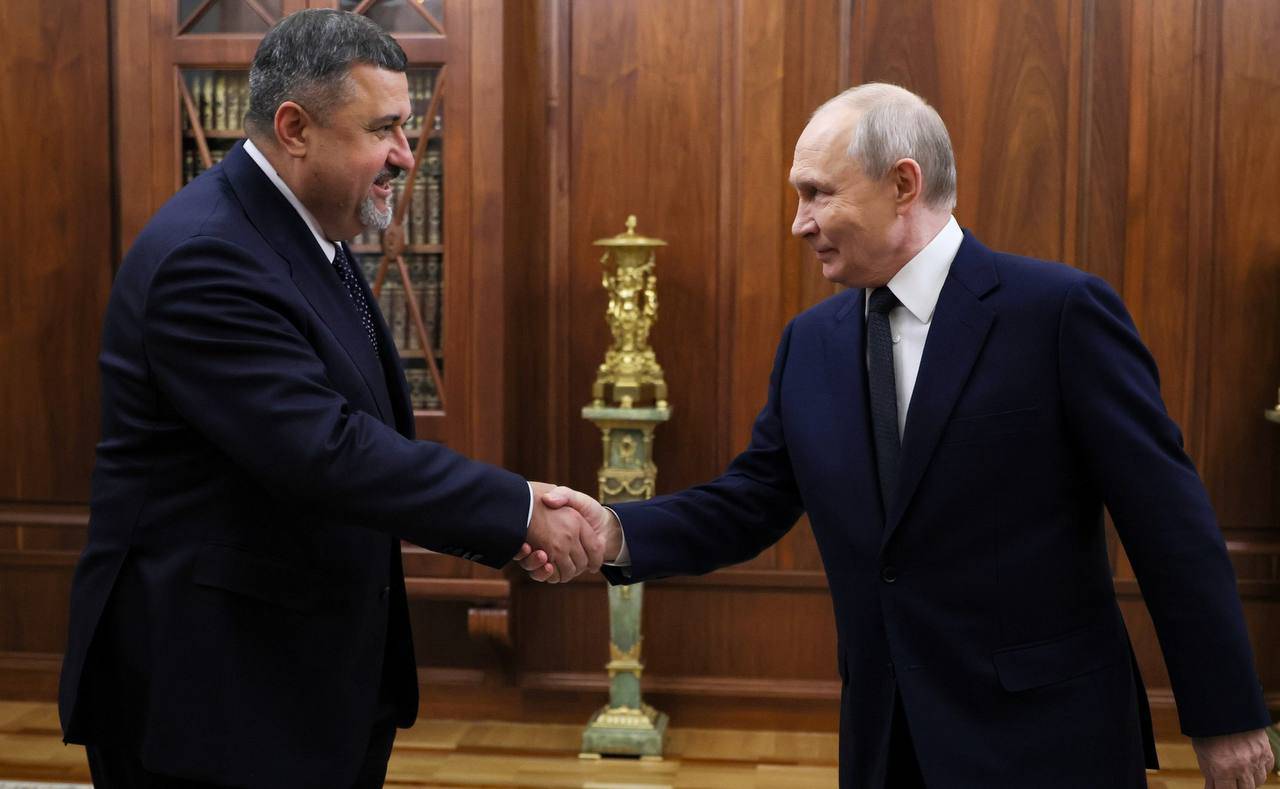
Vladimir Putin met with the head of Dagestan, Fedor Shchukin, at the Kremlin, congratulated him on his election, and emphasized the republic’s special significance to Russia. This marks the second meeting between the president and the regional leader in the last two months.
During the conversation, the Russian president specifically highlighted the participation of Dagestan’s residents in the war against Ukraine. He stated that they are “participating brilliantly in the ‘special military operation’” and maintaining an active stance. The president instructed Shchukin to focus on supporting the families of service members and veterans returning from the front.
Furthermore, Putin urged the head of the republic to take local traditions and culture into account when governing the region. He also noted Dagestan’s high birth rate and the need to address the social issues associated with it.
However, behind the discussions about supporting war participants and their families lies another aspect of Dagestan’s involvement in the conflict: the losses the republic has sustained. Among the republics and krais of the North Caucasian Federal District, Dagestan leads in the number of casualties from the war in Ukraine. According to *Kavkazsky Uzel* (Caucasian Knot), as of October 31, 2026, Russian authorities and security agencies had officially confirmed the deaths of at least 2,190 natives of the republic. The scale of these losses is particularly striking when compared to other regions in the district: 980 military personnel have been officially confirmed dead from Stavropol Krai, and 598 from North Ossetia. The outlet maintains a list of the fallen, identified by name, based on public statements from government authorities and security services.
As early as the autumn of 2022, human rights advocates warned that mobilization could pose an existential threat to Russia’s smaller ethnic groups. In an article titled "Mobilization: A Threat to the Existence of Ethnic Minorities," published on November 1, Daavr Dorzhin—a lawyer at the Memorial Human Rights Defense Center—pointed to the disproportionate burden of mobilization placed on certain ethnic regions. He noted that for smaller ethnic groups, the mass deployment of men to war could lead to severe demographic consequences.
Warnings from human rights defenders regarding the risks faced by residents of ethnic republics are corroborated by reports of men being forcibly sent to the front. In August 2026, the outlet *Verstka*—citing the organizations "Conscript’s School" (*Shkola prizyvnika*), "Go to the Woods" (*Idite lesom*), and "A Call to Conscience" (*Prizyv k sovesti*)—reported complaints of forced detentions and coercion to sign military contracts in at least 17 Russian regions, including Buryatia, Tatarstan, and Bashkortostan. In October, the outlet reported that the scope of such complaints had expanded to at least 33 regions—including Dagestan, Chechnya, and occupied Crimea. The accounts described individuals being detained on the street or at their workplaces, subjected to beatings, and threatened with the planting of narcotics.
In July 2025, *Kavkazsky Uzel* (Caucasian Knot) reported on 18-year-old Said Murtazaliev. According to his mother, he was detained in the Moscow region on suspicion of fraud and subsequently tortured into signing a contract with the Ministry of Defense. After being sent to the front, the young man told his family that his commanders had threatened him with physical harm. He has been listed as missing in action since March 8, 2025. A separate issue, which remained unaddressed during the meeting, concerns problems with payments to the families of deceased servicemen from Dagestan; in some instances, relatives are forced to seek the assistance they are entitled to through the courts.
Specifically, in July 2025, the Tlyaratinsky District Court ruled that the procedure used by the "Vse Vmeste" ("All Together") foundation to deny a payment to the mother of a deceased volunteer fighter was unlawful. The woman had applied for the 1.25 million ruble payout back in January 2024, but was told she was ineligible because her son had signed a contract with a volunteer unit rather than directly with the Ministry of Defense. The court determined that the existing restrictions violated the family's rights and ordered the foundation to pay the full amount.
This is not the only legal dispute involving the regional foundation. In September 2024, the Sovetsky District Court of Makhachkala ruled that the refusal to process an application from the father of another deceased serviceman was unlawful. The foundation had rejected documents submitted by a representative acting under a notarized power of attorney, insisting instead that the applicant appear in person. The court ordered the foundation to reconsider the application.