Turkey condemned the hijab ban in Azerbaijani schools, while Saakashvili called it a "bold move."
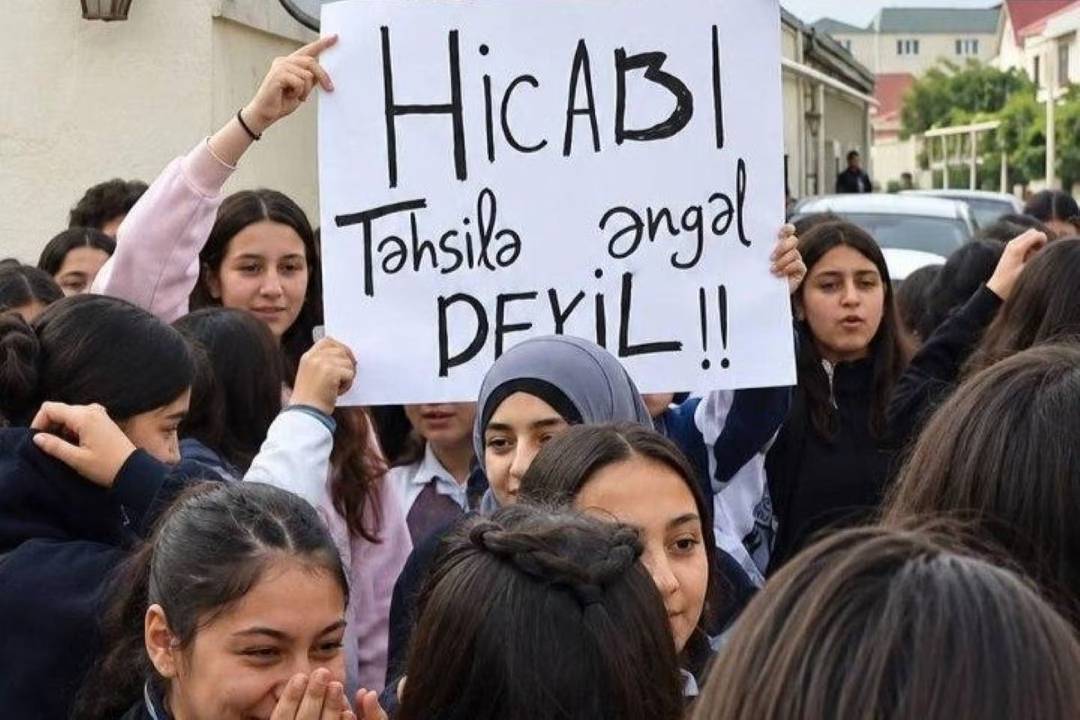
A recent decision by Azerbaijani authorities regarding a standardized school uniform—aligned with the principles of secular education—has sparked debate both within the country and abroad. Amidst protests against restrictions on wearing the hijab in schools, various politicians and public figures have voiced their positions. Their assessments have been sharply divided: some cite a violation of the right to education, while others point to the need to protect the state's secular nature and warn against attempts to politicize religious issues.
Oktay Saral, chief advisor to Turkish President Recep Tayyip Erdoğan, spoke out against the restrictions, stating that they deprive female students of the opportunity to study due to their religious beliefs.
"The hijab is not an obstacle, but a requirement of faith! The right to education must not be sacrificed for the sake of any ideological agenda!" Saral wrote on social media.
He urged the Azerbaijani authorities to reconsider the decision.
"We expect Azerbaijan to rectify this mistake as soon as possible. Obstacles should not be placed in the path of young people toward their future; instead, the way forward must be opened for them," Saral asserted.
Saral's statement provoked an angry reaction in Baku. The Milli Majlis working group on inter-parliamentary relations with Turkey spoke out against what it termed an anti-Azerbaijani campaign in Turkish media and on social networks. The parliamentary statement specifically cited accusations made by certain MPs from the ruling Justice and Development Party (AKP) and by Erdoğan's chief advisor. The authors of the statement cited the "One Nation, Two States" principle—commonly used to describe relations between Azerbaijan and Turkey—and emphasized that it does not grant the right to interfere in a neighboring country's internal affairs or to impose political and religious views upon it.
The MPs also deemed the use of "insulting and slanderous language" directed at Azerbaijani President Ilham Aliyev—as well as at "our people, our history, and our country's prominent figures"—to be "unacceptable." They expressed strong dissatisfaction with the Turkish authorities' reaction to the situation.
"Unfortunately, the AKP authorities are taking no steps to prevent all this," Baku concluded.
Separately, the parliamentarians pointed to the Turkish authorities' tolerance of provocative actions near Azerbaijani diplomatic missions. They urged representatives of Turkey's ruling party to respect Azerbaijan's sovereignty and constitutional order and to refrain from making statements that could harm relations between the two countries.
For his part, Allahshukur Pashazade, Chairman of the Caucasus Muslims Office, stated that the dispute over school uniforms is being exploited to stoke confrontation. In an interview with Real TV, he emphasized that the word "hijab" does not appear in the official decision regarding uniforms.
"The adopted decision does not contain the word 'hijab.' It concerns a standard school uniform. Yet, it is being labeled as a 'hijab' to have a greater impact on Muslims," Pashazade said.
At the same time, the Sheikh-ul-Islam acknowledged that consultations with interested parties should have taken place before the decision was made.
"I deeply regret that preliminary consultations could have been held before this decision was adopted, yet that did not happen. Perhaps some people misunderstand the situation or simply do not wish to understand it," he lamented. Pashazade believes that attempts are being made to exploit the protests for political purposes and to portray the situation as the oppression of Muslims in Azerbaijan.
"They are politicizing this issue and turning people against the state. This is unacceptable," the cleric stated indignantly.
The Sheikh-ul-Islam also urged believers not to succumb to provocations and assured that the protest supporters would not succeed in achieving their goals.
Imprisoned former Georgian President Mikheil Saakashvili took a position opposite to Saral’s, supporting Baku’s decision. He described it as "an important and bold step by Ilham Aliyev to strengthen Azerbaijan as a secular state and curb the influence of Islamists."
However, the politician did not limit his statement to an assessment of Azerbaijan’s domestic policy; he also shifted the focus to Georgia.
"Meanwhile, Iran—having already lost its leverage over Azerbaijan—is actively promoting the radical Islamization of Azerbaijanis living in Georgia. This poses a mortal threat to the country’s statehood and territorial integrity. The Islamists here are a danger to Georgia, Azerbaijan, and the entire region," Saakashvili wrote on his Facebook page.
Saakashvili’s statement drew sharp criticism from members of the Azerbaijani community in Georgia. In particular, Samira Bayramova—a Georgian civic activist and human rights defender advocating for ethnic minorities—reminded the former president in a social media post of his own government's past decisions and questioned the consistency of his current statements.
Bayramova asked why Saakashvili’s administration had authorized the Al-Mustafa International University to operate officially in Georgia in 2011 if Iranian influence on the Azerbaijani community was already viewed as a threat at that time. She also pointed out that representatives of the former president’s party had collaborated with local political figures whom she considers to be linked to Iran.
The activist also highlighted the issue of religious rights. She noted that Article 9 of the European Convention on Human Rights protects freedom of religion and that wearing a hijab can be a form of expressing religious beliefs. If female students are barred from attending classes due to religious attire, Bayramova argues, this infringes not only upon freedom of religion but also upon the right to education.
The human rights activist stated that Saakashvili’s rhetoric creates the impression that Muslim identity or Azerbaijani heritage inherently pose a security threat. She urged the former president not to exploit the Azerbaijani community for political ends.
"Georgian Azerbaijanis are equal citizens of Georgia, not a political tool or a bargaining chip," Bayramova emphasized.