Theft of government vehicles in Pervomaisky, “cleansing operations” in Chiri-Yurt, New and Staryye Atagi and Duba-Yurt, kidnapping of a resident of Argun
November 29, 2001
***
In the village of Pervomaiskoye, unknown persons stole government vehicles at gunpoint. At 19.15, three people in military uniform and masks entered the house of Vakha Zilaudinovich Bishaev, born in 1955, on Sadovaya Street. They were armed with short-barreled assault rifles (AKSU). Introducing themselves as employees of the commandant's office, the unknown people asked to help them pull out a car stuck on the outskirts of the village. The owner of the house worked as a driver of a special vehicle for servicing drilling rigs of the Rosneft company. He tried to refuse, citing a lack of fuel. Unknown people threatened him with weapons, and he had to agree.
Taking his neighbor with him and leaving his crying wife and two young children, Vakha Bishaev left the village in a KrAZ car with the headlights off (this was the demand of the unknown persons). On the outskirts he was ordered to stop and honk his headlights towards the local (Russian) cemetery. In response, a light signal was also given. When we got closer, several more people appeared who were waiting in a UAZ car. Although they all spoke Russian and called each other by the names Sergey, Kolya, Andrey, some had a barely noticeable accent.
Vakha Bishaev and his neighbor were pushed out of the car, forced to lie down in the snow, and held with machine guns pointed at the back of their heads for more than an hour. During this time, one group of unknown people drove the KrAZ truck somewhere, and after some time, those guarding Bishaev and his neighbor got into the UAZ and drove away.
Vakha Bishaev and his neighbor returned home on foot. The next day, one of the villagers saw a stolen car moving towards the village of Oktyabrskoye.
In the republic, attacks on local residents with the aim of taking away vehicles, both public and private, have become noticeably more frequent. Over the previous two to three weeks, cases of tractor thefts in the villages of Pervomaiskoye and Oktyabrskoye became known. Stolen vehicles were delivered through checkpoints to Sernovodsk, and from there they were transported to neighboring Ingushetia. Along with local criminals, the Russian military also took part in this criminal business: without their help, it would have been impossible to move through checkpoints under virtually curfew conditions.
***
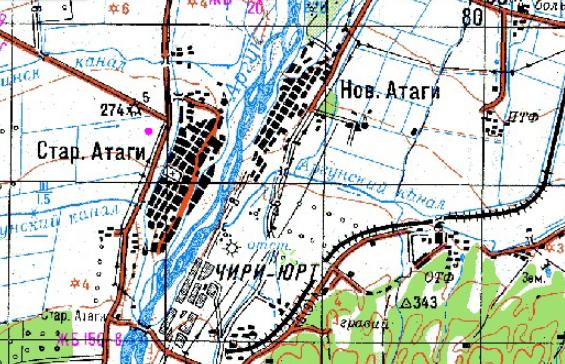
The villages of Chiri-Yurt, New and Starye Atagi, and Duba-Yurt were blocked by military equipment. Almost immediately after this, the Russian military began “cleansing operations.” Contrary to the order of the Prosecutor General of the Russian Federation Vladimir Ustinov (No. 46 of July 2, 2001), the heads of district administrations, local police officers and prosecutors were not present. According to unofficial information, the operation was carried out by units of the 70th motorized rifle regiment of the 42nd division of the Russian Defense Ministry.
During the “cleansing”, the commandant of the Shalinsky district, Gennady Nakhaev, visited the villages, however, according to the testimony of local residents, he did not even try to stop the arbitrariness. Moreover, sometimes he himself became the instigator of illegal actions, humiliating and insulting defenseless people. To an elderly woman in Novye Atagi, whose grandson was detained by the military for no reason, he said: “You, old b..., Russia provides you with a pension! Should I hit you in the forehead now or shoot you later?!” Many Atagino residents heard these words.
The military took the passports of everyone who did not have permanent registration in these villages. First of all, among refugees from Grozny. They did not take into account temporary residence certificates issued by local administrations. People were forced to buy back their passports for 50 rubles.
In order to detain someone, the military themselves created a pretext by planting weapons or ammunition. This happened, for example, in the village of Chiri-Yurt, where they first planted weapons and then filmed the “successful search” of the house on a video camera. During the “search,” the owners of the house were in the yard at gunpoint.
However, in some places this turned out to be unnecessary. The military simply pointed to a machine gun, often their own, or a cartridge and told the residents of the house that they had found it in the room under the bed or somewhere else. The military pointedly ignored the witnesses, protocols and other “excesses” provided for in such cases by law.
On one of the nights of the “cleansing” operation, machine gun fire suddenly rang out. The bullets hit the window of one of the houses. On December 3, those who could pay 50 rubles began to be released from the village. On December 4, the settlements were finally unblocked. The military left, releasing all the people detained in the previous days.
***
In the city of Argun, the military, who arrived in armored personnel carriers, took Rizvan Vakhitovich Arsamykov, born in 1975, from his home (Vygonnaya St., 1). According to his mother, Malkan Shuukhalova, her son did not participate in hostilities in either the first or second war.
The kidnappers were wearing uniforms and masks. No documents were presented. Their ethnicity is Russian. They spoke only Russian.
Relatives searched for Rizvan Arsamykov for a long time, but to no avail. They lost hope of finding him. When approached by Memorial Human Rights Center staff, Malkan Shuukhalova was reluctant to answer questions, repeating that they were doing a useless job.
The prosecutor's office opened a criminal case regarding the kidnapping of this man, but the relatives did not know his number or the status of the investigation. As of August 2008, Rizvan Arsamykov was considered missing.
From the book “People Live Here”, Usam Baysaev, Dmitry Grushkin, 2006.