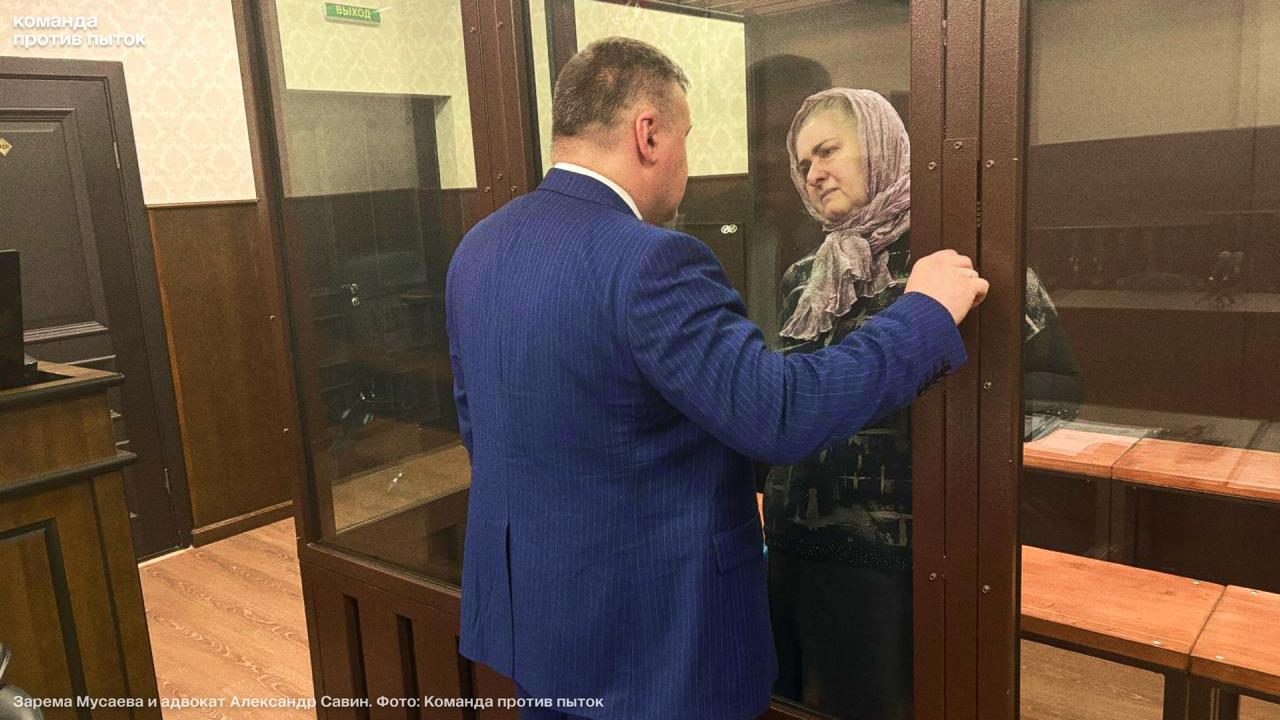
For the first time, the state prosecutor disagreed with the verdict against Zarema Musayeva
The Supreme Court of Chechnya overturned the sentence of Zarema Musayeva, who was sentenced to four years in a penal colony on charges of disrupting the colony's operations. The decision was made following an appeal by lawyer Alexander Savin, according to the "Team Against Torture."
For the first time in Musayeva's trial, the prosecutor agreed with the defense's arguments at the hearing, also calling for the verdict to be overturned and the case sent for a new trial. He pointed to the trial court's formal approach, which failed to consider the defense's arguments and the contradictory evidence in the case, which lacks witnesses to the attack on the FSIN officer.
Zarema Musayeva, who denied her guilt, will await a new trial in custody, as the court upheld her pretrial detention.
Zarema Musayeva, the 55-year-old wife of former Chechen judge Saidi Yangulbaev and the mother of opposition activists critical of Chechen leader Ramzan Kadyrov, was detained in January 2022 in Nizhny Novgorod by Chechen security forces. After being taken to Grozny, she was accused of fraud and assault against a police officer, allegedly scratching his face on the way.
In July 2023, a Chechen court sentenced Musayeva to five years in prison based on these charges. In early March 2024, the Pyatigorsk Court of Cassation reduced her sentence, reducing it from five years to four years and nine months. She was recognized as a political prisoner.
Musayeva was scheduled to be released in March 2025, but a new criminal case was opened against her. The court sentenced her to four years in a penal colony on charges of disrupting the functioning of a correctional facility. According to the case file, Musayeva allegedly attacked a guard during transport to the hospital, scratching his neck and damaging his shoulder strap. However, the testimony of FSIN officers is contradictory: one guard claimed she hit and scratched him, while the other did not witness it.
At the end of 2025, Chechen leader Ramzan Kadyrov commented on Zarema Musayeva's case during a live broadcast, admitting that she was "taken" to Chechnya because members of her family "worked on social media."