The British Embassy reminded Georgia that the BBC is an independent media outlet in response to demands for an apology
The British Embassy in Georgia responded to Prime Minister Irakli Kobakhidze's statement that London should apologize for a "fake" spread by the BBC. This refers to the British Broadcasting Corporation's controversial report alleging that Georgian authorities used a World War I-era chemical weapon called "kamit" to suppress anti-government protests.
In response to the demand for an apology, the embassy reiterated that the BBC is an independent media outlet.
"The BBC is independent from the British government in both operational and editorial matters, and this matter is at the discretion of the corporation itself," the diplomatic mission told Radio Liberty.
Earlier, the Georgian prime minister stated that the UK should apologize for the BBC's lies. The politician thus commented on British Ambassador Gareth Ward's statement that "political relations between the countries have been damaged because anti-democratic pressure is being exerted on the opposition and civil society in Georgia."
According to Kobakhidze, "the first thing the UK should do is apologize for the fake news" spread by the BBC, since the corporation "is a public broadcaster directly funded by public channels." He called the published material "an absolutely artificial attempt" to provoke a scandal, "based on lies."
"We intend to appeal to Ofcom, the British Regulatory Commission. If necessary, to court. We will use all legal means to force the BBC to apologize for the lies it has spread," the prime minister threatened.
As a reminder, former Georgian Interior Minister Vakhtang Gomelauri previously stated that the chemical weapon known as "kamit" and other substances mentioned in the BBC investigation "were indeed purchased by the Ministry of Internal Affairs and used, but before 2012," that is, during the rule of the National Movement party. This claim was denied by Georgian Prime Minister Irakli Kobakhidze, and then by the current minister, Geka Geladze. According to Geladze, his predecessor implied that various substances were purchased in 2009, but not "kamit."
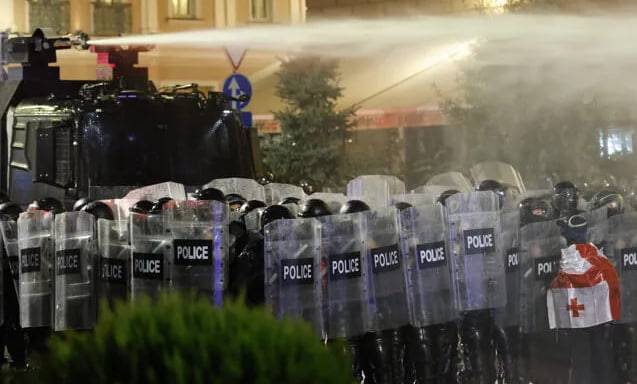
In response to the politicians' contradictory statements, 25 Georgian non-governmental organizations issued a joint statement demanding the publication of a list of the chemicals used by police against participants in pro-European protests. On December 6, the State Security Service officially identified the substance used by the Ministry of Internal Affairs to disperse the rallies. The agency claims that the substance in question is a chemical compound of the CS gas—chlorobenzylidene malononitrile—dissolved in propylene glycol. These substances are not prohibited, the State Security Service notes.
As a reminder, the British Broadcasting Corporation (BBC) published a report alleging that the Georgian authorities used the chemical weapon "Kamit" during the suppression of pro-European protests in Tbilisi in 2024. The investigation is based on testimonies from demonstrators protesting the government's decision to suspend the country's European integration process: they complained of "the water scalding," as well as shortness of breath, coughing, and vomiting that lasted for weeks. After speaking with chemical weapons experts, representatives of the Georgian special police forces, and medical professionals, the journalists concluded that the aforementioned substance was used.