Georgian police action against fans displaying Palestinian flag sparks outrage in Turkey
Turkey’s Foreign Ministry summoned Georgia’s ambassador to Ankara, Archil Kalandia, following clashes between Georgian police and Turkish football fans during a match in Batumi. Ankara demanded a comprehensive investigation into the incident and called for law enforcement officers responsible for what Turkish authorities described as excessive use of force to be held accountable. UEFA said decisions regarding police intervention had been taken by the Georgian authorities and launched its own disciplinary investigation.
The incident occurred on November 26 during a UEFA Europa League matchday five fixture between Turkey’s Beşiktaş and Israel’s Hapoel Be’er Sheva. The match was originally scheduled to take place in Istanbul but was relocated to Batumi over security concerns.
Ahead of the game, Beşiktaş supporters gathered in central Batumi, chanting pro-Palestinian slogans and waving Turkish and Palestinian flags. One of the banners also read: “Batumi is Turkey’s 82nd province.”
Problems with admitting Turkish supporters to the stadium arose even before kick-off. Beşiktaş officials later said club representatives had contacted the UEFA match delegate and secured the opening of emergency exits, allowing supporters to enter the stands.
Before the match, Beşiktaş players refused to shake hands with members of the Israeli team.
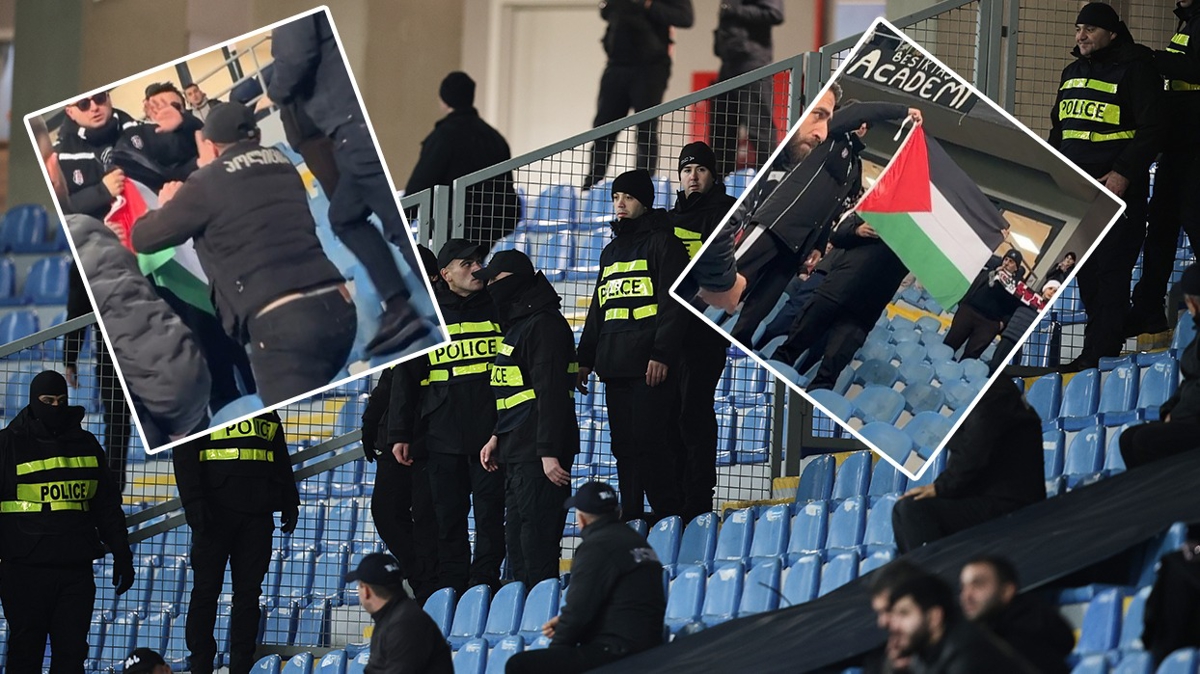
Georgian police intervened after Turkish supporters unfurled a Palestinian flag. According to Turkish media reports, officers did not prevent supporters of the Israeli club from displaying the Israeli flag.
Despite attempts to confiscate pro-Palestinian symbols, Beşiktaş supporters unfurled a banner during the match reading: “Rise up against occupation, freedom for Palestine.” It also featured the Turkish and Palestinian flags and the Istanbul club’s emblem.
Georgian police officers entered the stands and, according to Turkish media reports, used pepper spray. Published video footage shows one injured person being carried away on a stretcher.
In the 26th minute, Danish referee Morten Krogh suspended the match. Players and match officials left the pitch. Beşiktaş players and the club’s sporting director, Önder Özen, attempted to calm the supporters. Play resumed approximately half an hour later, with the Turkish side eventually winning 2–1.
Georgia’s Interior Ministry reported that 16 people had been detained. It rejected allegations that the police intervention was prompted by the display of Palestinian symbols. According to the ministry, disturbances began before the flags and banners appeared, and officers intervened in response to aggressive behaviour by supporters and breaches of public order.
The incident prompted a strong reaction in Turkey. Numan Kurtulmuş, speaker of the Turkish Grand National Assembly, described the actions of Georgian police against supporters who had unfurled a Palestinian flag and called for Palestine’s liberation as unacceptable.
“Supporting the brotherly Palestinian people’s struggle for freedom is an ethical and moral responsibility,” Kurtulmuş said.
He said the use of force against people expressing solidarity with Palestinians ran counter to the universal values of sport and violated fundamental rights and freedoms. He called on the relevant authorities and international sporting organisations to take immediate action, pledging that Turkey would defend the rights of its citizens and athletes.
Turkey’s Minister of Youth and Sports, Osman Aşkın Bak, condemned the Georgian police’s actions in a post on X.
“I strongly condemn the disproportionate intervention by security forces against our Beşiktaş supporters in Georgia this evening,” the minister said.
He stressed that Turkey opposed all forms of discrimination and injustice incompatible with the universal values of sport.
“We will continue to resolutely defend the rights of Turkish sport and our supporters in every forum,” Bak added.
Ömer Çelik, spokesperson for Turkey’s ruling Justice and Development Party (AK Party), also described the use of force against supporters displaying a Palestinian flag and a banner calling for Palestine’s liberation as unacceptable.
Speaking to television channel TV100, Çelik said the problems had begun as Turkish supporters were entering the stadium. He said they were subsequently instructed to move their pro-Palestinian banner to the lower section of the stands. Although the supporters complied, police nevertheless used force against them, the ruling party spokesperson alleged.
Çelik also said that calls for Palestine’s liberation should not be regarded as political slogans.
AK Party Deputy Chairman Kürşad Zorlu accused UEFA of double standards.
“What happened in Batumi was not an incident in the stands, but a manifestation of double standards,” he said.
Zorlu noted that Beşiktaş had first been deprived of the opportunity to play a home match in front of its own supporters and had subsequently faced excessive use of police force outside Turkey. He also criticised what he described as UEFA’s inadequate response to the use of pepper spray against Turkish citizens.
Turkey’s Minister of Transport and Infrastructure, Abdulkadir Uraloğlu, also condemned the police’s actions, expressed solidarity with Beşiktaş supporters and wished those injured a speedy recovery.
Beşiktaş president Serdal Adalı criticised the conduct of Georgian law enforcement officers. Following the incident, Turkish President Recep Tayyip Erdoğan personally telephoned Adalı to express his support for the club and its supporters.
Beşiktaş officials contacted UEFA and the Turkish Consulate General in Batumi over the use of force against supporters. The club pledged to monitor the situation until all Turkish supporters had returned home safely.
The Turkish Football Federation also condemned the actions of Georgian police and said it would seek to establish the full circumstances of the incident, identify those responsible and ensure that sanctions were imposed without delay.
Other Turkish football clubs, including Galatasaray, Fenerbahçe, Trabzonspor, Başakşehir, Samsunspor and Erzurumspor, issued statements expressing solidarity with Beşiktaş and condemning the conduct of Georgian law enforcement officers.
Turkish Interior Minister Mustafa Çiftçi discussed the incident by telephone with his Georgian counterpart, Sulkhan Tamazashvili. He expressed concern over the excessive use of force against Turkish citizens and demanded that their safe return home be ensured.
According to Çiftçi, the Georgian interior minister said during the conversation that UEFA representatives had confiscated Palestinian flags from supporters and that the Georgian authorities had played no role in the confiscation. Tamazashvili also said he had dispatched his deputy to the stadium after the disturbances began.
The incident in Batumi was also discussed in a telephone conversation between the foreign ministers of Turkey and Georgia, Hakan Fidan and Maka Bochorishvili.
“When these regrettable and unacceptable events occurred, I was on a plane. Yesterday, we concluded a meeting of the National Security Council. Together with the defence minister and the chief of the General Staff, we boarded a plane bound for Pakistan. It was during that time that these incidents occurred at the match. Immediately afterwards, I called the Georgian foreign minister. We were also in direct contact with our ambassador and consul general, who were on the ground,” Fidan said.
According to Fidan, Turkey’s immediate priorities were to stabilise the situation, prevent Turkish citizens from being detained, ensure their safety and provide them with the necessary assistance. He said all necessary measures had been taken and that other government agencies had also become involved in efforts to resolve the situation.
Georgia’s ambassador, Archil Kalandia, was summoned to the Turkish Foreign Ministry, where Ankara lodged a formal protest, issued a warning and presented materials that it said substantiated its account of the incident. The ministry demanded a comprehensive investigation and legal action against police officers responsible for the excessive use of force and unlawful conduct towards Turkish citizens.
“For us, this is an absolutely unacceptable situation. It is inconsistent with the level of relations between our two countries. We cannot accept such treatment of our supporters. I believe our messages on this issue have been understood,” Fidan said.
On the evening of November 26, UEFA issued an official statement denying responsibility for security arrangements at the stadium in Batumi. The governing body stressed that, as with other matches during the current season, UEFA was not the organiser of the fixture and had no control over the actions of local law enforcement authorities.
“All interventions at the stadium were decided upon and carried out directly by the competent local authorities within the scope of their responsibilities and powers,” UEFA said in its statement.
The organisation also rejected the account of how the clashes began that had been reported by several media outlets. According to UEFA, the confrontation between Georgian police officers and Beşiktaş supporters, which led to the temporary suspension of the match, escalated after officers intervened in the Turkish supporters’ section to stop clashes among Beşiktaş fans themselves.
UEFA also clarified that it had been informed by the Turkish Football Federation that the match could not be held at Beşiktaş’s home stadium in Istanbul. The federation had acted in accordance with recommendations and instructions from the competent Turkish authorities. The same notification identified the newly agreed venue in Batumi, Georgia.
The following day, November 27, UEFA issued a further statement concerning disturbances at two Europa League matches: Beşiktaş against Hapoel Be’er Sheva in Batumi, and France’s Marseille against Bulgaria’s Levski in Marseille.
“Violence, aggression, hatred and any form of provocative, discriminatory or extremist behaviour have no place in football,” UEFA said.
The governing body strongly condemned the violence and disturbances at both matches, stressing that the incidents ran counter to the fundamental principles of its competitions — respect, fair play, integrity and safety — as well as UEFA’s statutory objective of ensuring that football matches are played in a spirit of peace, mutual respect and sporting fairness.
UEFA appointed ethics and disciplinary inspectors to conduct investigations into both incidents, examine all available evidence and establish the circumstances surrounding the events in accordance with the organisation’s applicable regulations. UEFA said further decisions would be announced in due course.
Turkish media reported on November 27 that “diplomatic and legal measures undertaken at the instruction of President Recep Tayyip Erdoğan had secured the release of all 16 Beşiktaş supporters detained in Batumi.”
Their release was also confirmed on November 27 by Georgian Interior Minister Sulkhan Tamazashvili. He said, however, that administrative proceedings would continue.
“Unfortunately, four of our officers were injured,” the Georgian interior minister said.
Tamazashvili noted that Beşiktaş had been the organiser of the match and expressed confidence that UEFA would require the Turkish club to compensate for the damage caused.