Mass protest in Tbilisi marks two years since Georgia froze its EU accession process
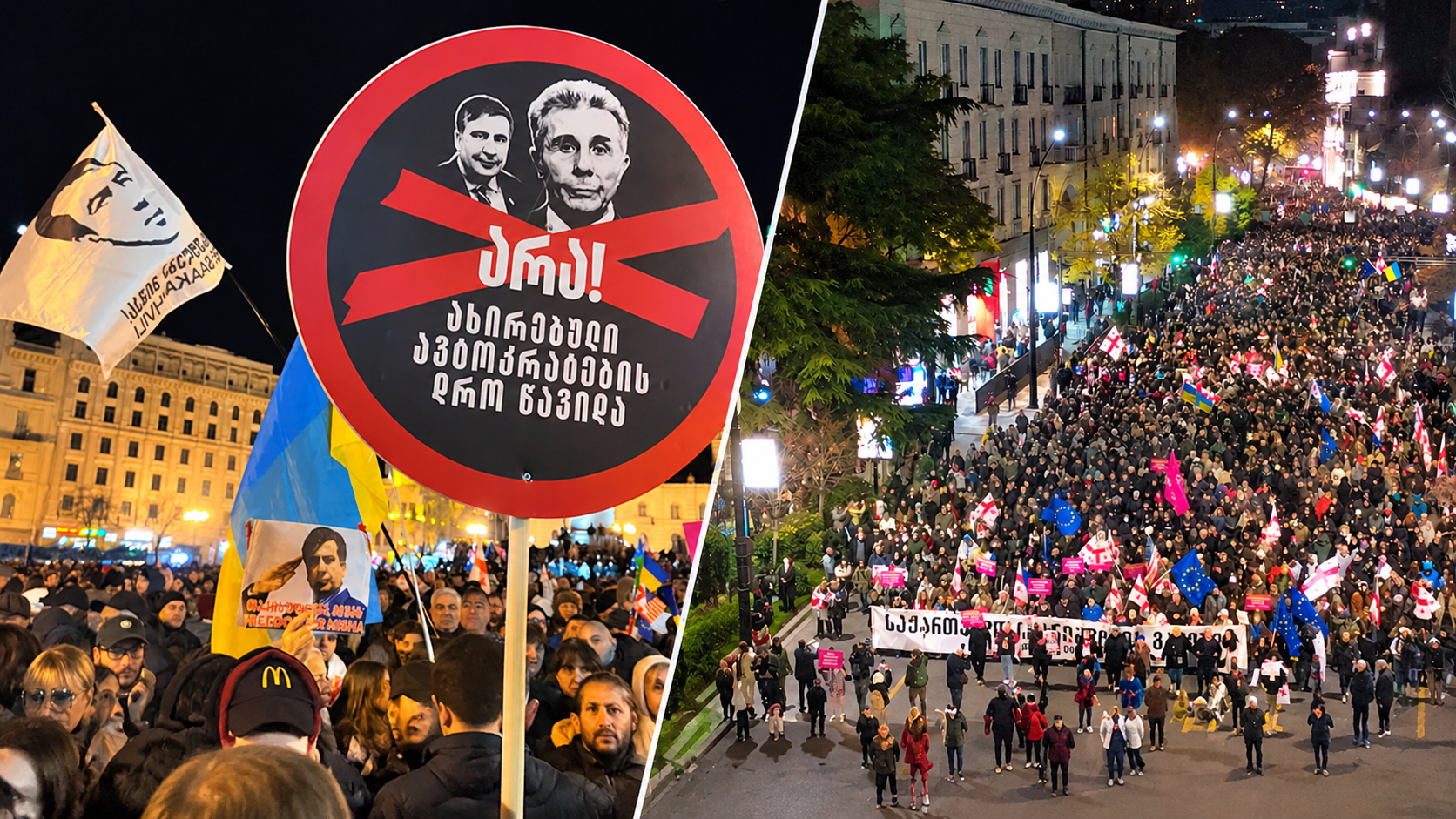
A large-scale anti-government demonstration is taking place in Tbilisi this evening, marking the second anniversary of the start of sustained pro-European protests. Over the past two years, hundreds of protesters have been detained, dozens have been imprisoned, relations between Tbilisi and Brussels have deteriorated sharply, and five leading opposition parties are facing a possible ban.
Demonstrators marched towards Freedom Square in three separate columns. The traditional Saturday march set off from Avlabari metro station, representatives of opposition parties and their supporters gathered outside Tbilisi State University, while members of the Movement for Social Democracy departed from Orbeliani Square.
Protesters are carrying Georgian and European Union flags, placards and banners bearing slogans including “Georgia without Ivanishvili” and “Georgia is Europe”. Traffic in central Tbilisi has been disrupted. The protesters’ principal demands remain unchanged: fresh parliamentary elections, the resumption of Georgia’s EU integration process and the release of political prisoners.
The sustained protests were triggered by an announcement on November 28, 2024, by Georgian Prime Minister Irakli Kobakhidze that his government would not put the opening of EU accession negotiations on its agenda until the end of 2028 and would decline EU budgetary grants during that period.
The decision came amid a political crisis that erupted following the parliamentary elections of October 26, 2024. The opposition rejected the ruling Georgian Dream party’s victory, accusing the authorities of widespread electoral fraud. Georgia’s then-president, Salome Zourabichvili, also refused to recognise the election results.
Kobakhidze’s announcement brought tens of thousands of people onto the streets of Tbilisi and other cities across the country. The early days of the protests saw fierce clashes between demonstrators and police in the Georgian capital, with officers deploying water cannon and tear gas. Human rights organisations documented numerous cases of beatings and ill-treatment of detainees, as well as attacks on journalists.
According to the Georgian news outlet Civil Georgia, around 125 people had faced criminal prosecution as of November 24, 2026: 61 in connection with protests following the parliamentary elections and the suspension of the EU integration process, and a further 64 over disturbances on October 4, 2025, the day of local elections. Of those, 45 remain behind bars. Some of those convicted have been released after serving their sentences, entering into plea agreements or receiving presidential pardons.
In a statement issued on November 27, 2026, the international human rights organisation Amnesty International said that thousands of people had been subjected to arbitrary detention and fines over the past two years, hundreds had reported torture and other forms of ill-treatment, and more than 150 had been imprisoned following unfair trials that the organisation described as politically motivated.
During the crackdown on protests in November and December 2024 alone, more than 300 demonstrators reported torture and ill-treatment. Yet only a handful of police and special forces officers have faced criminal prosecution. Amnesty International noted that none of their commanding officers had been subjected to criminal proceedings.
Human rights advocates called on the Georgian authorities to investigate allegations of torture, hold those responsible accountable, release everyone detained solely for exercising their rights and ensure an independent review of convictions handed down in connection with the protests.
According to data from the international research project Armed Conflict Location & Event Data (ACLED), Georgia recorded 1,371 protest events between November 28, 2024, and November 19, 2026, compared with 552 in the preceding two years. The overwhelming majority of demonstrations were peaceful. The figures include not only anti-government protests but also demonstrations over socio-economic issues.
Although pro-European demonstrations have declined in scale and geographical reach compared with the first months of the protest movement, daily rallies in Tbilisi have continued. Batumi has emerged as another centre of the movement.
Government opponents, however, have yet to achieve their demands. Instead, the authorities have progressively tightened penalties for violations of rules governing public assemblies, restricted the activities of non-governmental organisations and independent media, and initiated legal proceedings to ban leading opposition parties.
Georgia’s Constitutional Court is considering an application by the ruling party to ban five political groups: the United National Movement, the Coalition for Change, Lelo–Strong Georgia, the Federalists and former Prime Minister Giorgi Gakharia’s For Georgia party.
Georgian Dream accuses them of violating constitutional provisions prohibiting political parties whose objectives include overthrowing or forcibly altering the constitutional order. The opposition views the authorities’ actions as an attempt to eliminate political competition.
In March 2026, nine opposition parties formed an alliance, and in October they launched a new protest campaign under the slogan “Georgia without Ivanishvili”. Today’s demonstration is one of the campaign’s key events.
The deterioration in relations between Tbilisi and Brussels began before the events of November 2024. Having secured EU candidate status in December 2023, Georgia came under sharp criticism from European institutions just months later over the adoption of its Law on Transparency of Foreign Influence.
The legislation required non-governmental organisations and media outlets receiving more than 20 per cent of their income from foreign sources to register as organisations pursuing the interests of a foreign power. Opposition parties and civil society representatives dubbed it the “Russian law”, viewing it as an instrument of pressure on independent organisations and media outlets.
In June 2024, the European Council concluded that the actions of the Georgian authorities had effectively halted the country’s EU accession process. Tensions deepened following the adoption of the Law on Family Values and Protection of Minors, the disputed parliamentary elections, the forcible suppression of demonstrations and the criminal prosecution of opposition figures.
The European Parliament has repeatedly condemned the actions of Georgia’s leadership, called for fresh parliamentary elections, the release of political prisoners, investigations into violence against protesters and the imposition of targeted sanctions on government officials.
The European Union suspended part of its financial assistance to the Georgian government. In January 2025, the Council of the EU restricted the application of its visa facilitation agreement to Georgian diplomats and officials. From March 6, 2026, visa-free travel for holders of Georgian diplomatic, service and official passports was suspended for one year.
Visa-free travel remains in place for ordinary Georgian citizens, although a further deterioration in democracy and human rights could lead to broader restrictions.
Kobakhidze, meanwhile, maintains that the decision taken two years ago was justified. In an interview with the pro-government television channel Imedi today, the prime minister again accused the European bureaucracy of exerting political pressure on Georgia and government opponents of attempting to bring about a revolutionary change of power.
Revisiting the circumstances surrounding the adoption of the Law on Transparency of Foreign Influence, Kobakhidze rejected comparisons with Russian legislation.
“Today, everyone understands that the transparency law had nothing to do with Russia or with violations of any legal standards. It stipulated only one thing: NGOs, that is, foreign non-governmental organisations operating in Georgia, were required to submit declarations to the Ministry of Justice once a year,” the prime minister said.
He claimed that the legislation had been targeted by a “campaign based on utterly shameful lies” and that protests against its adoption had been accompanied by two violent attempts at revolution.
Kobakhidze described the European Union’s decision not to grant Georgia candidate status in June 2022 as unjustified, linking it to the subsequent escalation of domestic political tensions.
“Candidate status was used to blackmail the country. This struggle continued for almost two years, and we managed to secure that status. When candidate status lost its value as an instrument of blackmail, it was granted to us,” Kobakhidze said.
Explaining his announcement of November 28, 2024, the prime minister stressed that his government had not abandoned Georgia’s European course.
“We said that, for our part, we would not put the issue of opening negotiations on the agenda until 2028. At the same time, we immediately made it clear that if they decided to open negotiations, we would sign the relevant document straight away. That statement was perfectly clear and unambiguous.”
Kobakhidze insisted that Georgia’s accession to the European Union by 2030 remained the government’s objective.
“We could no longer allow the European bureaucracy to use the issue of European integration as a means of blackmail. First, it was candidate status, which was used to wear the country down for more than a year and a half. Attempts at revolution were linked to it, and the next instrument was the issue of opening negotiations,” the prime minister said.
Kobakhidze described the mass demonstrations that erupted following his announcement two years ago as a continuation of the campaign against the foreign influence law, and the events of the first five days of protests as another violent attempt to overthrow the government.
“Subsequently, however, they gave us an opportunity to restore calm in the country,” the prime minister said, adding that the past two years had been considerably more peaceful for Georgia than the period between 2020 and 2024.
In Brussels, however, Georgia’s prospects of joining the European Union are seen as contingent on a change in the political direction of its leadership, the restoration of democratic institutions, respect for human rights and adherence to the rule of law.