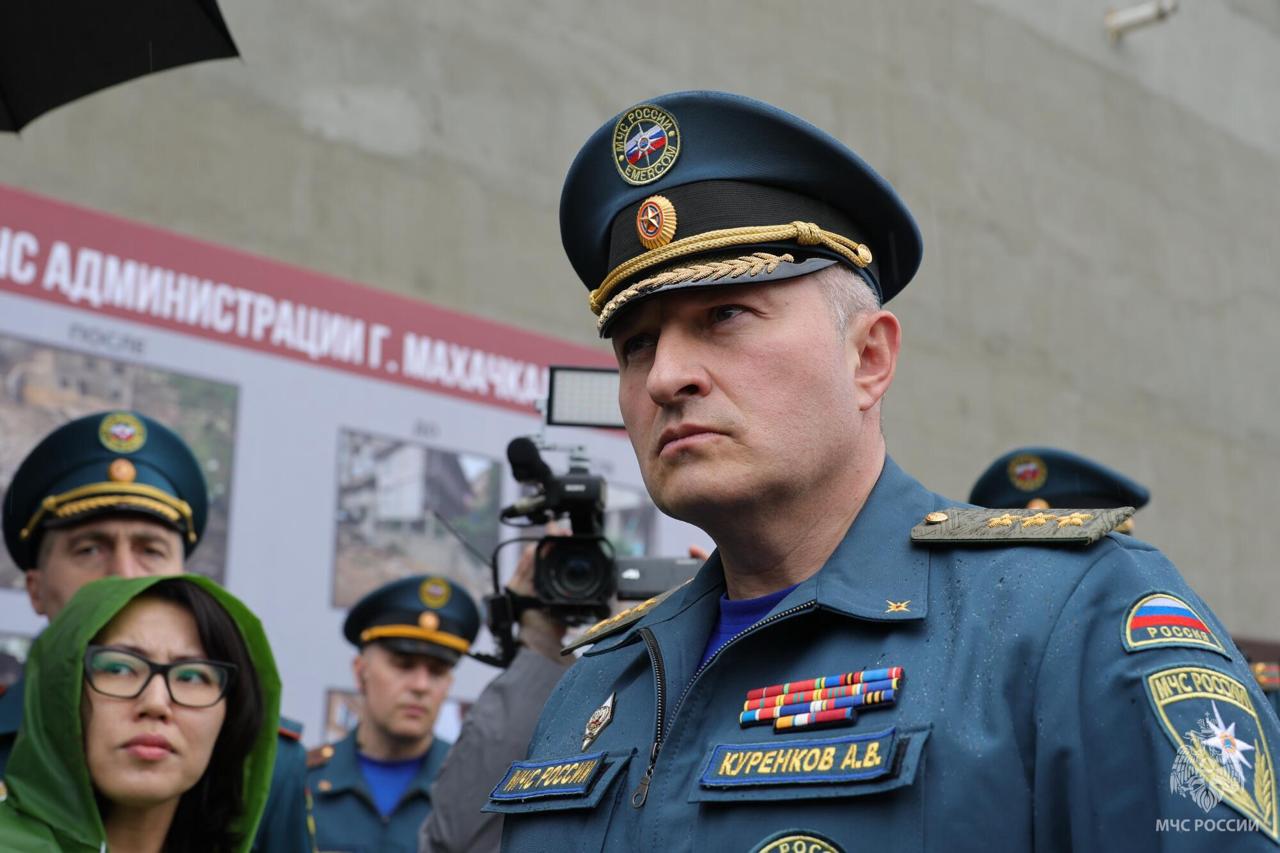
Russian Emergencies Ministry Head: Flood Victims in Dagestan and Chechnya to Receive Over 1.1 Billion Rubles
Russian Emergencies Ministry Head Alexander Kurenkov announced that over 1.1 billion rubles have been allocated for payments to residents of Dagestan and Chechnya affected by the spring floods. This includes one-time financial assistance and compensation for lost property. According to the minister, approximately 58,000 people are expected to receive the assistance.
Kurenkov arrived in Makhachkala, where he participated in a meeting of the government commission on emergency response and inspected the progress of restoration work. The Emergencies Ministry stated that the main post-flood work has been completed, and there are currently no disruptions to utility services.
Heavy rains on March 28 and April 4-5 led to flooding in Dagestan and Chechnya. Following this, a federal state of emergency was declared in both regions. According to the Ministry of Emergency Situations, more than 26,600 people in Dagestan have received payments. In total, residents of the republic have submitted over 274,000 applications. In Chechnya, Kurenkov reported that over 40,000 applications were received, but payments have been made for approximately 7,000 of them.
According to official data, approximately 9,800 residential buildings were flooded in Dagestan, over 7,100 of which were considered damaged. Six people died as a result of the floods, and over 6,200 residents were injured. In Chechnya, over 3,000 residential buildings were damaged.
During his trip, Kurenkov visited Aivazovsky (Perov) Street in Makhachkala, where a three-story extension to a six-story residential building partially collapsed on April 5. Authorities believe the cause was the rising waters of the Tarnairka River after heavy rains, which washed away the embankment. No one was injured, but nearly 400 residents were forced to evacuate. The head of the Ministry of Emergency Situations demanded that the inspection of damaged buildings be expedited. He said residents should receive information about the condition of their homes and further government decisions as soon as possible.
Dagestan Construction Minister Bakhtiyar Ullayev stated that the risk of further soil erosion, landslides, and foundation damage remains. Authorities are currently considering two options: shoring up the slope and protecting the building's foundation, or completely demolishing the building.
According to Ullayev, the Russian Ministry of Construction has approved financial support for the republic. Dagestan authorities expect to allocate between 250 and 265 million rubles from the regional budget for restoration work by June 11. The contract is planned to be signed by mid-July, and the main construction work could begin in September.
Makhachkala Mayor Dzhambulat Salavov reported that approximately 120 people remain in temporary accommodation centers.
As flood relief efforts in Dagestan continue, questions have once again arisen about the state of the city's urban and hydraulic infrastructure. Following the floods, local residents, bloggers, and some regional media outlets criticized the authorities for haphazard construction, stormwater drainage problems, and long-standing violations in construction in coastal and landslide-prone areas. The effectiveness of funds previously allocated for dam reinforcement, coastal protection, and flood protection was also discussed in the republic.
A change in the region's leadership also drew additional attention to the situation. Shortly after the massive floods, Sergei Melikov resigned as head of Dagestan, and Fyodor Shchukin was appointed acting head of the republic. Officially, the personnel changes were not linked to the consequences of the floods, but in the regional media, these events were directly linked.
During his visit to Dagestan, Kurenkov also presented state and departmental awards to residents of Dagestan and Chechnya who participated in the rescue efforts and flood cleanup.
Among those awarded were Arsen Gummayev and Polad Seidov, residents of the village of Mamedkala. According to the Ministry of Emergency Situations, after the floods began, they helped organize the work of volunteer equipment, participated in street clearing, and water pumping.
The ministry also recognized the actions of Salambek Abdulbariyev. During the flood on federal highway R-215, he used a truck to evacuate a woman and three children from a car that was in the water.
Viskhan Zakayev also received an award from the Ministry of Emergency Situations. The ministry reported that during the dam breach at the Gejukha Reservoir, he used an excavator to reach blocked storm drains. This helped divert some of the water, mitigating the risk of flooding residential buildings and public facilities.
Amid forecasts of further heavy rains and strong winds, authorities announced the deployment of additional equipment and rescuers to areas at risk of flooding. A government commission also approved a plan for further recovery efforts.