“Cleansing” and kidnapping of a man in Grozny, detonation of a landmine in Gudermes

November 28, 2001

***
In the Leninsky district of Grozny, the Russian military carried out another operation to check the passport regime, i.e. "cleansing". And again with the same violations as the day before. For example, they broke open the doors of apartments in which the owners were absent. There were quite a few of them, because by nine in the morning people were already leaving for work.

On Lermontov Street, the military robbed several houses, whose owners left the republic due to the war.

***
At 6.15 in the Oktyabrsky district of Grozny, up to 20 military men (some were wearing masks) broke into a house on Dekabristov Street and forcibly took Said-Magomed Usmanovich Kadyrov, born in 1966, from there. His wife tried to prevent the kidnapping, telling the military that her husband had recently undergone stomach surgery. But she was ordered not to move, threatening to be shot. Having pulled a cap over his head, Kadyrov was taken out into the street, put into one of the two UAZs in which they arrived, and taken away in an unknown direction.

Three days later, Said-Magomed Kadyrov was released. He said that he was kept in the Oktyabrsky District VOVD, but refused to provide other details. In early 2006, he died of illness.

***
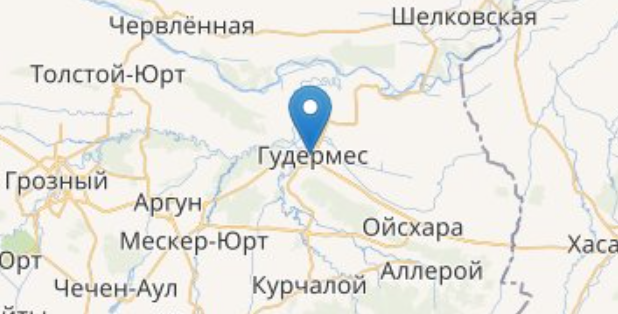
At 7.45 in Gudermes, a controlled landmine was detonated along the route of St. Petersburg riot police officers.

Two riot policemen, who went on duty on foot, received injuries of varying degrees of severity and survived. Two others have died. Residential buildings in the vicinity were damaged and windows were broken. There were no killed or wounded among the civilian population.

From the book “People Live Here”, Usam Baysaev, Dmitry Grushkin, 2006.
Последние новости
In Dagestan, the body of a drowned youth was found at a depth of 60 meters
Society
In Dagestan, the body of a drowned youth was found at a depth of 60 meters
6 September 2026

On September 6, rescuers discovered the body of a 20-year-old man who drowned on August 25 near the village of Shamilkala on the Irganay Reservoir in Dagestan. It is reported to be at a depth of approximately 60 meters. The body has not yet been recovered, as rescuers are awaiting additional equipment.

Rostov Region hit by drone attack: two high-rise buildings damaged, child injured
Politics
Rostov Region hit by drone attack: two high-rise buildings damaged, child injured
6 September 2026

On the night of September 6, Rostov Region, along with other Russian regions, was again attacked by Ukrainian drones. Specifically, a massive airstrike was reported on Rostov-on-Don. According to the Telegram channel Astra, drones circled over the city for over four hours, and gunfire and the sound of a helicopter were heard. Bataysk was also hit. The Telegram monitoring channels Supernova+ and Exilenova+ published photos and videos from eyewitnesses.

Expert Explains Why Moscow and Yerevan Take Incompatible Positions on a Referendum on Armenia’s EU Membership
Politics
Expert Explains Why Moscow and Yerevan Take Incompatible Positions on a Referendum on Armenia’s EU Membership
5 September 2026

The meeting between Vladimir Putin and Nikol Pashinyan in Bishkek, as expected, failed to resolve the central contradiction in relations between Moscow and Yerevan: whether Armenia is prepared to make a final choice between Eurasian and European integration. According to Sergey Markedonov, a leading researcher at MGIMO’s Institute for International Studies, Moscow and Yerevan hold fundamentally different positions on whether Armenia should hold a referendum that could determine the country’s future foreign policy course.

Justice in the Bin’: ECHR Drops Nearly 1,000 Cases Against Russia, Most Filed by North Caucasus Residents
Human rights
Justice in the Bin’: ECHR Drops Nearly 1,000 Cases Against Russia, Most Filed by North Caucasus Residents
5 September 2026

The European Court of Human Rights (ECHR) in Strasbourg has struck out 879 remaining applications against Russia involving more than 1,500 individuals and organisations. The Memorial Human Rights Centre described the decision as “unprecedented in the practice of the [ECHR], and indeed in the history of international justice as a whole”.